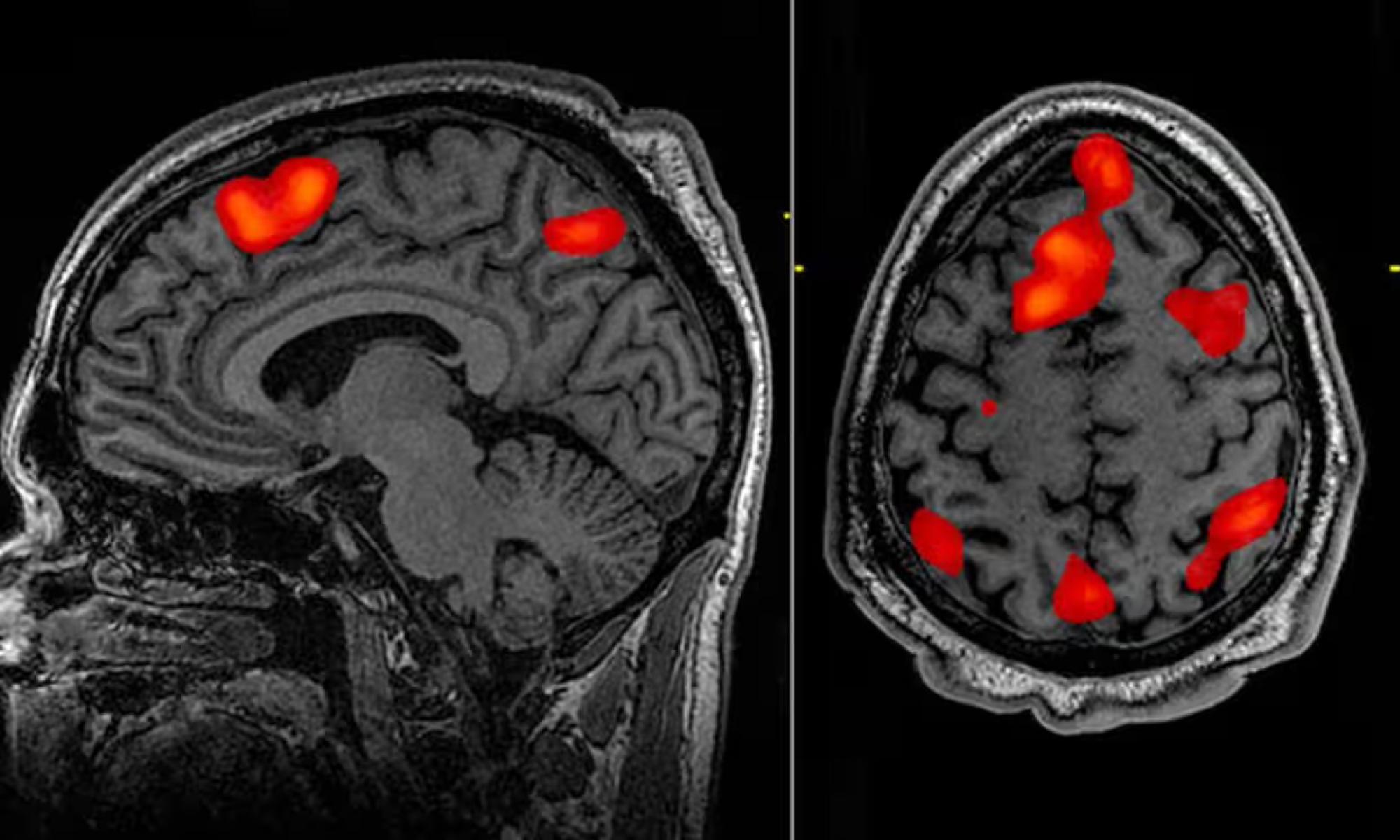
An AI-based decoder that can translate brain activity into a continuous stream of text has been developed, in a breakthrough that allows a person's thoughts to be read non-invasively for the first time. The decoder could reconstruct speech with uncanny accuracy while people listened to a story or even silently imagined one " using only fMRI scan data. Previous language decoding systems have required surgical implants. Large language models " the kind of AI underpinning OpenAI's ChatGPT ... are able to represent, in numbers, the semantic meaning of speech, allowing the scientists to look at which patterns of neuronal activity corresponded to strings of words with a particular meaning rather than attempting to read out activity word by word. The decoder was personalised and when the model was tested on another person the readout was unintelligible. It was also possible for participants on whom the decoder had been trained to thwart the system, for example by thinking of animals or quietly imagining another story. Jerry Tang, a doctoral student at the University of Texas at Austin and a co-author, said: "We take very seriously the concerns that it could be used for bad purposes and have worked to avoid that. We want to make sure people only use these types of technologies when they want to and that it helps them." Prof Tim Behrens, a computational neuroscientist ... said it opened up a host of experimental possibilities, including reading thoughts from someone dreaming.
Latest
Latest News
Each news summary is created according to strict standards. Here's how we do it.
Each summary is created using a consistent editorial procedure. The target length is approximately 16 lines of 11-point Arial text in a 650-pixel-wide column. Up to 25% of a summary may be set in bold to emphasize the most important ideas. Summaries are composed of verbatim excerpts presented in the same sequence as they appear in the original news source, with very minor editorial additions. Where material has been omitted between excerpts, the omission is indicated with ellipses (...). Any words added by an editor for clarity or context appear in [brackets]. Our original news editor was Fred Burks. Tod Fletcher edited most summaries from 2007 through 2014, and Mark Bailey has served as news editor since 2014.