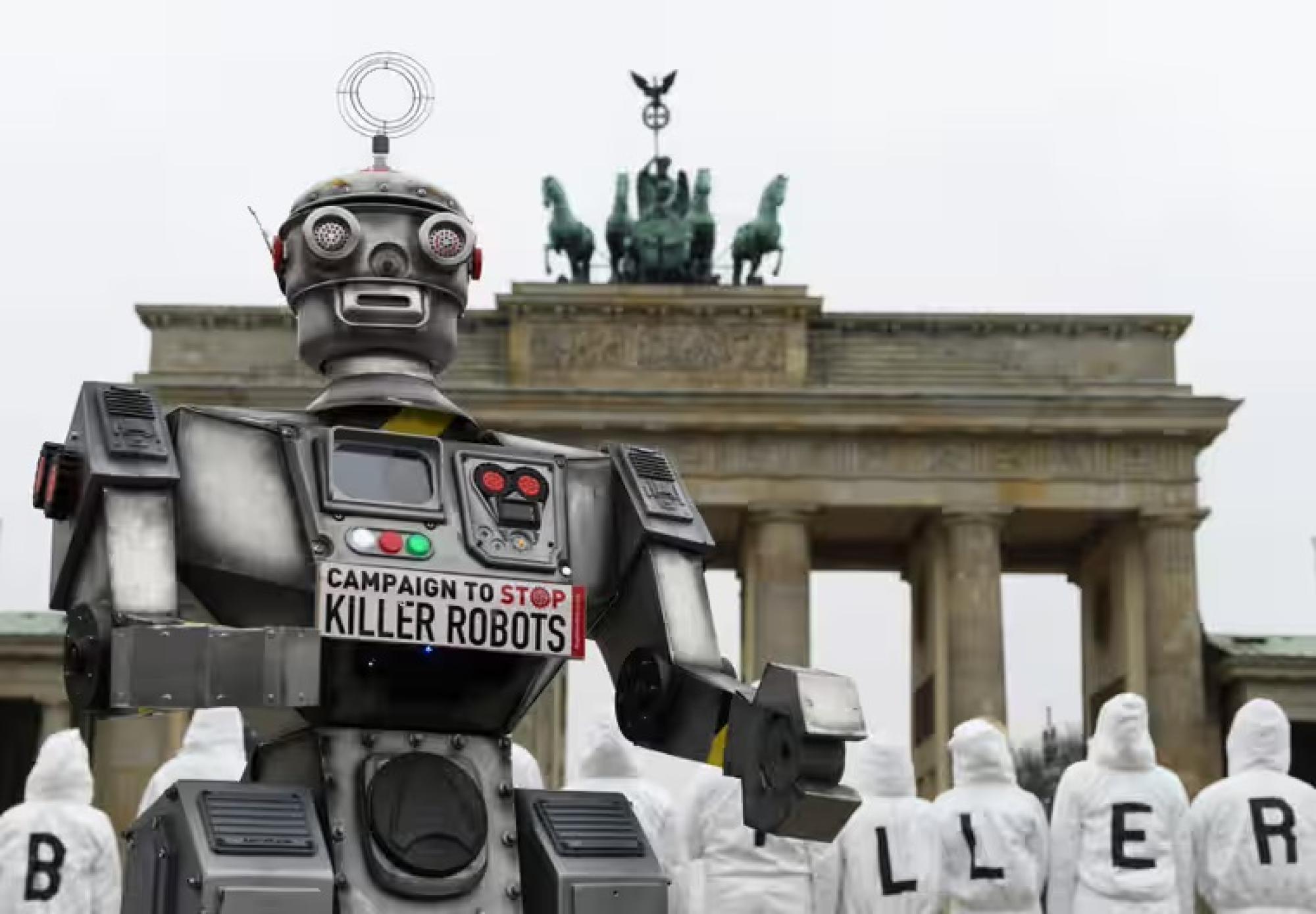
The Ukrainian military has used AI-equipped drones mounted with explosives to fly into battlefields and strike at Russian oil refineries. American AI systems identified targets in Syria and Yemen for airstrikes earlier this year. The Israel Defense Forces used another kind of AI-enabled targeting system to label as many as 37,000 Palestinians as suspected militants during the first weeks of its war in Gaza. Growing conflicts around the world have acted as both accelerant and testing ground for AI warfare while making it even more evident how unregulated the nascent field is. The result is a multibillion-dollar AI arms race that is drawing in Silicon Valley giants and states around the world. Altogether, the US military has more than 800 active AI-related projects and requested $1.8bn worth of funding for AI in the 2024 budget alone. Many of these companies and technologies are able to operate with extremely little transparency and accountability. Defense contractors are generally protected from liability when their products accidentally do not work as intended, even when the results are deadly. The Pentagon plans to spend $1bn by 2025 on its Replicator Initiative, which aims to develop swarms of unmanned combat drones that will use artificial intelligence to seek out threats. The air force wants to allocate around $6bn over the next five years to research and development of unmanned collaborative combat aircraft, seeking to build a fleet of 1,000 AI-enabled fighter jets that can fly autonomously. The Department of Defense has also secured hundreds of millions of dollars in recent years to fund its secretive AI initiative known as Project Maven, a venture focused on technologies like automated target recognition and surveillance.
Latest
Latest News
Each news summary is created according to strict standards. Here's how we do it.
Each summary is created using a consistent editorial procedure. The target length is approximately 16 lines of 11-point Arial text in a 650-pixel-wide column. Up to 25% of a summary may be set in bold to emphasize the most important ideas. Summaries are composed of verbatim excerpts presented in the same sequence as they appear in the original news source, with very minor editorial additions. Where material has been omitted between excerpts, the omission is indicated with ellipses (...). Any words added by an editor for clarity or context appear in [brackets]. Our original news editor was Fred Burks. Tod Fletcher edited most summaries from 2007 through 2014, and Mark Bailey has served as news editor since 2014.