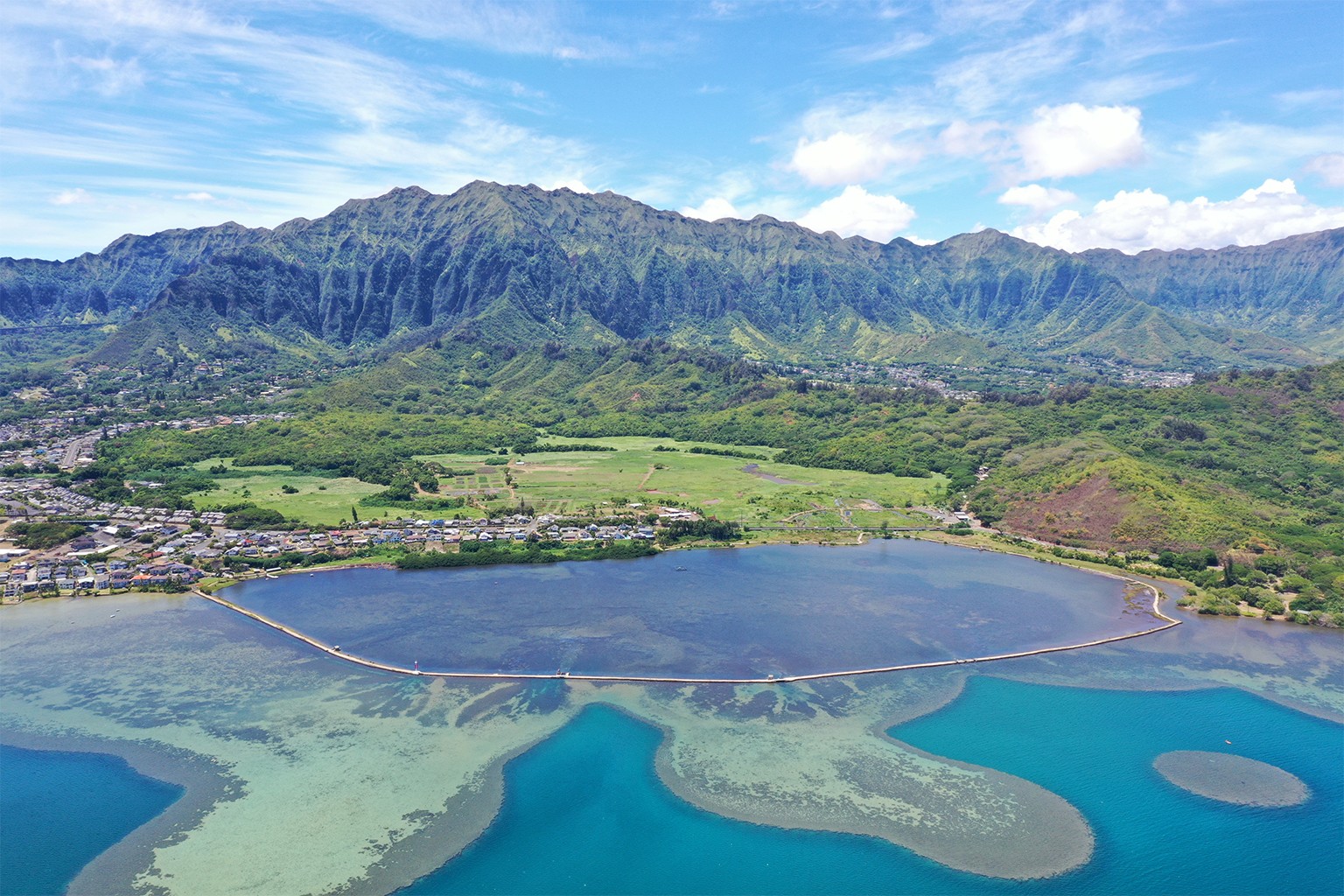
I titled my latest book Waiwai: Water and the Future of Hawaiʻi. Wai means water. It’s reduplication is waiwai, which is often translated as “wealth." If you have water, you can grow food. Wai [is] the foundation of self-determination. Traditional Hawaiian society was organized through ahupuaʻa—land divisions that generally followed watersheds from the mountains to the sea. Rainfall in the mountains flowed through streams into loʻi kalo, as well as fishponds, reefs, and the ocean beyond. Water was the lifeblood that connected every part of the system. Living on some of the world’s most isolated islands, our people couldn’t just tap another watershed or a neighboring state’s river. Instead, they developed one of the world’s most sophisticated food systems, integrating irrigation with aquaculture on an extraordinary scale. Historical accounts estimate that the islands’ hundreds of loko i’a, or fishponds, produced more than 2 million pounds of fish annually, while research suggests these agroecological systems sustained a population of hundreds of thousands. Communities understood their land, reefs, and forests intimately, knowing when to harvest and when to let resources replenish. Today we’d call that adaptive management. To our ancestors, it was simply how you cared for the place that fed you. Although the word ʻāina is often translated simply as “land,” it literally means “that which feeds us.” That’s a much deeper idea of reciprocity. We care for the ʻāina, and the ʻāina cares for us, an interdependence that guides how we live every day. Forget that relationship, and land and water become commodities. Remember it, and we begin rebuilding the conditions that allow communities—and cultures—to thrive.
Latest
Latest News
Each news summary is created according to strict standards. Here's how we do it.
Each summary is created using a consistent editorial procedure. The target length is approximately 16 lines of 11-point Arial text in a 650-pixel-wide column. Up to 25% of a summary may be set in bold to emphasize the most important ideas. Summaries are composed of verbatim excerpts presented in the same sequence as they appear in the original news source, with very minor editorial additions. Where material has been omitted between excerpts, the omission is indicated with ellipses (...). Any words added by an editor for clarity or context appear in [brackets]. Our original news editor was Fred Burks. Tod Fletcher edited most summaries from 2007 through 2014, and Mark Bailey has served as news editor since 2014.