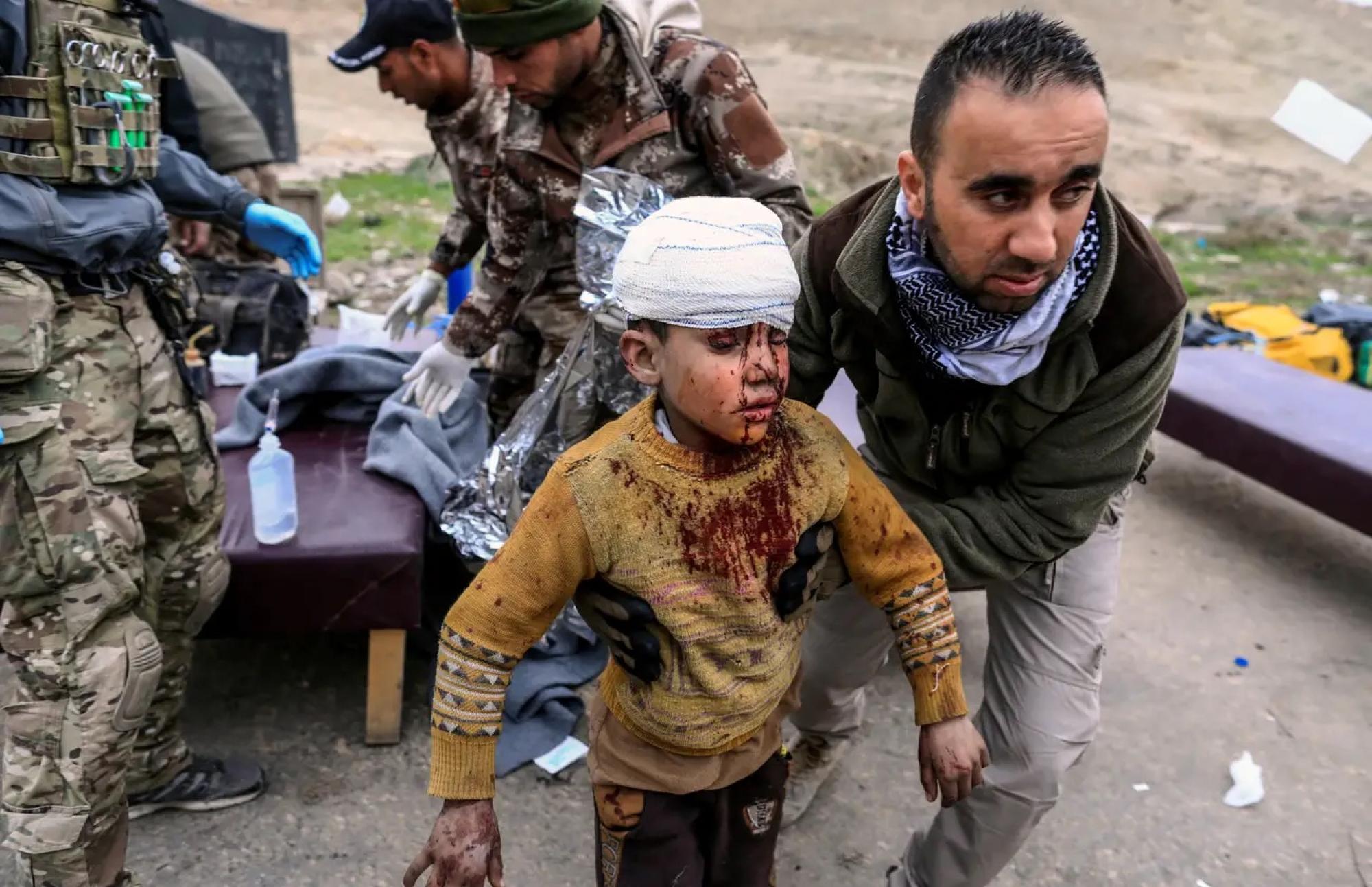
The pricetag of America's global war on terror is estimated to stand at roughly $8 trillion, according to a new report from Brown University's Costs of War project. The estimate factors in "future costs for veteran's care, the total budgetary costs and future obligations of the post-9/11 wars." The report attributes $2.3 trillion to the Afghanistan and Pakistan war zone, $2.1 trillion to the Iraq and Syria war zone, and $355 billion to other war zones. Dr. Neta C. Crawford, co-director of the Costs of War Project, in a statement said the project's accounting "goes beyond the Pentagon's numbers because the costs of the reaction to 9/11 have rippled through the entire budget." Costs of War also estimates that the war on terror, which will mark its 20th anniversary in a few weeks on September 11, has directly killed 897,000 to 929,000 people - including at least 387,072 civilians. In a report released last year, Costs of War estimated that the war on terror has displaced at least 37 million people on top of the hundreds of thousands of people killed in direct war violence. Though the US no longer has a troop presence in Afghanistan, the war on terror is seemingly poised to continue there as the Biden administration signals that it will continue to target ISIS-K in the country via drones and other means. The US also continues to have a military presence in Iraq and Syria, among other countries, and in recent weeks has conducted multiple airstrikes against Al Shabaab, an Al Qaeda affiliate, in Somalia.
Latest
Latest News
Each news summary is created according to strict standards. Here's how we do it.
Each summary is created using a consistent editorial procedure. The target length is approximately 16 lines of 11-point Arial text in a 650-pixel-wide column. Up to 25% of a summary may be set in bold to emphasize the most important ideas. Summaries are composed of verbatim excerpts presented in the same sequence as they appear in the original news source, with very minor editorial additions. Where material has been omitted between excerpts, the omission is indicated with ellipses (...). Any words added by an editor for clarity or context appear in [brackets]. Our original news editor was Fred Burks. Tod Fletcher edited most summaries from 2007 through 2014, and Mark Bailey has served as news editor since 2014.