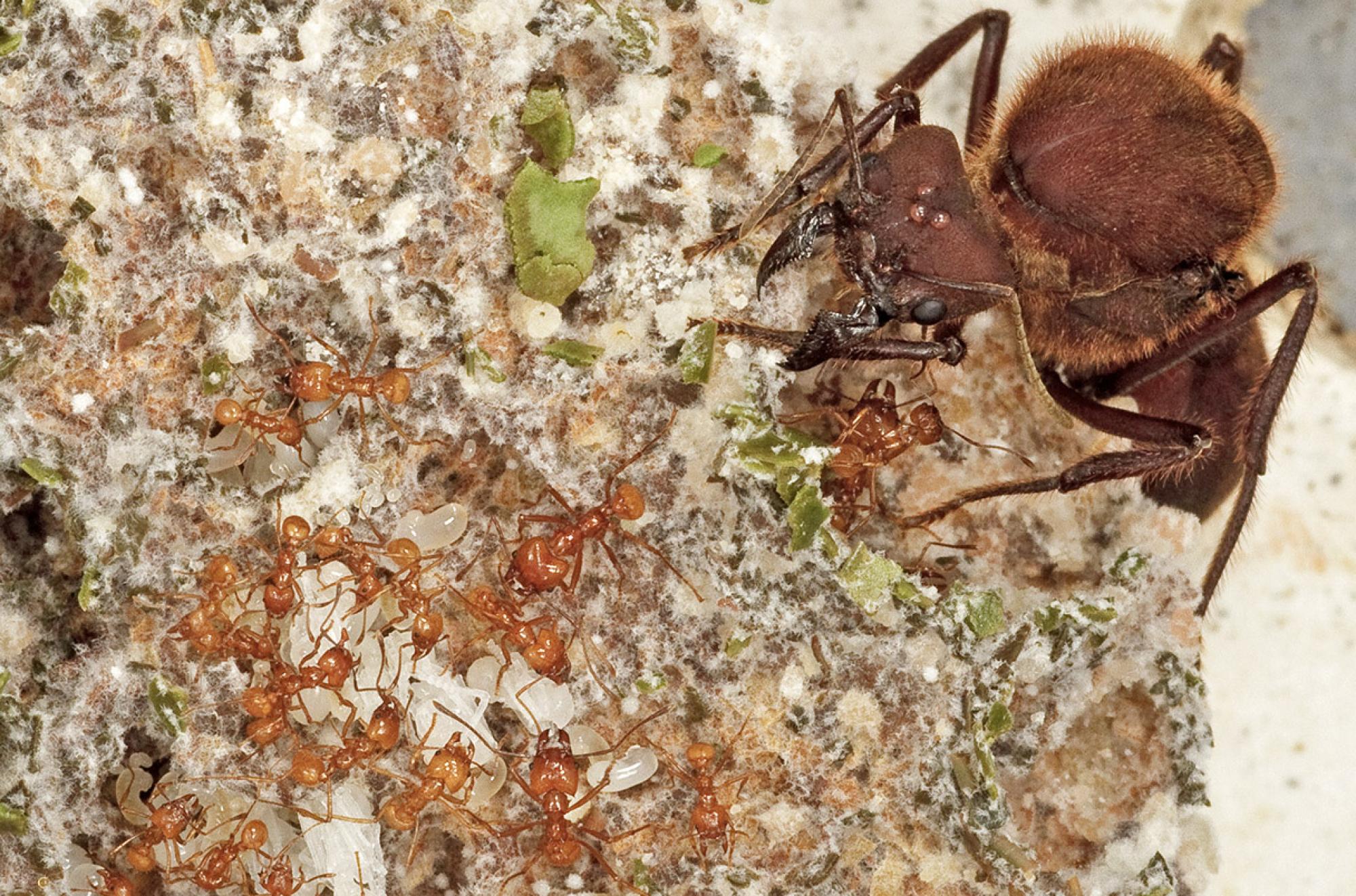
Hundreds of ant species farm fungi today, and studies of ant evolution suggest the adaptation goes back tens of millions of years. Now, scientists have sharpened the picture by bringing in the fungal family tree as well. They pinpoint a date for the origins of the partnership and suggest a surprising catalyst: the asteroid that killed the dinosaurs 66 million years ago. Since ants' fungal gardens were first described 150 years ago, entomologists have uncovered 247 species of ants that tend them and rely on this fungal crop to survive. Researchers surmise that the ants descend from a common ancestor that later evolved into separate species nurturing different types of fungi. The ant and fungal taxa involved in farming both arose about 66 million years ago, which coincides with the massive asteroid strike that drove nonavian dinosaurs and many other species extinct. That cataclysmic impact produced lingering clouds of debris that shut down photosynthesis across the planet for several months, possibly even years. Researchers suggest ants that had already developed a loose relationship with fungi were ready to take advantage of this newly abundant source of food. For the first few million years, the ants tended fungal species also found in the wild. Then, about 27 million years ago, a subset of ants completely domesticated their fungal cultivars, just as humans have done with most of our staples, which are now remote from their wild roots.
Latest
Latest News
Each news summary is created according to strict standards. Here's how we do it.
Each summary is created using a consistent editorial procedure. The target length is approximately 16 lines of 11-point Arial text in a 650-pixel-wide column. Up to 25% of a summary may be set in bold to emphasize the most important ideas. Summaries are composed of verbatim excerpts presented in the same sequence as they appear in the original news source, with very minor editorial additions. Where material has been omitted between excerpts, the omission is indicated with ellipses (...). Any words added by an editor for clarity or context appear in [brackets]. Our original news editor was Fred Burks. Tod Fletcher edited most summaries from 2007 through 2014, and Mark Bailey has served as news editor since 2014.