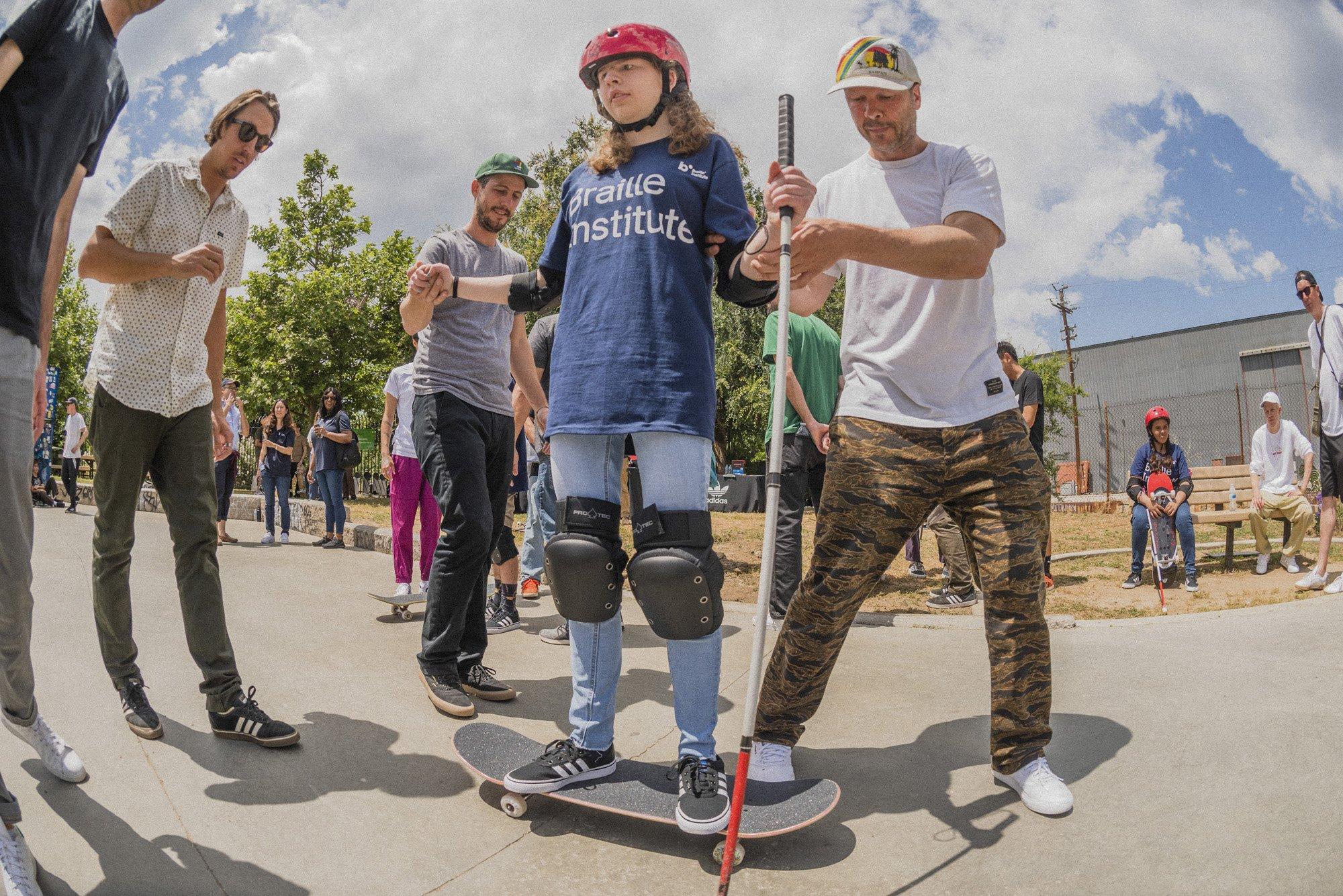
Dan Mancina has been a skateboarder since the age of seven, but when he was 13, he was diagnosed with rhinitis pigmentosa, a degenerative eye disease that rendered him almost completely blind by 22. He hit pause on his skateboarding for a couple of years in his early 20s, but decided to pick it back up again, now using a white cane to shred more confidently. Now almost 38, he's a professional skateboarder, relearning tricks, and even completing the course at the Paris 2024 Olympic Games. About seven years ago, he started dreaming of creating the world's first adaptive skatepark right in his hometown of Detroit, Michigan. Finally, the park is a reality. Called "The Ranch," the 5,000-square-foot skatepark is completely accessible, allowing both seasoned low-vision boarders to take it for a spin and newcomers to the sport to feel welcome. In a recent video, blind content creator Anthony S. Ferraro, who reviews and documents his experiences in accessible environments ... on TikTok, showed off the park's features. Features include rollers, bank ramps, and ledges, with manual pads and platforms, all designed to be easier to navigate for people with vision impairments or in wheelchairs. Auditory cues are also placed throughout the park in the form of beepers, which warn a skater about a dangerous drop or guide them to a particular obstacle. "Thanks for building this park, Dan, [you're] a true pioneer." Next up, he plans to host workshops and camps for other visually impaired skaters who want to learn how to skate with a white cane. "It's been so inspiring to watch this come to reality. I've never had a place where I can skate with full confidence," Ferraro ends his video.
Latest
Latest News
Each news summary is created according to strict standards. Here's how we do it.
Each summary is created using a consistent editorial procedure. The target length is approximately 16 lines of 11-point Arial text in a 650-pixel-wide column. Up to 25% of a summary may be set in bold to emphasize the most important ideas. Summaries are composed of verbatim excerpts presented in the same sequence as they appear in the original news source, with very minor editorial additions. Where material has been omitted between excerpts, the omission is indicated with ellipses (...). Any words added by an editor for clarity or context appear in [brackets]. Our original news editor was Fred Burks. Tod Fletcher edited most summaries from 2007 through 2014, and Mark Bailey has served as news editor since 2014.