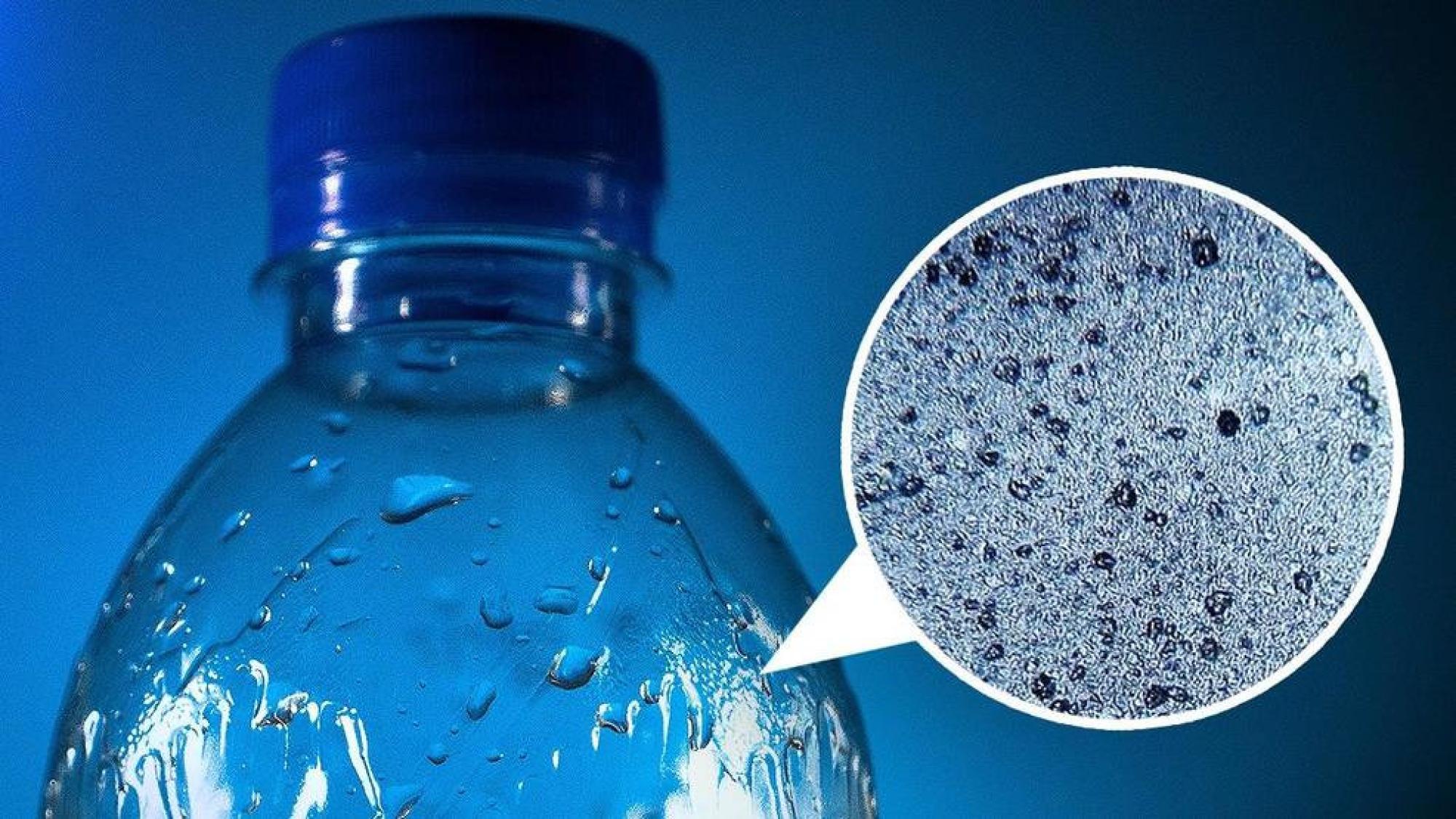
Researchers have discovered bottled water sold in stores can contain 10 to 100 times more bits of plastic than previously estimated nanoparticles so infinitesimally tiny they cannot be seen under a microscope. At 1,000th the average width of a human hair, nanoplastics are so teeny they can migrate through the tissues of the digestive tract or lungs into the bloodstream, distributing potentially harmful synthetic chemicals throughout the body and into cells. One liter of water " the equivalent of two standard-size bottled waters " contained an average of 240,000 plastic particles from seven types of plastics, of which 90% were identified as nanoplastics and the rest were microplastics. Microplastics are polymer fragments that can range from less than 0.2 inch (5 millimeters) down to 1/25,000th of an inch (1 micrometer). Anything smaller is a nanoplastic that must be measured in billionths of a meter. The new finding reinforces long-held expert advice to drink tap water from glass or stainless steel containers to reduce exposure. In the new study, published ... in the journal Proceedings of the National Academy of Sciences, researchers from Columbia University presented a new technology that can see, count and analyze the chemical structure of nanoparticles in bottled water. Nanoplastics ... can invade individual cells and tissues in major organs, potentially interrupting cellular processes and depositing endocrine-disrupting chemicals.
Latest
Latest News
Each news summary is created according to strict standards. Here's how we do it.
Each summary is created using a consistent editorial procedure. The target length is approximately 16 lines of 11-point Arial text in a 650-pixel-wide column. Up to 25% of a summary may be set in bold to emphasize the most important ideas. Summaries are composed of verbatim excerpts presented in the same sequence as they appear in the original news source, with very minor editorial additions. Where material has been omitted between excerpts, the omission is indicated with ellipses (...). Any words added by an editor for clarity or context appear in [brackets]. Our original news editor was Fred Burks. Tod Fletcher edited most summaries from 2007 through 2014, and Mark Bailey has served as news editor since 2014.