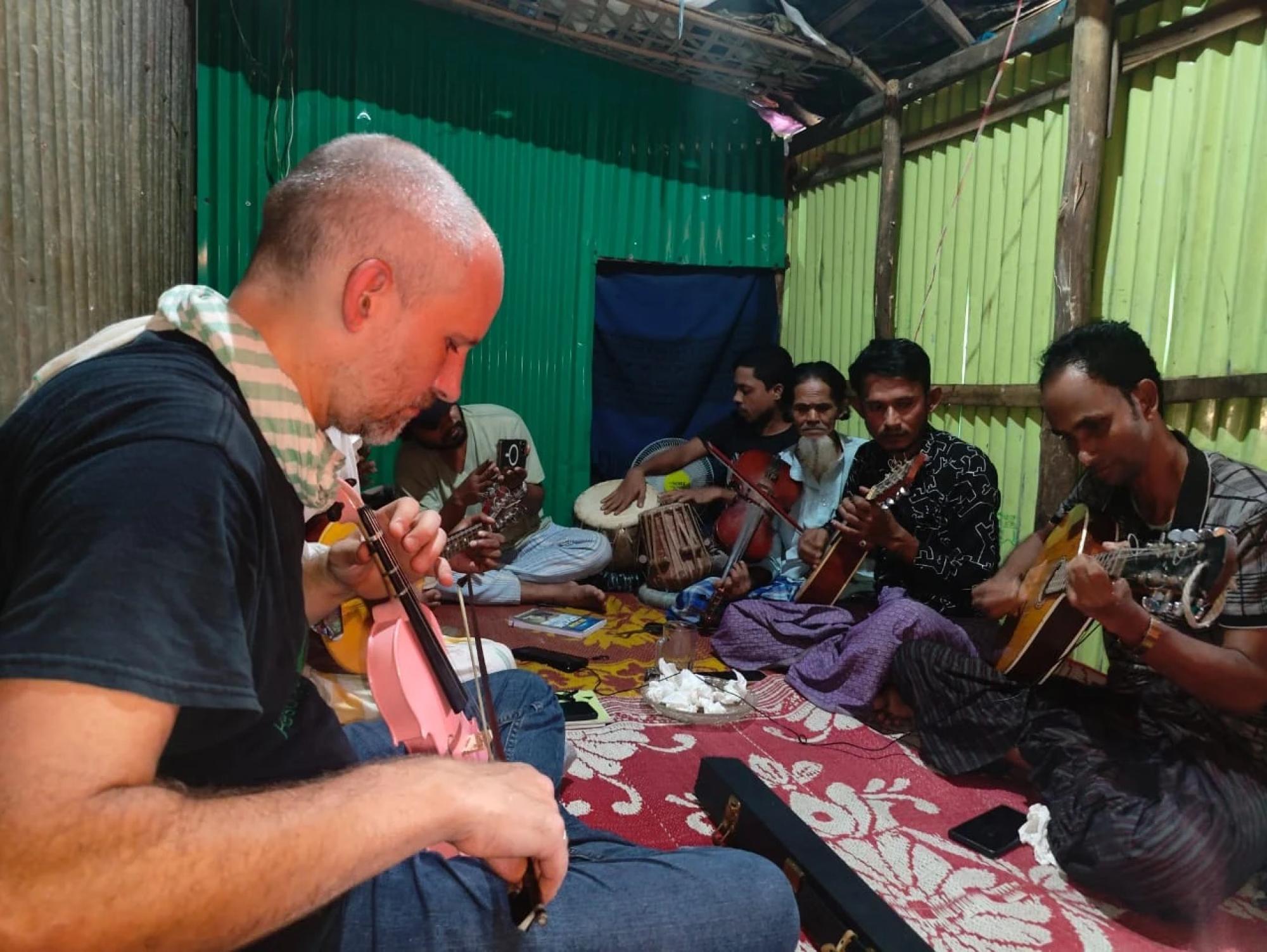
[The] universality of music, its ability to elicit the same emotions in diverse audiences, is exactly what inspires the work of Chicago-based nonprofit Crossing Borders Music. Composed of artists trained mainly in the Western classical tradition, the group compiles and performs music from Haitian, Palestinian, Rohingya, Native American and many other marginalized communities via free concerts held in libraries, cultural centers and university spaces. "Often, we find that in the West, refugees and immigrants are defined only by the conflict in their home countries," says Tom Clowes ... the founder of Crossing Borders. "But nobody wants to be defined by the worst things that have happened to them, especially when it's not even something that they've done, but something that's happened to them." The nonprofit's musical collaborations and concerts are a bid to not just showcase these diverse and complex musical traditions, but also to create empathy and understanding for immigrants and other communities who often get overlooked because of race, ethnicity, disability, gender, sexual orientation, identity or past trauma. Crossing Borders reaches over 10,000 people in person and online each year and organized 27 free concerts in 2024. "And when we hear audience members say our music defied their expectations or broadened their worldview, or that they felt their culture was affirmed and uplifted, we know we're fulfilling our mission," Clowes says.
Latest
Latest News
Each news summary is created according to strict standards. Here's how we do it.
Each summary is created using a consistent editorial procedure. The target length is approximately 16 lines of 11-point Arial text in a 650-pixel-wide column. Up to 25% of a summary may be set in bold to emphasize the most important ideas. Summaries are composed of verbatim excerpts presented in the same sequence as they appear in the original news source, with very minor editorial additions. Where material has been omitted between excerpts, the omission is indicated with ellipses (...). Any words added by an editor for clarity or context appear in [brackets]. Our original news editor was Fred Burks. Tod Fletcher edited most summaries from 2007 through 2014, and Mark Bailey has served as news editor since 2014.