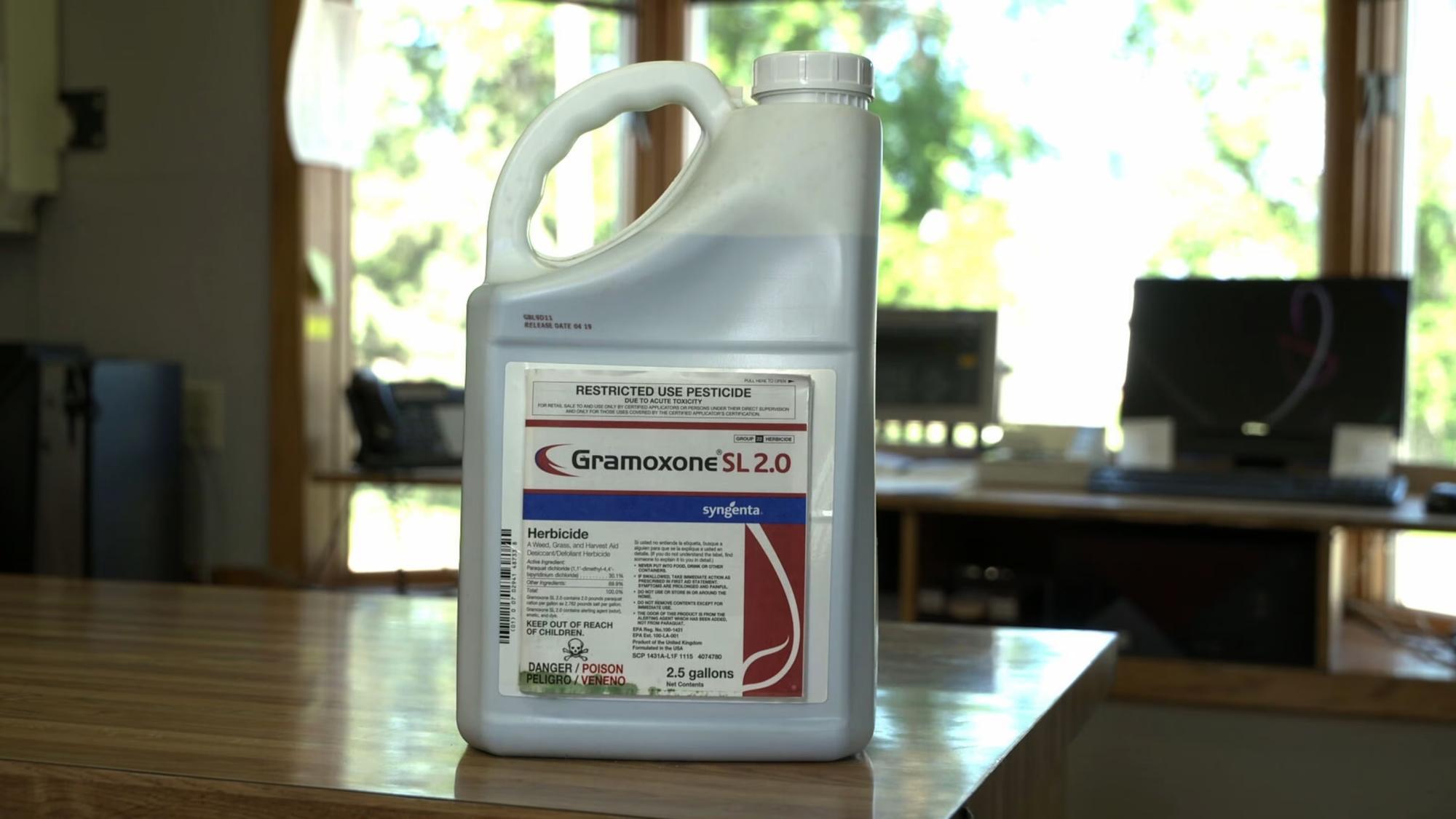
It is against the law to use paraquat in China, Switzerland, the United Kingdom and dozens of other countries. Many countries have banned the herbicide due to its extreme toxicity, while others have expressed concerns over the possible risk for Parkinson's disease. Yet the herbicide, manufactured by a Swiss company that is owned by the Chinese state, is still widely used throughout the United States in part because it is a highly effective way to kill weeds. The company, Syngenta, says that paraquat, which it produces under the name Gramoxone, is safe for its intended and labelled use." Clayton Tucholke, who used Gramoxone for years on his farm in LaBolt, South Dakota, and has since been diagnosed with Parkinson's disease, says otherwise. "It should have been pulled, I think, you know, so it didn't happen to somebody else," Tucholke told ABC News. The Tucholkes are among the more than 4,000 Americans who have filed lawsuits as part of a multi-district litigation against Syngenta, which currently manufactures Gramoxone, and Chevron, which distributed it in the U.S. from 1966 until 1986. Although Syngenta and Chevron told ABC News that there is no scientific evidence that supports a causal link between paraquat and Parkinson's disease, the Tucholkes and other plaintiffs allege that such a link exists, arguing that Syngenta and Chevron knew or should have known that the herbicide could "cause severe neurological injuries."
Latest
Latest News
Each news summary is created according to strict standards. Here's how we do it.
Each summary is created using a consistent editorial procedure. The target length is approximately 16 lines of 11-point Arial text in a 650-pixel-wide column. Up to 25% of a summary may be set in bold to emphasize the most important ideas. Summaries are composed of verbatim excerpts presented in the same sequence as they appear in the original news source, with very minor editorial additions. Where material has been omitted between excerpts, the omission is indicated with ellipses (...). Any words added by an editor for clarity or context appear in [brackets]. Our original news editor was Fred Burks. Tod Fletcher edited most summaries from 2007 through 2014, and Mark Bailey has served as news editor since 2014.