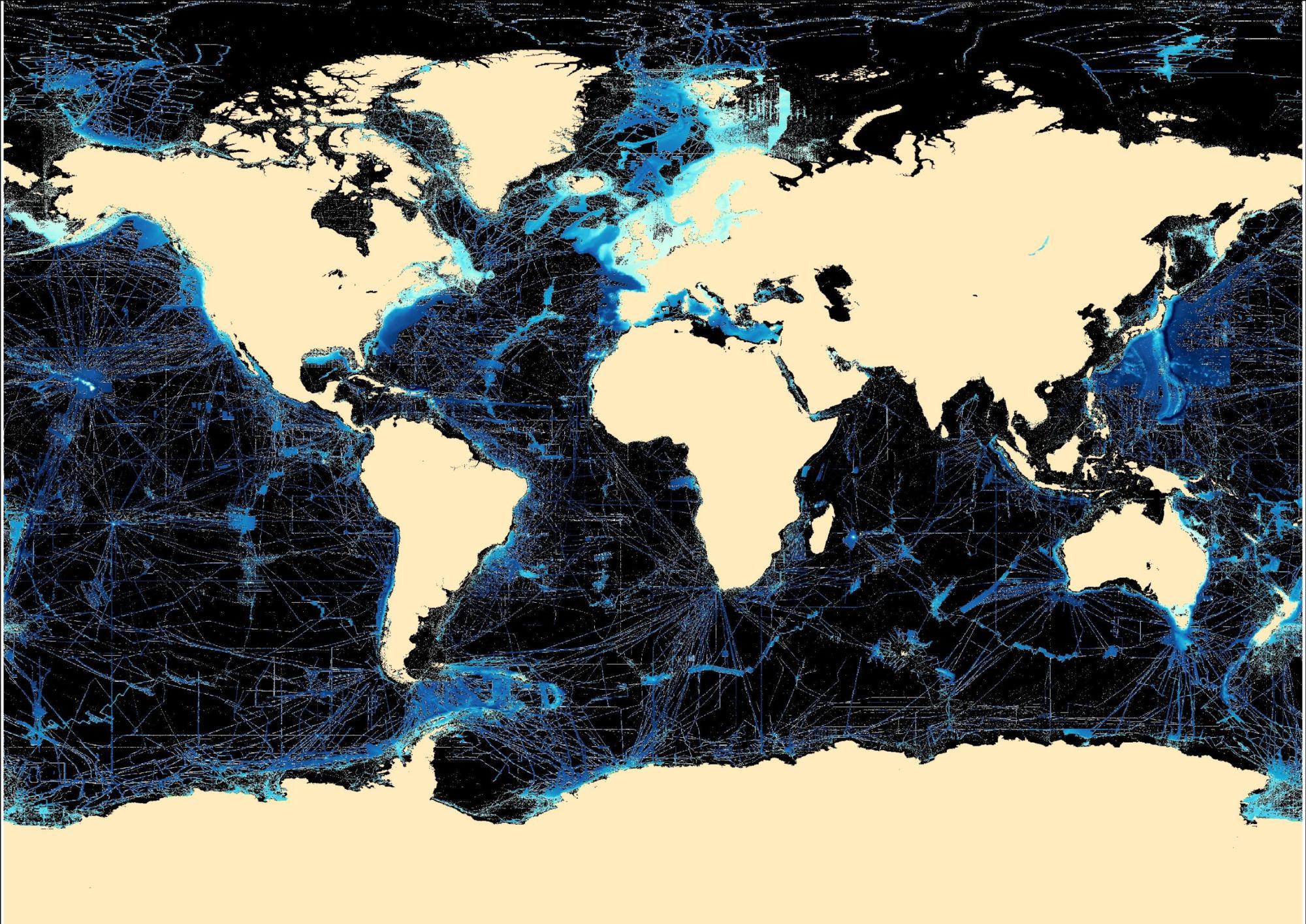
In 2023, Seabed 2030 announced that its latest map of the entire seafloor is nearly 25% complete. The data to make the world's first publicly available map is stored at the International Hydrography Organization (IHO)'s Data Centre for Digital Bathymetry. 17 research vessels owned by American universities ... constantly circle the globe studying the deep ocean. The ocean mappers came up with a new plan: crowdsourcing. By attaching a data logger to a boat's echosounder, any vessel can build a simple map of the seafloor. Tion Uriam, the head of the Hydrographic Unit at the Republic of Kiribati's Ministry of Communications, Transport and Tourism Development, recently received two data loggers that he's planning to install on local ferries. "It's a win to be part of that initiative," he says. "Just to put us on the map and raise our hands [to say] we want to be part of a global effort." The military or commercial value of nautical charts will always be a barrier. "Sea charts were destined to be removed from the academic realm and from general circulation," wrote the map historian Lloyd Brown. "They were much more than an aid to navigation; they were the key to empire, the way to wealth." [Marine geologist Kevin] Mackay experienced this on a scientific-mapping expedition. He received a call from a military he chooses not to name and "they said 'you need to destroy that data because there was military value ... it's a place where submarines like to hide'," he recalls. "Obviously, we ignore them because we're [mapping] for science, we don't care."
Latest
Latest News
Each news summary is created according to strict standards. Here's how we do it.
Each summary is created using a consistent editorial procedure. The target length is approximately 16 lines of 11-point Arial text in a 650-pixel-wide column. Up to 25% of a summary may be set in bold to emphasize the most important ideas. Summaries are composed of verbatim excerpts presented in the same sequence as they appear in the original news source, with very minor editorial additions. Where material has been omitted between excerpts, the omission is indicated with ellipses (...). Any words added by an editor for clarity or context appear in [brackets]. Our original news editor was Fred Burks. Tod Fletcher edited most summaries from 2007 through 2014, and Mark Bailey has served as news editor since 2014.