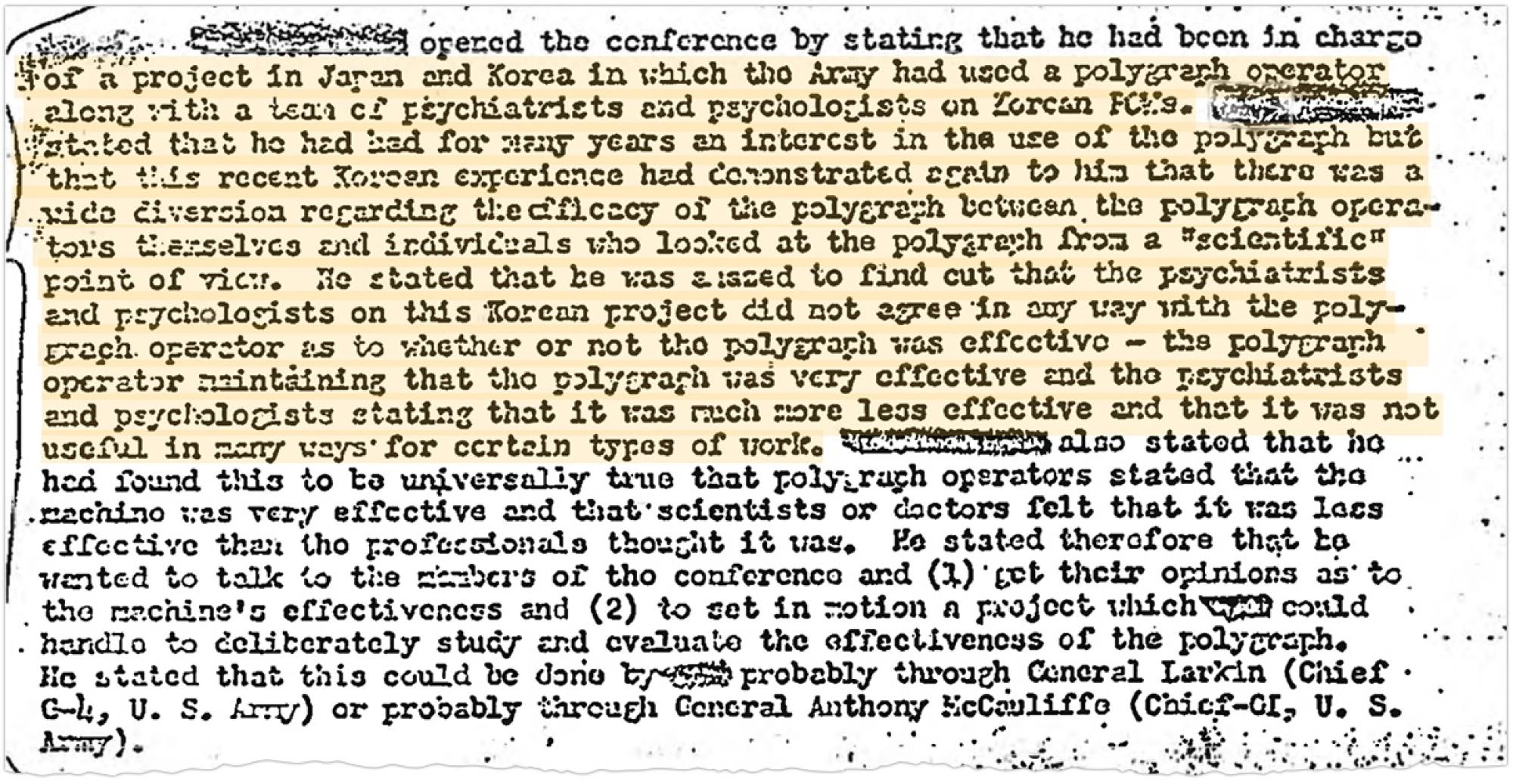
Korean prisoners of war in the 1950s were subjected to early MK-ULTRA experiments while in American custody, according to recently declassified CIA documents which confirm these experiments for the first time. The only reporting that previously referenced Koreans being used as guinea pigs for these experiments was journalist John Marks's landmark 1979 book, The Search for the "Manchurian Candidate." Using CIA documents, Marks traced the now-infamous MK-ULTRA project to its start, when it was known as Project Bluebird. In the book, Marks describes how, in October 1950, 25 unnamed North Korean POWs were chosen as the first test subjects to receive "advanced" interrogation techniques, with the overt goal of "controlling an individual to the point where he will do our bidding against his will and even against such fundamental laws of nature as self-preservation." The declassified documents, which the National Security Archive released between December 2024 and April 2025, are available through a special collection titled "CIA and the Behavioral Sciences: Mind Control, Drug Experiments and MK-ULTRA." [A] memo includes detailed plans for interrogation teams trained to utilize the polygraph, various drugs, and hypnotism "for personality control purposes." In a later memo from February 2, 1951, there are inquiries into acquiring six "hypospray" devices: experimental instruments designed to covertly inject sedatives through the skin via "jet injection."
Latest
Latest News
Each news summary is created according to strict standards. Here's how we do it.
Each summary is created using a consistent editorial procedure. The target length is approximately 16 lines of 11-point Arial text in a 650-pixel-wide column. Up to 25% of a summary may be set in bold to emphasize the most important ideas. Summaries are composed of verbatim excerpts presented in the same sequence as they appear in the original news source, with very minor editorial additions. Where material has been omitted between excerpts, the omission is indicated with ellipses (...). Any words added by an editor for clarity or context appear in [brackets]. Our original news editor was Fred Burks. Tod Fletcher edited most summaries from 2007 through 2014, and Mark Bailey has served as news editor since 2014.