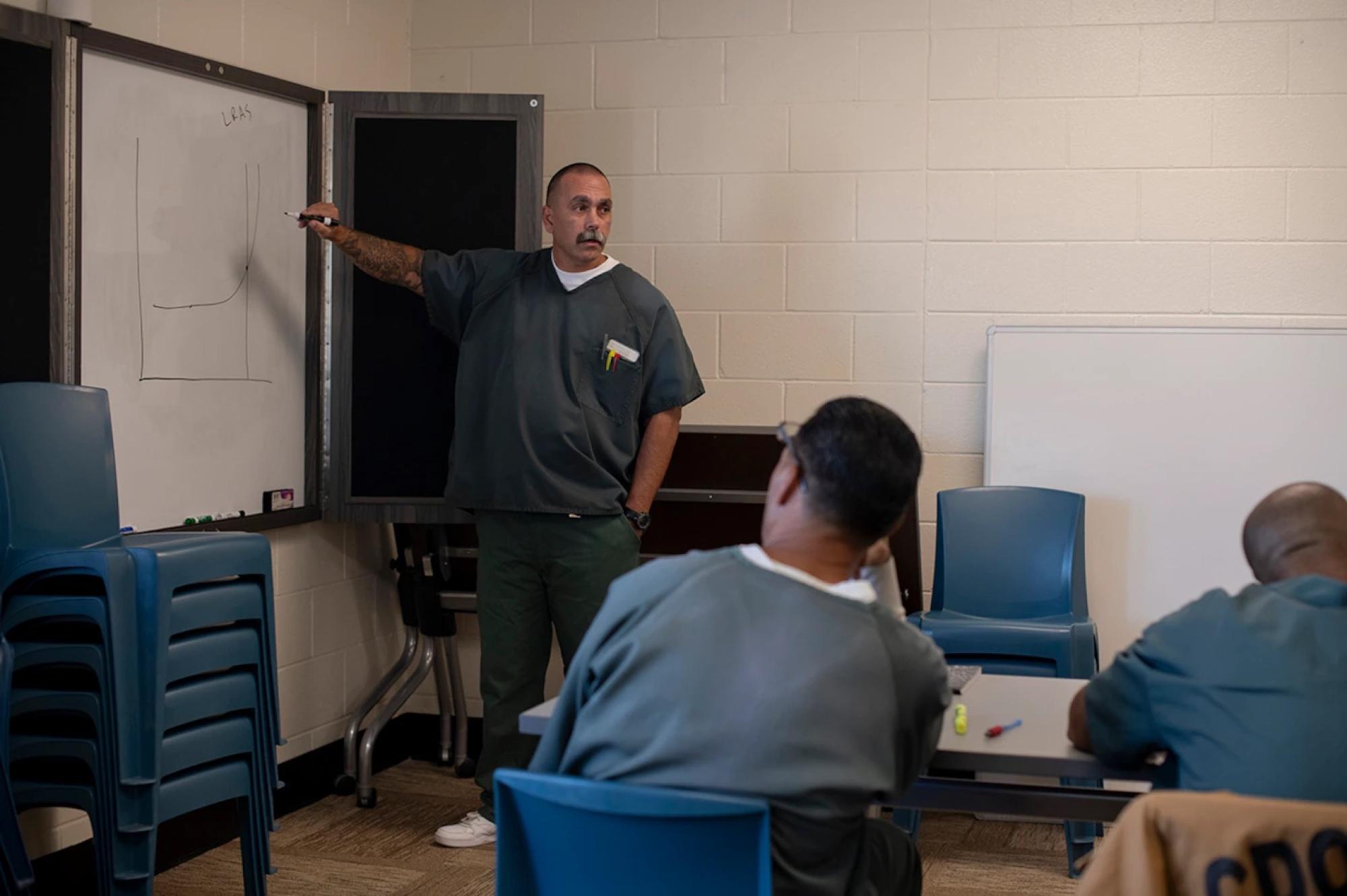
On a late-November afternoon, at the head of a cramped classroom, David Carrillo stood at a small podium and quizzed 17 students on macroeconomic terminology. For the two-hour class, Carrillo, the adjunct professor teaching for Adams State University, mostly kept his hands in his pockets as he lectured students in green uniforms. Like his students at the Colorado Territorial Correctional Facility, Carrillo, 49, also wears green. He holds a position that is extremely rare in prison: He's an incarcerated professor teaching in a prison bachelor's degree program. A new initiative at Adams State one of the first of its kind in the country " focuses on employing incarcerated people with graduate degrees as college professors, rather than bringing in instructors from the outside. Most people in Colorado prisons only make 80 cents a day, so it would take them around 17 years to earn the $3,600 that Carrillo gets for a single class. Higher wages help incarcerated individuals build savings to help cover their basic needs when they are released. Poverty can often be a driver of decisions that land people back in prison. Adams State hopes to eventually employ more graduates of their own programs in the future. Currently ... around 100 people in prisons across the country are working towards their MBA through Adams State like Carrillo did. The 36-credit print-based MBA correspondence program costs $350 per credit for a total of $12,600, plus textbooks.
Latest
Latest News
Each news summary is created according to strict standards. Here's how we do it.
Each summary is created using a consistent editorial procedure. The target length is approximately 16 lines of 11-point Arial text in a 650-pixel-wide column. Up to 25% of a summary may be set in bold to emphasize the most important ideas. Summaries are composed of verbatim excerpts presented in the same sequence as they appear in the original news source, with very minor editorial additions. Where material has been omitted between excerpts, the omission is indicated with ellipses (...). Any words added by an editor for clarity or context appear in [brackets]. Our original news editor was Fred Burks. Tod Fletcher edited most summaries from 2007 through 2014, and Mark Bailey has served as news editor since 2014.