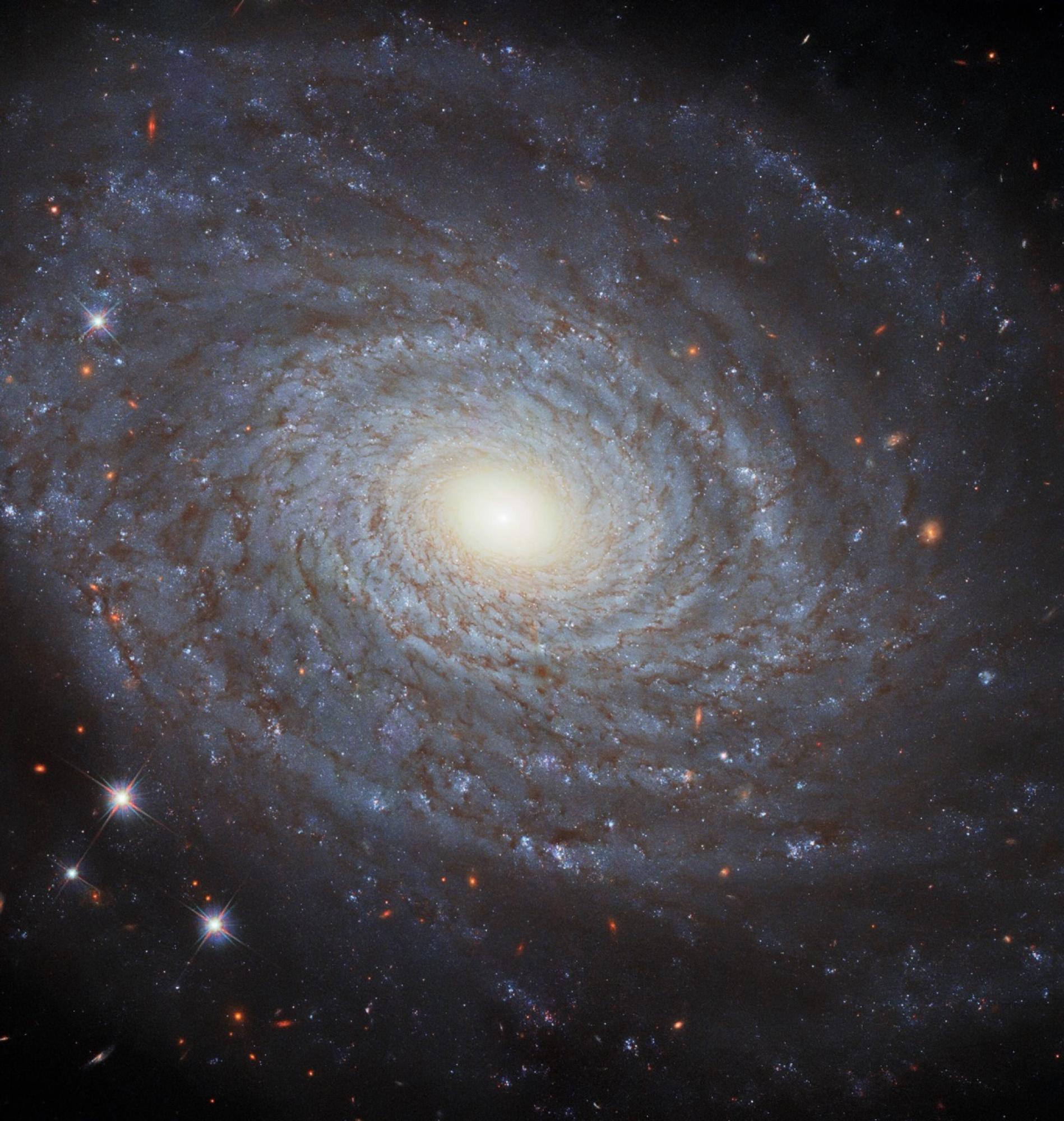
We are not alone in the universe. A few years ago, this notion seemed farfetched; today, the existence of extraterrestrial intelligence is taken for granted by most scientists. Even the staid National Academy of Sciences has gone on record that contact with other civilizations is no longer something beyond our dreams but a natural event in the history of mankind that will perhaps occur in the lifetime of many of us." Sir Bernard Lovell, one of the worlds leading radio astronomers, has calculated that, even allowing for a margin of error of 5000%, there must be in our own galaxy about 100 million stars which have planets of the right chemistry, dimensions, and temperature to support organic evolution. Unless we are terribly conceited, we must assume that the "others" are far more advanced than we are. Even a 50 year gap would be tremendous; a 500-year gap staggers the imagination, and as for a 5000-year gap... It is quite possible that "others" have satellite probes in space, retransmitting to "them" anything that sounds nonrandom to the probe. But they have probably called us several thousand years ago, and are waiting for an answer; or worse yet, they have given up; or, more probably, they have reached such impressive technological advances that they have destroyed themselves. After we resolve our pressing scientific questions, it might be appropriate to make discreet inquiries as to how we could live in harmony and peace with our fellow man. [We] must keep a level head ... and be prepared to cope with problems the like of which he has never seen - out of this world, so to speak.
Latest
Latest News
Each news summary is created according to strict standards. Here's how we do it.
Each summary is created using a consistent editorial procedure. The target length is approximately 16 lines of 11-point Arial text in a 650-pixel-wide column. Up to 25% of a summary may be set in bold to emphasize the most important ideas. Summaries are composed of verbatim excerpts presented in the same sequence as they appear in the original news source, with very minor editorial additions. Where material has been omitted between excerpts, the omission is indicated with ellipses (...). Any words added by an editor for clarity or context appear in [brackets]. Our original news editor was Fred Burks. Tod Fletcher edited most summaries from 2007 through 2014, and Mark Bailey has served as news editor since 2014.