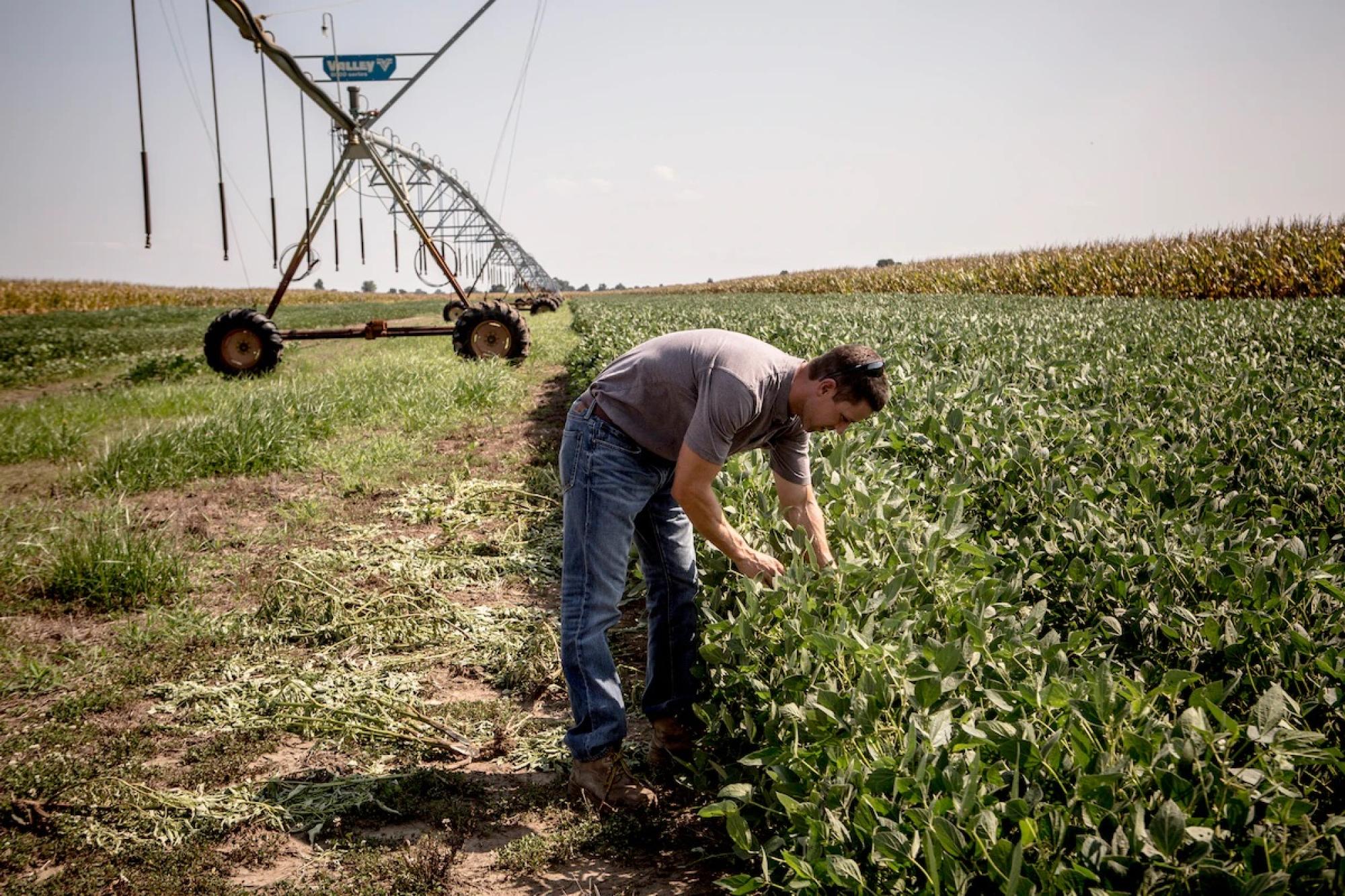
The Environmental Protection Agency announced Wednesday its proposed decision to reregister dicamba, a herbicide widely used on soybean and cotton farms that has been banned twice by federal courts. The EPA originally approved dicamba's use on genetically engineered soybeans and cotton in 2016. Environmental groups sued the EPA over dicamba in 2020 because of its potential drift away from the intended target, especially during warmer temperatures, and harm neighboring crops, nearby ecosystems and rural communities. The U.S. Court of Appeals for the 9th Circuit ruled against the EPA and said the agency "understated the amount of dicamba damage." The court determined that dicamba "caused substantial and undisputed damage" that tore the "social fabric of the farming communities." After the court vacated the herbicide's registration, the EPA re-registered it months later, and was again challenged by environmental groups. A second federal court vacated that registration in 2024 and prohibited the sale of the herbicide. The popularity of dicamba, which was first introduced in 1967, arose from a need to find solutions to Roundup-resistant weeds, also known as "superweeds." Monsanto ... began selling genetically engineered seeds that could survive being doused by dicamba and Roundup in 2016. Between 2016 and 2019, dicamba use across the country nearly quadrupled to an estimated 31 million pounds a year.
Latest
Latest News
Each news summary is created according to strict standards. Here's how we do it.
Each summary is created using a consistent editorial procedure. The target length is approximately 16 lines of 11-point Arial text in a 650-pixel-wide column. Up to 25% of a summary may be set in bold to emphasize the most important ideas. Summaries are composed of verbatim excerpts presented in the same sequence as they appear in the original news source, with very minor editorial additions. Where material has been omitted between excerpts, the omission is indicated with ellipses (...). Any words added by an editor for clarity or context appear in [brackets]. Our original news editor was Fred Burks. Tod Fletcher edited most summaries from 2007 through 2014, and Mark Bailey has served as news editor since 2014.