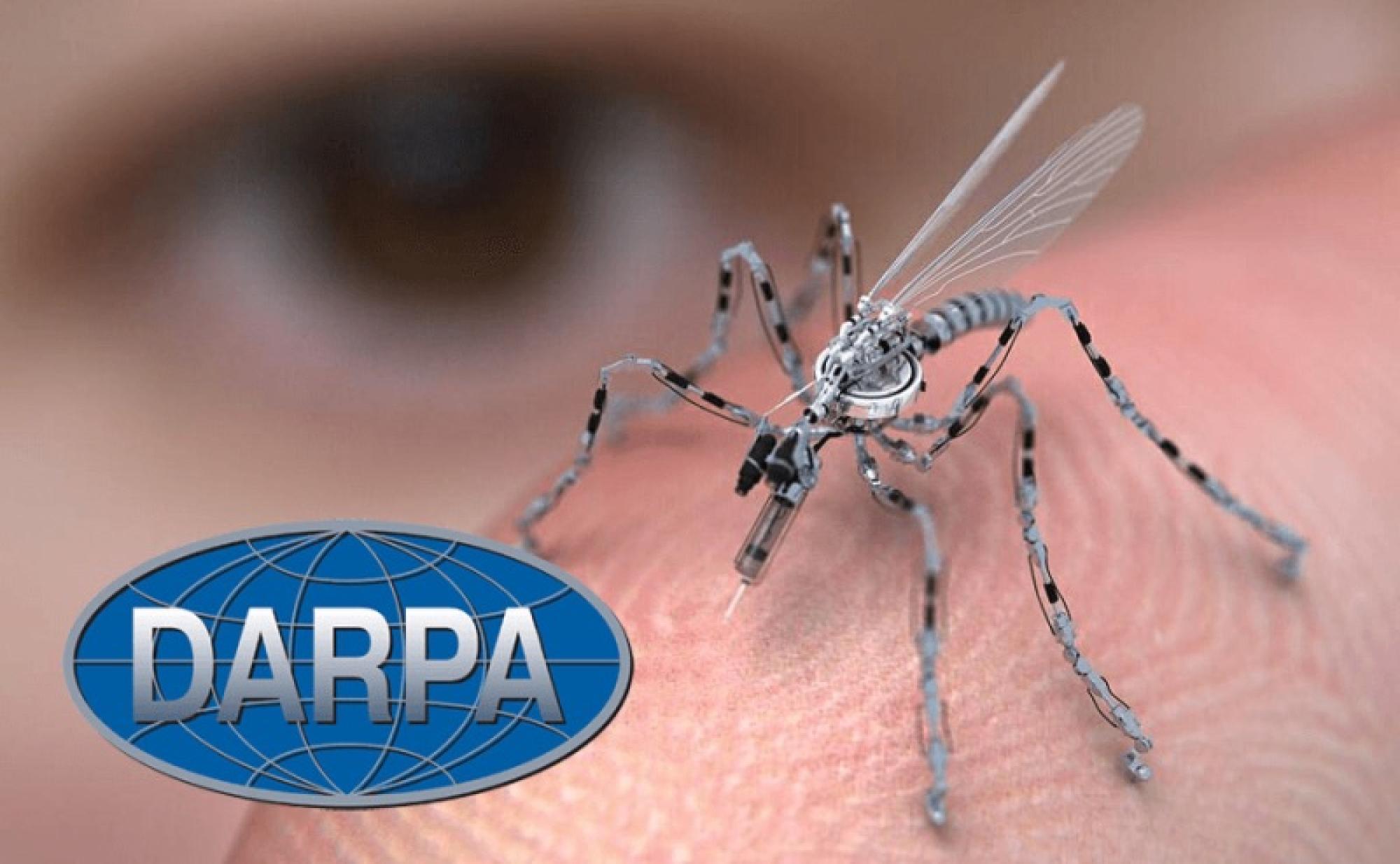
Future wars just might revolve around insect-size spy robots. A recent digest of present-day microbots by US national security magazine The National Interest breaks down the many machines currently in development by the US military and its associates. They include sea-based microdrones, cockroach-style surveillance bots, and even cyborg insects. Arguably the most refined program to date is the RoboBee, currently being shopped by Harvard's Wyss Institute. Originally funded by a $9.3 million grant from the National Science Foundation in 2009, the RoboBee is a bug-sized autonomous flying vehicle capable of transitioning from water to air, perching on surfaces, and autonomous collision avoidance in swarms. The RoboBee features two "wafer-thin" wings that flap some 120 times a second to achieve vertical takeoff and mid-air hovering. The US Defense Advanced Research Projects Agency (DARPA) has reportedly taken a keen interest in RoboBee prototypes, sponsoring research into microfabrication technology, presumably for quick field deployments. Other developments, like the aforementioned cyborg insect, remain in early stages. Researchers have successfully demonstrated the capabilities of these remote-control systems using of a range of insect hosts, from the unicorn beetle to the humble cockroach. Underwater microrobotics are another area of interest for DARPA.
Latest
Latest News
Each news summary is created according to strict standards. Here's how we do it.
Each summary is created using a consistent editorial procedure. The target length is approximately 16 lines of 11-point Arial text in a 650-pixel-wide column. Up to 25% of a summary may be set in bold to emphasize the most important ideas. Summaries are composed of verbatim excerpts presented in the same sequence as they appear in the original news source, with very minor editorial additions. Where material has been omitted between excerpts, the omission is indicated with ellipses (...). Any words added by an editor for clarity or context appear in [brackets]. Our original news editor was Fred Burks. Tod Fletcher edited most summaries from 2007 through 2014, and Mark Bailey has served as news editor since 2014.