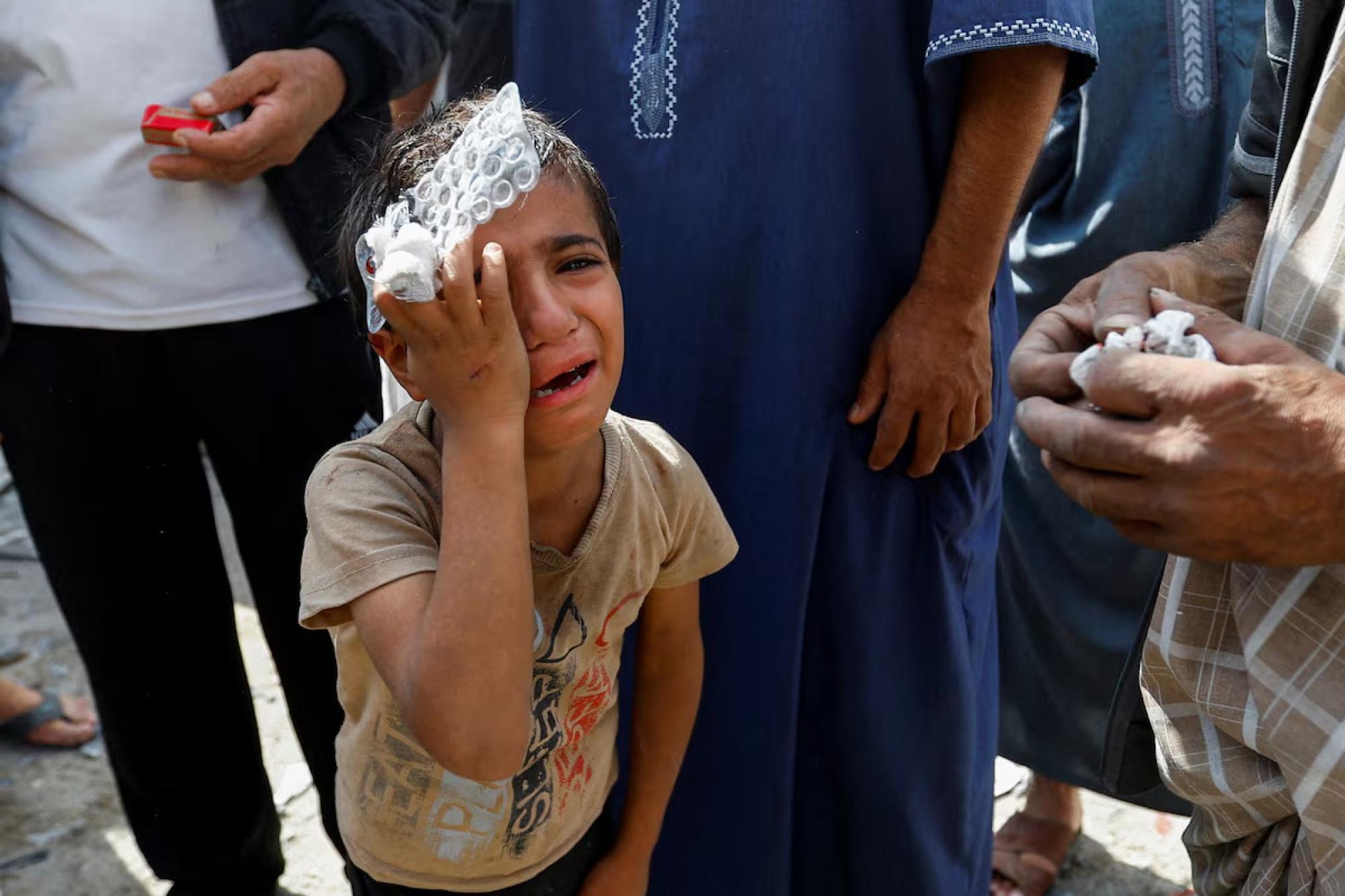
A new study of children living through the war in Gaza has found that 96% of them feel that their death is imminent and almost half want to die as a result of the trauma they have been through. A needs assessment, carried out by a Gaza-based NGO sponsored by the War Child Alliance charity, also found that 92% of the children in the survey were "not accepting of reality", 79% suffer from nightmares and 73% exhibit symptoms of aggression. "This report lays bare that Gaza is one of the most horrifying places in the world to be a child," Helen Pattinson, chief executive of War Child UK, said. "Alongside the levelling of hospitals, schools and homes, a trail of psychological destruction has caused wounds unseen but no less destructive on children who hold no responsibility for this war." The estimated death toll in Gaza is more than 44,000 and a recent assessment by the UN Human Rights Office found that 44% of the fatalities it was able to verify were children. About 1.9 million Palestinians in Gaza, approximately 90% of the territory's total population, have been displaced, many several times. Half of that number are children who have lost their home and been forced to flee their neighbourhoods. More than 60% of the surveyed children reported having experienced traumatic events during the war and some had been exposed to multiple traumatic events. An estimated 17,000 children in Gaza are unaccompanied, separated from their parents.
Latest
Latest News
Each news summary is created according to strict standards. Here's how we do it.
Each summary is created using a consistent editorial procedure. The target length is approximately 16 lines of 11-point Arial text in a 650-pixel-wide column. Up to 25% of a summary may be set in bold to emphasize the most important ideas. Summaries are composed of verbatim excerpts presented in the same sequence as they appear in the original news source, with very minor editorial additions. Where material has been omitted between excerpts, the omission is indicated with ellipses (...). Any words added by an editor for clarity or context appear in [brackets]. Our original news editor was Fred Burks. Tod Fletcher edited most summaries from 2007 through 2014, and Mark Bailey has served as news editor since 2014.