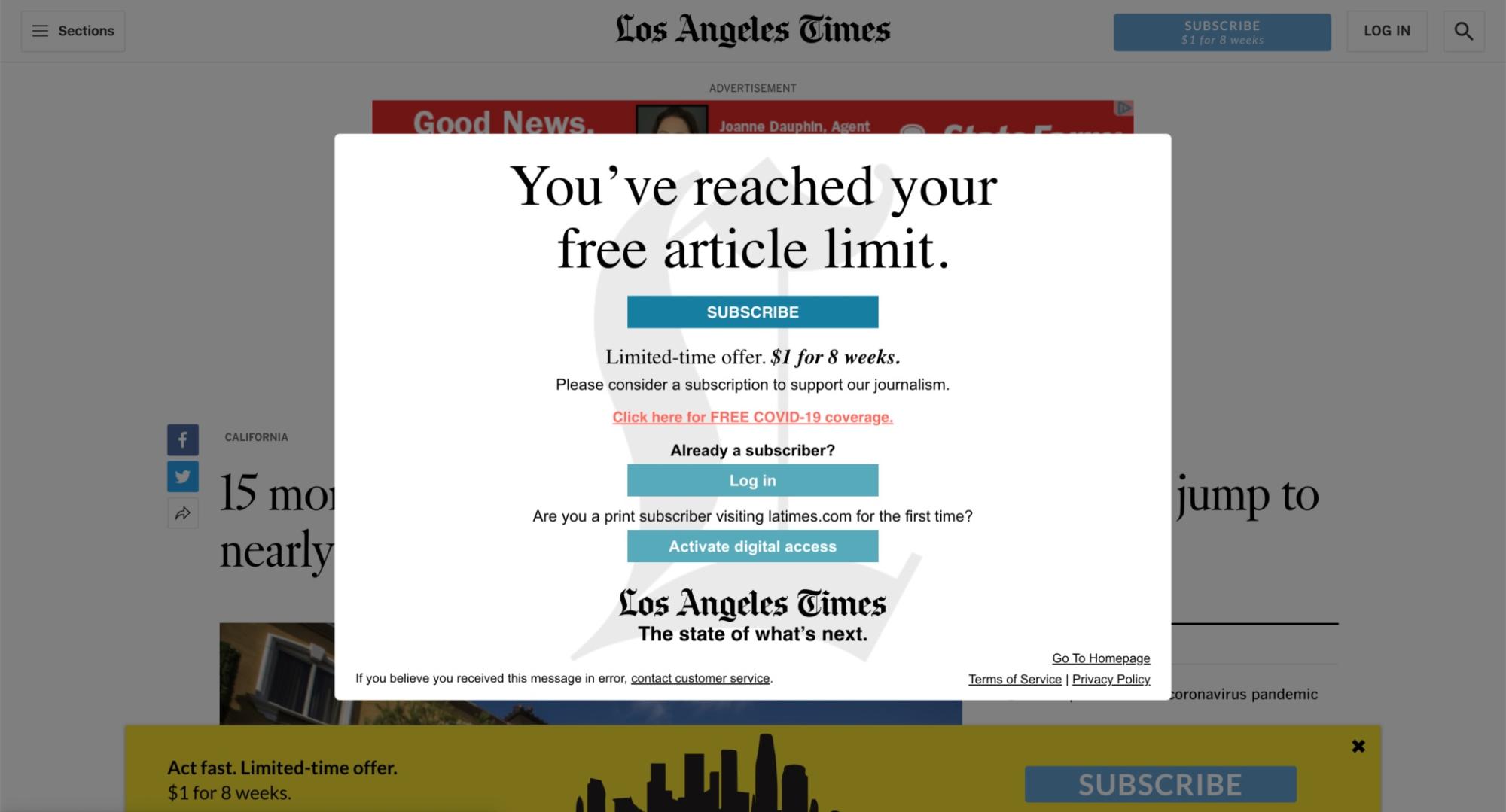
According to the Reuters Institute for the Study of Journalism, more than 75 percent of America's leading newspapers, magazines, and journals are behind online paywalls. And how do American news consumers react to that? Almost 80 percent of Americans steer around those paywalls and seek out a free option. Paywalls create a two-tiered system: credible, fact-based information for people who are willing to pay for it, and murkier, less-reliable information for everyone else. Simply put, paywalls get in the way of informing the public, which is the mission of journalism. And they get in the way of the public being informed, which is the foundation of democracy. It is a terrible time for the press to be failing at reaching people, during an election in which democracy is on the line. There's a simple, temporary solution: Publications should suspend their paywalls for all 2024 election coverage and all information that is beneficial to voters. Democracy does not die in darkness"it dies behind paywalls. Less than a third of Americans in a recent Gallup poll say they have "a fair amount" or a "a great deal" of trust that the news is fair and accurate. Part of the problem ... is that the platform companies, which are the largest distributors of free news, have deprioritized news. Meta has long had an uncomfortable relationship with news on Facebook. In the past year ... Meta has changed its algorithm in a way that has cost some news outlets 30 to 40 percent of their traffic.
Latest
Latest News
Each news summary is created according to strict standards. Here's how we do it.
Each summary is created using a consistent editorial procedure. The target length is approximately 16 lines of 11-point Arial text in a 650-pixel-wide column. Up to 25% of a summary may be set in bold to emphasize the most important ideas. Summaries are composed of verbatim excerpts presented in the same sequence as they appear in the original news source, with very minor editorial additions. Where material has been omitted between excerpts, the omission is indicated with ellipses (...). Any words added by an editor for clarity or context appear in [brackets]. Our original news editor was Fred Burks. Tod Fletcher edited most summaries from 2007 through 2014, and Mark Bailey has served as news editor since 2014.