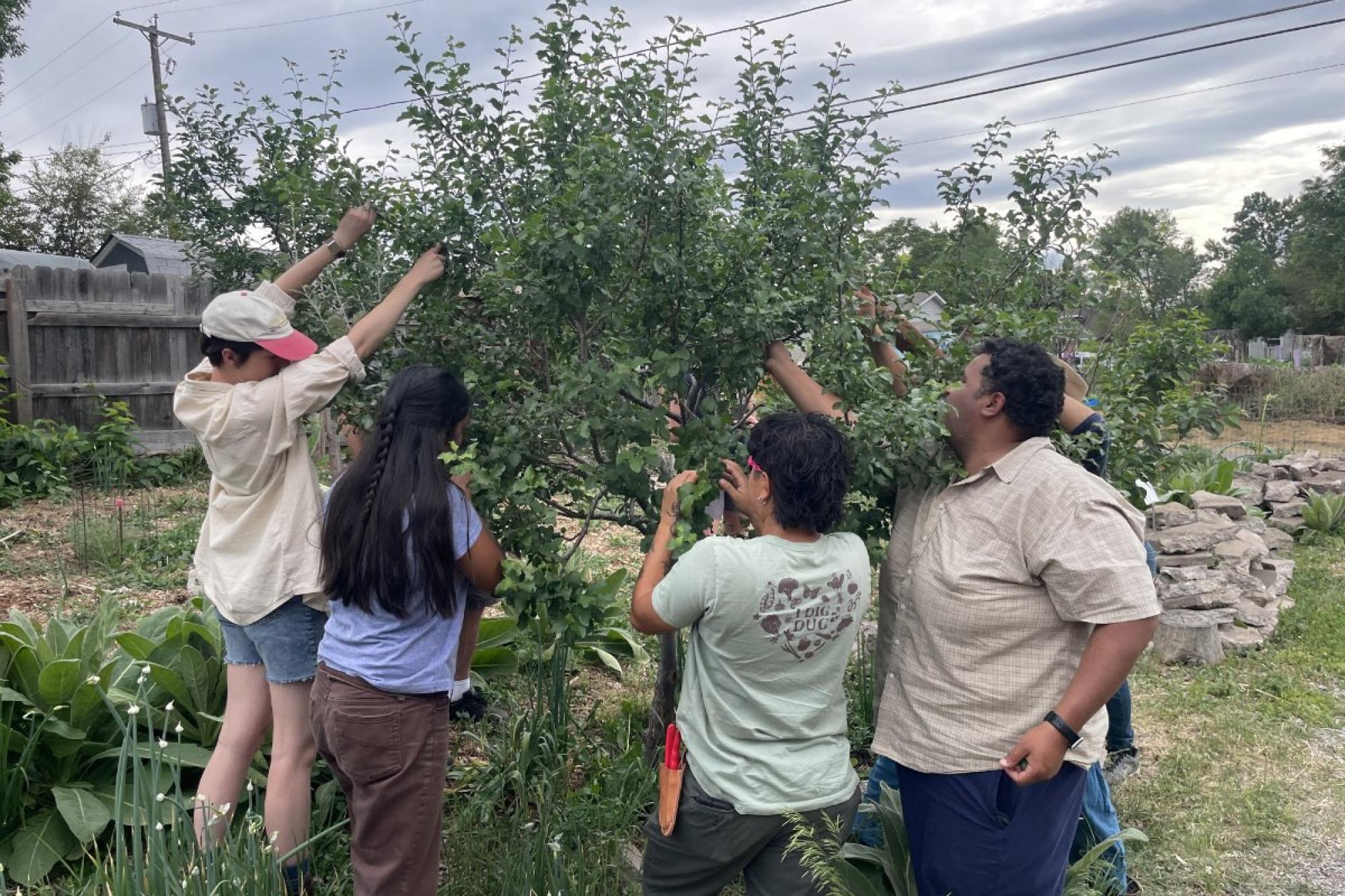
The urban tree canopy in Denver is one of the sparsest in the country. In 2020, when Linda Appel Lipsius became executive director of the decades-old Denver Urban Gardens (DUG) network, which oversees more than 200 community vegetable gardens throughout six metro Denver counties, she wanted to continue increasing community access to fresh food"a longtime goal of the garden program. But she had another aim, too: increasing the city's tree coverage. Appel Lipsius decided to build a system of food forests throughout the Denver area. These dense, layered plantings incorporate fruit-bearing trees with other perennials to mimic natural forests. Now, DUG oversees 26 food forests, with 600 or so fruit and nut trees and 600 berry bushes. While urban trees are recognized for their multiple benefits, including cooling and carbon drawdown, "there are not a lot of players in Denver, or even in most cities around the country, who are focused on food trees," Appel Lipsius said. "We were able to step into this space to help build and bolster the canopy while adding food-producing perennials." Neighbors are welcome to enter and harvest a wide assortment of fruits, nuts, and berries. Beyond providing fresh food in neighborhoods that need it most, these agroforests reduce the urban heat island effect, create pollinator habitat, and combat pollution and climate change by absorbing and filtering harmful gases.
Latest
Latest News
Each news summary is created according to strict standards. Here's how we do it.
Each summary is created using a consistent editorial procedure. The target length is approximately 16 lines of 11-point Arial text in a 650-pixel-wide column. Up to 25% of a summary may be set in bold to emphasize the most important ideas. Summaries are composed of verbatim excerpts presented in the same sequence as they appear in the original news source, with very minor editorial additions. Where material has been omitted between excerpts, the omission is indicated with ellipses (...). Any words added by an editor for clarity or context appear in [brackets]. Our original news editor was Fred Burks. Tod Fletcher edited most summaries from 2007 through 2014, and Mark Bailey has served as news editor since 2014.