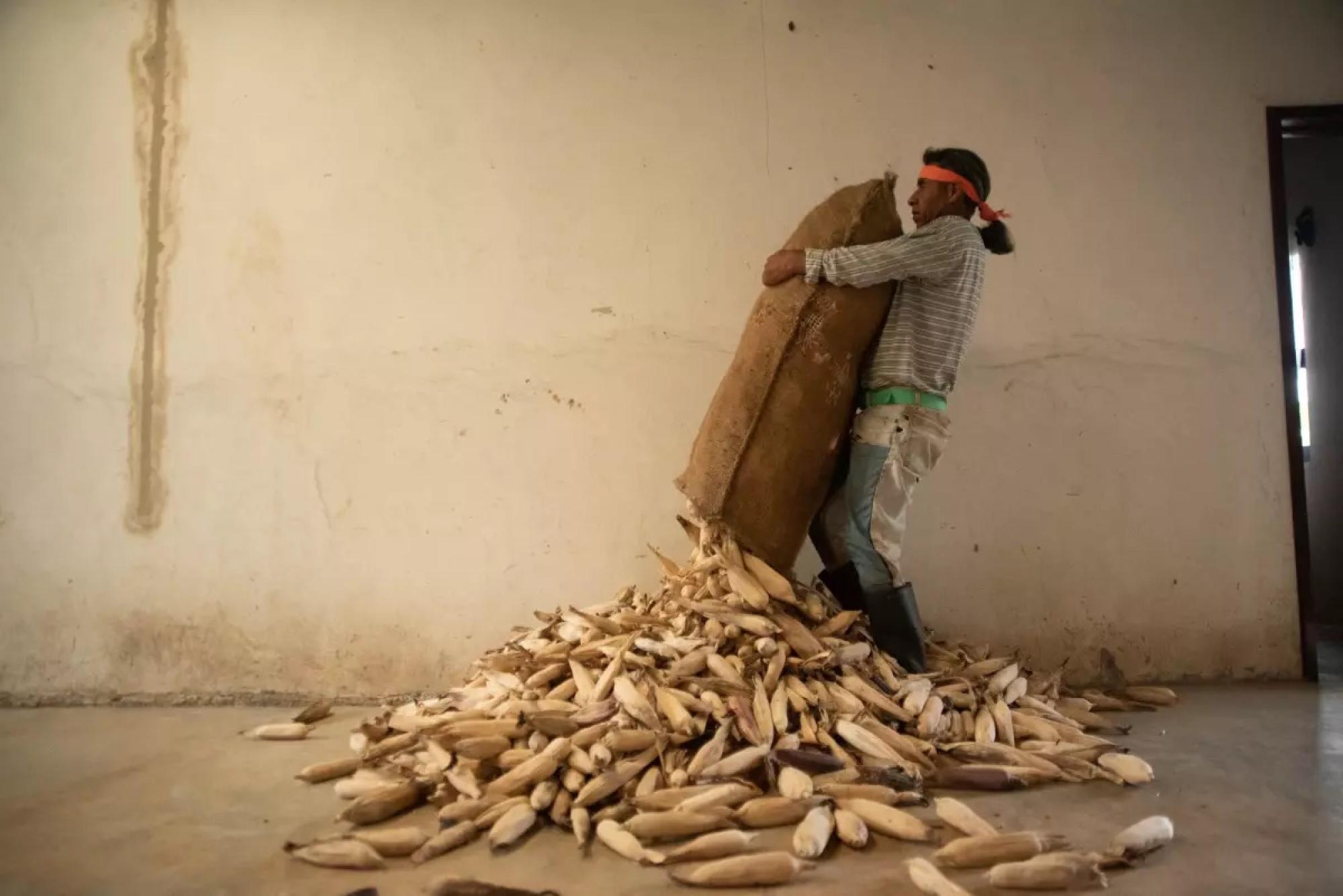
There's a popular saying in Mexico. Without corn, there is no country. This week, Mexico's leaders voted to enshrine that concept in the Constitution, declaring native corn "an element of national identity" and banning the planting of genetically modified seeds. The measure, which aims to protect Mexico's thousands of varieties of heirloom corn from engineered versions sold by American companies, has become a nationalist rallying cry. "Corn is Mexico," President Claudia Sheinbaum said recently, describing the reform as a way to secure Mexico's sovereignty. "We have to protect it for biodiversity but also culturally, because corn is what intrinsically links us to our origins, to the resistance of Indigenous peoples." The amendment to the Constitution comes after the defeat in December of a related effort that sought to phase out all imports of genetically modified corn. Then-President Andrés Manuel López Obrador issued a presidential decree in 2023 banning the use of genetically engineered corn in dough and tortillas and for animal feed and industrial use, but a trade dispute panel ruled that it violated the U.S.-Mexico-Canada Agreement. Mexico agreed to abide by the panel's ruling, and this week's action targets seeds, not all products. "There's a disturbing level of contamination of native maize with genetically modified traits," said Timothy Wise, a researcher at the Global Development and Environment Institute at Tufts University.
Latest
Latest News
Each news summary is created according to strict standards. Here's how we do it.
Each summary is created using a consistent editorial procedure. The target length is approximately 16 lines of 11-point Arial text in a 650-pixel-wide column. Up to 25% of a summary may be set in bold to emphasize the most important ideas. Summaries are composed of verbatim excerpts presented in the same sequence as they appear in the original news source, with very minor editorial additions. Where material has been omitted between excerpts, the omission is indicated with ellipses (...). Any words added by an editor for clarity or context appear in [brackets]. Our original news editor was Fred Burks. Tod Fletcher edited most summaries from 2007 through 2014, and Mark Bailey has served as news editor since 2014.