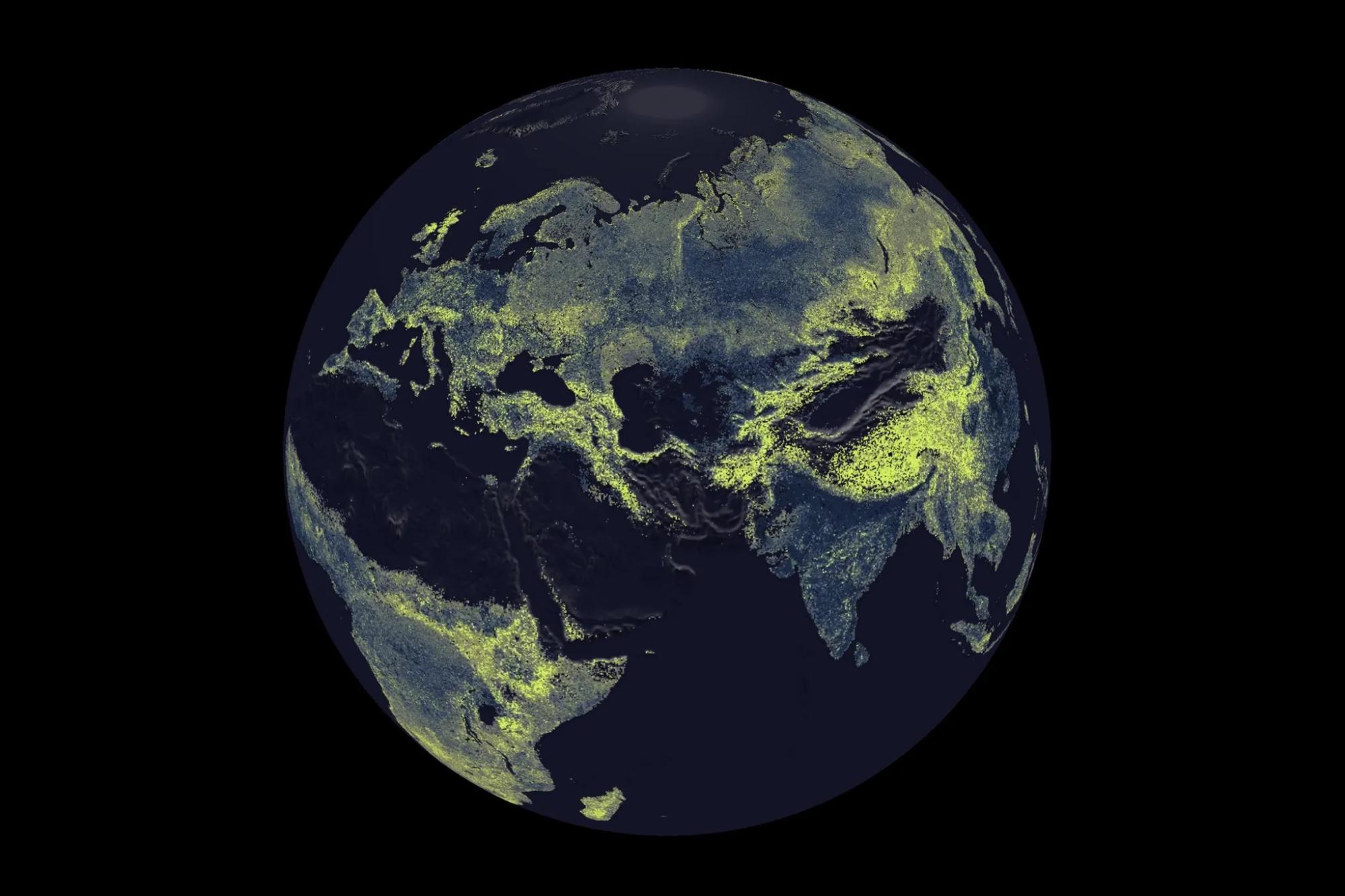
Scientists have mapped the Earth's entire underground fungal network, showing that it's so extensive that if it were stretched into a straight line, it would reach other star systems and span a sizable chunk of the Milky Way galaxy, for that matter. The groundbreaking work, published in a study in the journal Science, focused on microorganisms known as arbuscular mycorrhizal fungi. Forming the hidden backbone of our planet's soil, they circulate water and nutrients and regulate the climate by locking away vast stores of carbon. Altogether, the global fungal network weighs around 300 megatons, the study found, which is four to six times more than the biomass of all human beings. Around 40 percent of that fungal mass resides in high-altitude or flooded grasslands, like the Everglades in Florida. The authors hope that their work will highlight the indispensable but overlooked role that these fungal networks play in the Earth's ecosystems, with around 70 percent of all ground-based plant life depending on the fungi. In all, the model found that the planet is lined with more than 110 quadrillion kilometers of hyphae, or 68 quadrillion miles, which is almost a billion times the distance between the Earth and the Sun. On a cosmic ruler, that equals nearly 12,000 light years, or about a tenth the diameter of our galaxy. It's the clearest picture yet of just how much fungal networks underpin our terrestrial ecosystems.
Latest
Latest News
Each news summary is created according to strict standards. Here's how we do it.
Each summary is created using a consistent editorial procedure. The target length is approximately 16 lines of 11-point Arial text in a 650-pixel-wide column. Up to 25% of a summary may be set in bold to emphasize the most important ideas. Summaries are composed of verbatim excerpts presented in the same sequence as they appear in the original news source, with very minor editorial additions. Where material has been omitted between excerpts, the omission is indicated with ellipses (...). Any words added by an editor for clarity or context appear in [brackets]. Our original news editor was Fred Burks. Tod Fletcher edited most summaries from 2007 through 2014, and Mark Bailey has served as news editor since 2014.