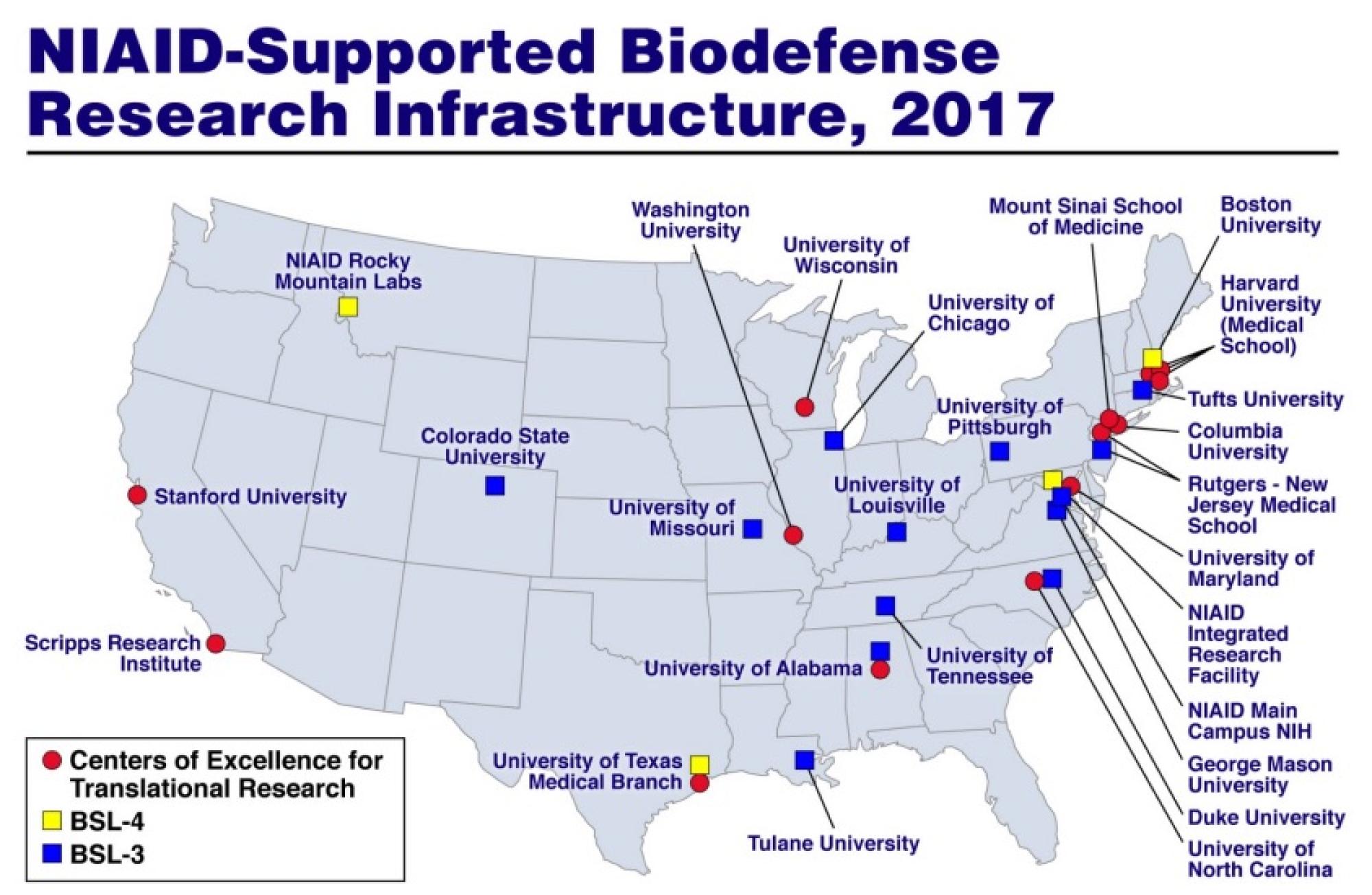
Anthony Fauci detailed how the research portfolio of his longtime former institute, the National Institute of Allergy and Infectious Diseases, did not distinguish between "biodefense efforts" and "naturally occurring" pathogens in a fall 2017 presentation. Fauci described "the joining with and ultimate indistinguishing of biodefense efforts and efforts directed at naturally occurring emerging and re-emerging infections. "Gain-of-function" research (GOF) makes viruses more pathogenic or transmissible. Much of this gain-of-function research is considered "dual use research of concern" (DURC) because it can be applied toward benevolent civilian aims or misapplied toward the development of bioweapons. Fauci's biodefense legacy has taken on a new significance in light of the COVID-19 pandemic. Critics, especially those who believe the pandemic is likely to have resulted from a lab accident, say the global proliferation of maximum security labs and GOF/DURC has made the world less safe. After the 2001 anthrax attacks, amid concerns about alleged "weapons of mass destruction," including biological weapons, former President George W. Bush asked Congress to invest billions in building maximum security labs capable of combating bioterrorism. By the late 2000s, fears of bioterrorism from the Middle East had faded. The Federal Bureau of Investigation's conclusion that a researcher at the U.S. Army Medical Research Institute on Infectious Diseases at Fort Detrick had been responsible for the 2001 anthrax attacks stoked a new kind of fear " of an expanding population of scientists with classified knowledge and access to pathogens. Counter-bioterrorism research at the National Institutes for Health surged from $53 million in 2001 to at least $1.6 billion in 2004. GAO reports uncovered major biosecurity breaches.
Latest
Latest News
Each news summary is created according to strict standards. Here's how we do it.
Each summary is created using a consistent editorial procedure. The target length is approximately 16 lines of 11-point Arial text in a 650-pixel-wide column. Up to 25% of a summary may be set in bold to emphasize the most important ideas. Summaries are composed of verbatim excerpts presented in the same sequence as they appear in the original news source, with very minor editorial additions. Where material has been omitted between excerpts, the omission is indicated with ellipses (...). Any words added by an editor for clarity or context appear in [brackets]. Our original news editor was Fred Burks. Tod Fletcher edited most summaries from 2007 through 2014, and Mark Bailey has served as news editor since 2014.