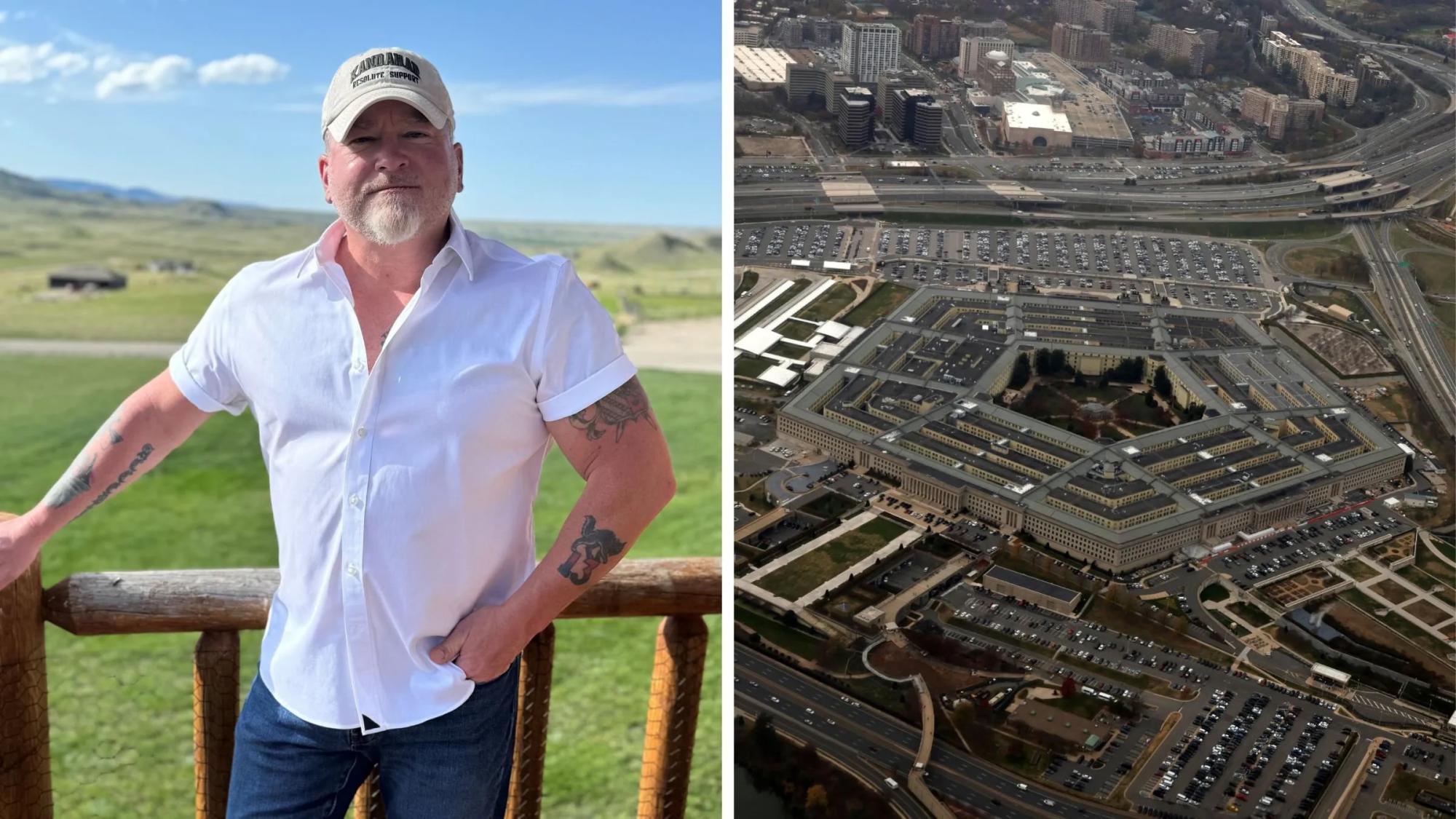
"The United States has been involved in the recovery of objects, vehicles of unknown origin that are neither from our country or any other foreign country," former senior US government intelligence Luis Elizondo told NewsNation. Elizondo claimed that one of the two spacecraft the Department of Defense has is from the alleged 1947 unidentified anomalous phenomena (UAP) crash in Roswell, New Mexico. "We as a nation have been interested in not only the vehicles themselves but the occupants of these vehicles; to include biological specimens. "We are not alone in this universe. The US government has been aware of that fact for decades." Elizondo claims: "I saw a technical device that had been removed, excised by the Department of Veterans Affairs by a surgeon, a trained physician, from a US military service member who claimed to have a UAP encounter," he told the outlet. "The physician claimed that the object tried to run on him or evade being excised." Elizondo ... graduated from the University of Miami with majors in microbiology and immunology, with studies in parasitology. After a stint in the army, he claims to have "served as a special agent in counterintelligence" for the US and was tasked with helping protect "advanced aerospace technology" from falling into the wrong hands. In 2008, however, Elizondo claims he took "a new position at the Pentagon," where he was later "approached by two individuals who were part of a program I hadn't heard of before," who knew his "background" and were considering him to join their "organization." "After meeting the director and several other individuals, I agreed to take on a role in their program, which was called the Advanced Aerospace Threat Identification Program (AATIP), a niche program under the umbrella of AWSAPP," he wrote. He would eventually make his way up the chain in the AATIP, where a "typical day" would be investigating UAP reports, "primarily from the Navy," specifically in incidents where they "came dangerously close to our aircraft."
Latest
Latest News
Each news summary is created according to strict standards. Here's how we do it.
Each summary is created using a consistent editorial procedure. The target length is approximately 16 lines of 11-point Arial text in a 650-pixel-wide column. Up to 25% of a summary may be set in bold to emphasize the most important ideas. Summaries are composed of verbatim excerpts presented in the same sequence as they appear in the original news source, with very minor editorial additions. Where material has been omitted between excerpts, the omission is indicated with ellipses (...). Any words added by an editor for clarity or context appear in [brackets]. Our original news editor was Fred Burks. Tod Fletcher edited most summaries from 2007 through 2014, and Mark Bailey has served as news editor since 2014.