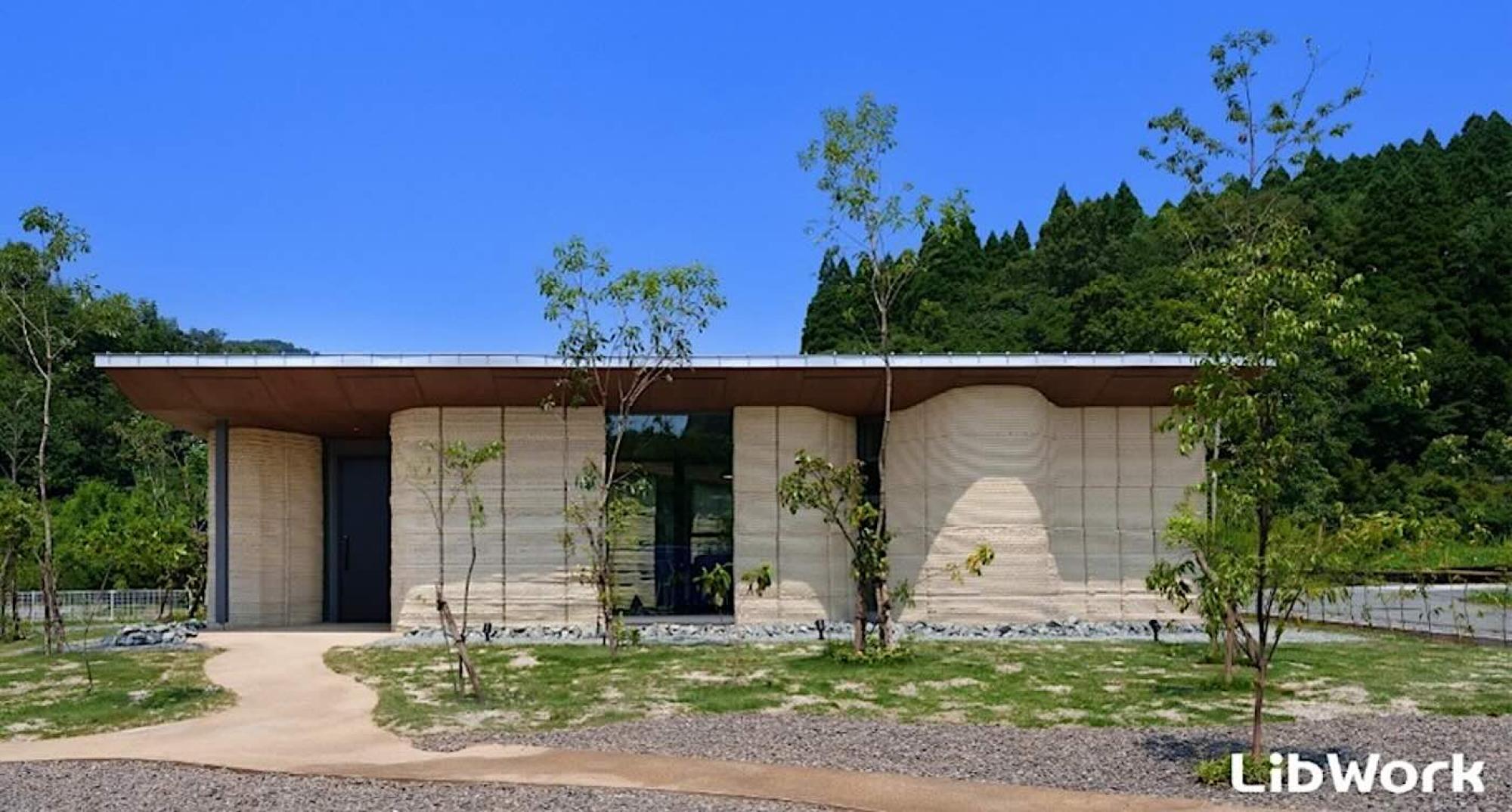
Collaborating with robotics engineers and Italian 3D printer manufacturers, a Japanese company is building "homes of earth" made primarily from soil. Lib Work, Ltd. completed their first 3D-printed earth home in Yamaga, Kumamoto on July 22, calling their creative process "uncharted territory where tradition and convention offered no guide". With an eye toward recycling, sustainability, and reduced carbon emissions, Lib Work focused on combining 3D-printing with natural materials enhanced for strength, constructibility, and design quality. The walls of the completed Lib Earth House Model B use no cement (which produces industrial waste). Instead, they utilized only naturally derived materials with soil as the primary component to create sustainable earthen walls. Compared to the previous model (Model A) that used some cement, the building's strength has improved approximately fivefold while significantly reducing CO2 emissions from the manufacturing process itself. The walls contain cutting-edge sensors as part of a wall condensation monitoring system that monitors in real-time the temperature and humidity inside the walls. This system enables the house to manage its own condition by detecting condensation in advance to maintain a long-lasting, comfortable living environment. Additionally, the homes include remote operation of air conditioning, lighting, and bath controls via smartphone or dedicated monitor. It also features an off-grid energy system.
Latest
Latest News
Each news summary is created according to strict standards. Here's how we do it.
Each summary is created using a consistent editorial procedure. The target length is approximately 16 lines of 11-point Arial text in a 650-pixel-wide column. Up to 25% of a summary may be set in bold to emphasize the most important ideas. Summaries are composed of verbatim excerpts presented in the same sequence as they appear in the original news source, with very minor editorial additions. Where material has been omitted between excerpts, the omission is indicated with ellipses (...). Any words added by an editor for clarity or context appear in [brackets]. Our original news editor was Fred Burks. Tod Fletcher edited most summaries from 2007 through 2014, and Mark Bailey has served as news editor since 2014.