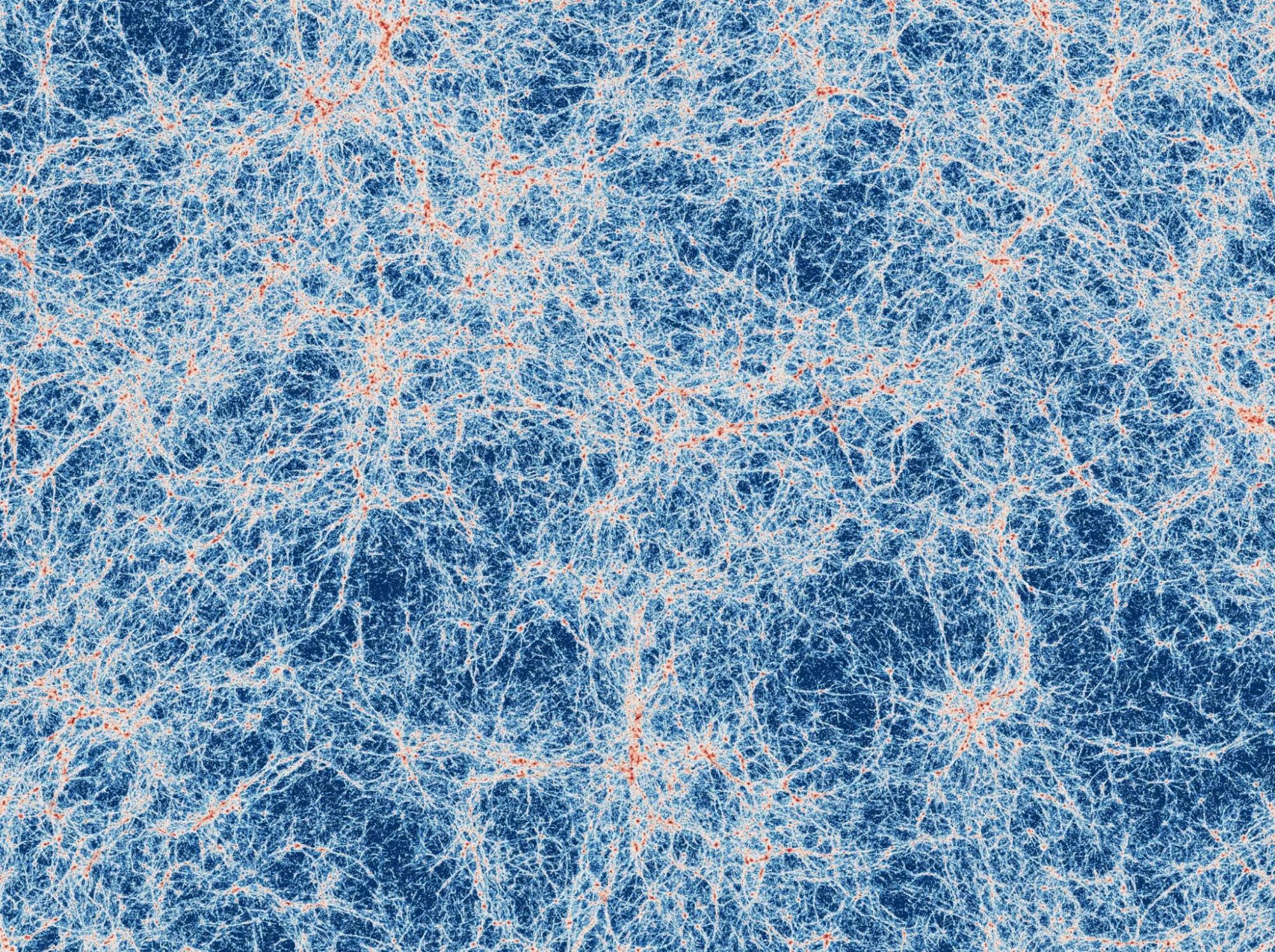
Dark matter, which makes up about 85% of all matter in the Universe, plays a crucial role in shaping cosmic structures. Under gravity's influence, it forms a vast, intricate web of filaments. At the intersections of these filaments, the brightest galaxies take shape. This cosmic web serves as the backbone of the Universe, guiding the flow of gas that fuels star formation in galaxies. Studying how this gas moves and interacts could significantly improve our understanding of how galaxies form and evolve. However, directly observing this intergalactic gas is extremely difficult. In [a] new study, an international team led by researchers at the University of Milano-Bicocca and including scientists at the Max Planck Institute for Astrophysics (MPA) obtained an unprecedented high-definition image of a cosmic filament using MUSE (Multi-Unit Spectroscopic Explorer), an innovative spectrograph installed on the Very Large Telescope at the European Southern Observatory in Chile. The study, led by Davide Tornotti, PhD student at the University of Milano-Bicocca, used this ultrasensitive data to produce the sharpest image ever obtained of a cosmic filament spanning 3 million light-years and connecting two galaxies, each hosting an active supermassive black hole. The discovery, recently published in Nature Astronomy opens new avenues to directly constrain gas properties within intergalactic filaments and to refine our understanding of galaxy formation and evolution.
Latest
Latest News
Each news summary is created according to strict standards. Here's how we do it.
Each summary is created using a consistent editorial procedure. The target length is approximately 16 lines of 11-point Arial text in a 650-pixel-wide column. Up to 25% of a summary may be set in bold to emphasize the most important ideas. Summaries are composed of verbatim excerpts presented in the same sequence as they appear in the original news source, with very minor editorial additions. Where material has been omitted between excerpts, the omission is indicated with ellipses (...). Any words added by an editor for clarity or context appear in [brackets]. Our original news editor was Fred Burks. Tod Fletcher edited most summaries from 2007 through 2014, and Mark Bailey has served as news editor since 2014.