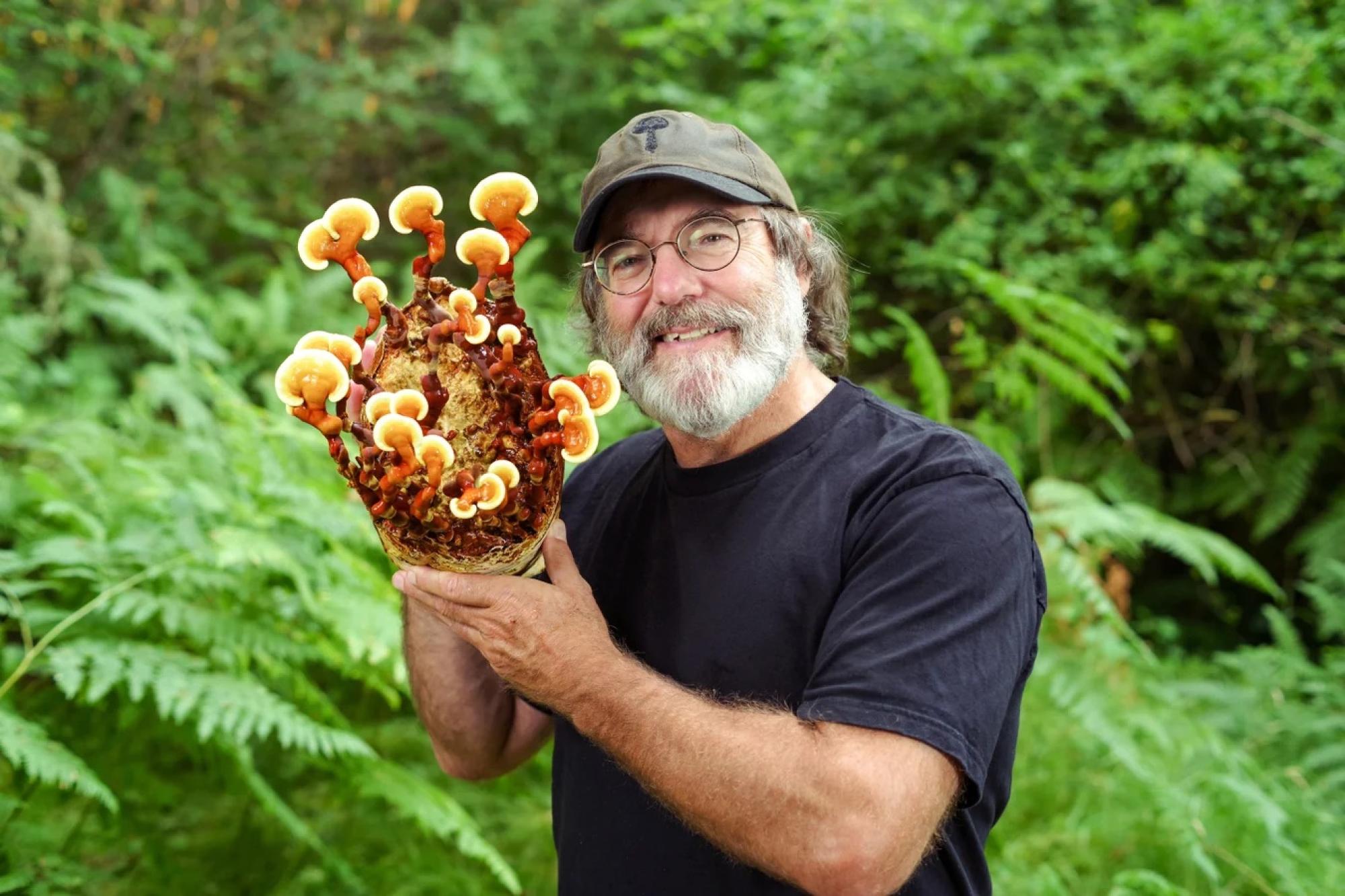
The list of mycologists whose names are known beyond their fungal field is short, and at its apex is Paul Stamets. In a new "astromycological" venture launched in conjunction with NASA, Stamets and various research teams are studying how fungi can be leveraged to build extraterrestrial habitats and perhaps someday even terraform planets. [Stamets:] Fungi were the first organisms that came to land, munching rocks, and fungi gave birth to animals about 650 million years ago. We're descendants of the descendants of these fungal networks. [Plants that support terraforming] need minerals, and pairing fungi up with the plants and debris from humans [causes them to] decompose into a form that then creates rich soils that could help generate the foods that astronauts need. We grow lots of reishi mycelium. We grow reishi blocks. We wanted to crush these blocks in order to turn them into soil. This great engineer built us a hydraulic stainless steel press, and I had like 2,000 psi [pounds per square inch] in this press, and we gave it my reishi blocks, and it bent the stainless steel. Trying to compress it, it actually broke the machine. This thing will crush rocks all day long and could not crush mycelium. They're also good at retaining heat, so their insulation properties are phenomenal. Moreover, these could become batteries. You can have solar panels on a structure on Mars made of mycelium. (The entire mycelium is about 85 percent carbon, and studies have shown that porous carbon can be an excellent capacitor.) You could then pregrow these and arrange them on a form such that they become nanobatteries. And they could then not only insulate you from the cold on the Martian or asteroid surface, but the house itself becomes a giant battery for power because they're so rich in carbon fibers.
Latest
Latest News
Each news summary is created according to strict standards. Here's how we do it.
Each summary is created using a consistent editorial procedure. The target length is approximately 16 lines of 11-point Arial text in a 650-pixel-wide column. Up to 25% of a summary may be set in bold to emphasize the most important ideas. Summaries are composed of verbatim excerpts presented in the same sequence as they appear in the original news source, with very minor editorial additions. Where material has been omitted between excerpts, the omission is indicated with ellipses (...). Any words added by an editor for clarity or context appear in [brackets]. Our original news editor was Fred Burks. Tod Fletcher edited most summaries from 2007 through 2014, and Mark Bailey has served as news editor since 2014.