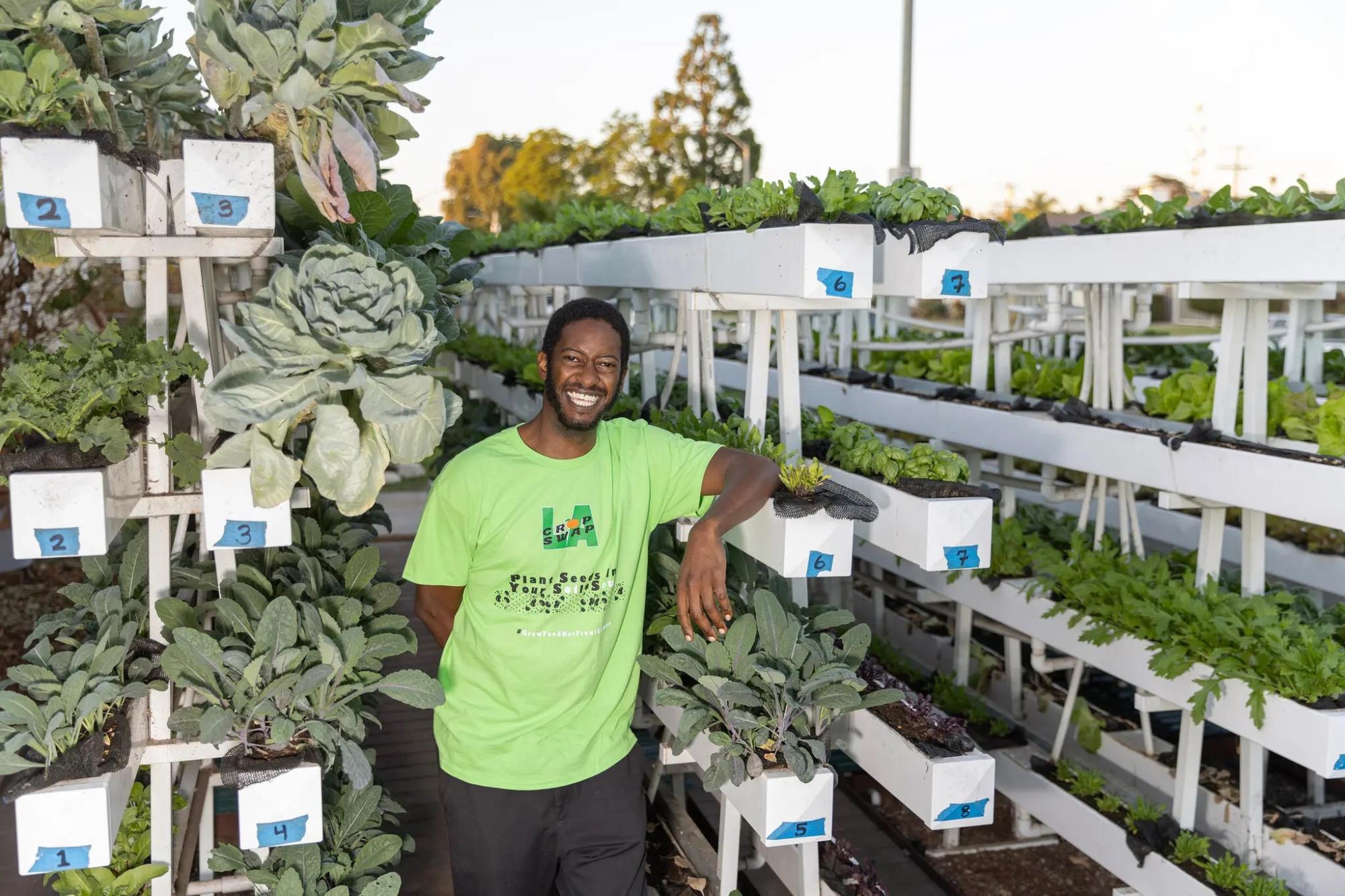
Tangles of grapes and blackberries grow in clusters along a trellis. Leafy rows of basil, sweet potatoes and mesclun spring from raised garden troughs. Most striking are corridors of elevated planters stacked four high, like multilevel bunk beds, filled with kale, cabbage, arugula, various lettuces, eggplants, tatsoi and collard greens. Run by a gardening wizard named Jamiah Hargins, this wee farm in the front yard of his bungalow provides fresh produce for 45 nearby families, all while using a tiny fraction of the water required by a lawn. At just 2,500 square feet, this farm forms the heart of Mr. Hargins's nonprofit, Crop Swap LA, which transforms yards and unused spaces into microfarms. It runs three front yard farms that provide organic fruits and vegetables each week to 80 families, all living in a one-mile radius, and often with food insecurity. Rooted in the empowering idea that people can grow their own food, Crop Swap LA has caught on, with a wait list of 300 residents wanting to convert their yards into microfarms. The mini farms bring environmental benefits, thanks to irrigation and containment systems that capture and recycle rain. That allows the farms to produce thousands of pounds of food without using much water. "Some people pay $100 a month on their water because they're watering grass, but they don't get to eat anything, no one gets any benefit from it," Mr. Hargins said. "I can't think of a more generous gift to give to the community than to grow delicious, naturally organic food for the direct community," [says Crop Swap LA subscriber] Katherine Wong. "This is one of the noblest things anyone is doing today."
Latest
Latest News
Each news summary is created according to strict standards. Here's how we do it.
Each summary is created using a consistent editorial procedure. The target length is approximately 16 lines of 11-point Arial text in a 650-pixel-wide column. Up to 25% of a summary may be set in bold to emphasize the most important ideas. Summaries are composed of verbatim excerpts presented in the same sequence as they appear in the original news source, with very minor editorial additions. Where material has been omitted between excerpts, the omission is indicated with ellipses (...). Any words added by an editor for clarity or context appear in [brackets]. Our original news editor was Fred Burks. Tod Fletcher edited most summaries from 2007 through 2014, and Mark Bailey has served as news editor since 2014.