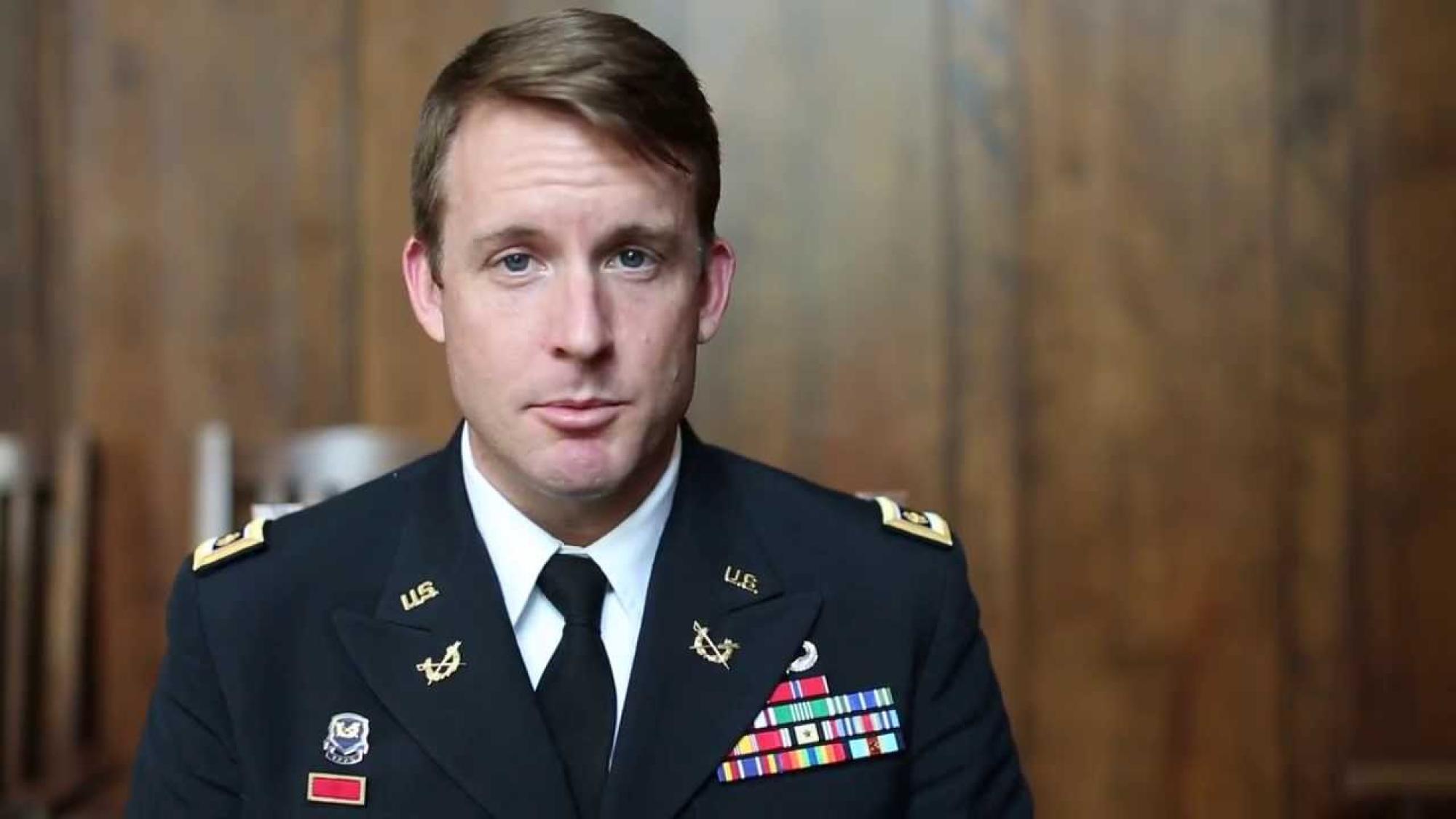
Khalid Sheikh Mohammed [is] facing a military commission at Guantanamo Bay and potentially the death penalty. He was captured in 2003 but his case still hasn't gone to trial. Last week, Maj. Jason Wright one of the lawyers defending Mohammed resigned from the Army. He has accused the U.S. government of abhorrent leadership" on human rights and due process guarantees and says it is crafting a "show trial." For nearly three years, he served on Mohammed's defense team. Wright formally resigned on Aug. 26. Wright [says] that it's hard to gain any client's trust, but it was especially hard with Mohammed. His former client is one of six "high-value detainees" being prosecuted at Guantanamo for offenses that could carry the death penalty. "All six of these men have been tortured by the U.S. government," he says. Wright says Mohammed in particular has faced a level of torture "beyond comprehension." He says his client was waterboarded by the CIA 183 times and subjected to over a week of sleep deprivation; there were threats that his family would be killed. "And those are just the declassified facts that I'm able to actually speak about," Wright says. Wright wasn't allowed to discuss too many details of the detainee abuse in court. "The CIA tortured these men. They've gone to extraordinary lengths to try to keep that completely hidden from public view," Wright says. "So the statute that Congress passed has a number of protections to ensure that no information about the U.S. torture program will ever come out."
Latest
Latest News
Each news summary is created according to strict standards. Here's how we do it.
Each summary is created using a consistent editorial procedure. The target length is approximately 16 lines of 11-point Arial text in a 650-pixel-wide column. Up to 25% of a summary may be set in bold to emphasize the most important ideas. Summaries are composed of verbatim excerpts presented in the same sequence as they appear in the original news source, with very minor editorial additions. Where material has been omitted between excerpts, the omission is indicated with ellipses (...). Any words added by an editor for clarity or context appear in [brackets]. Our original news editor was Fred Burks. Tod Fletcher edited most summaries from 2007 through 2014, and Mark Bailey has served as news editor since 2014.