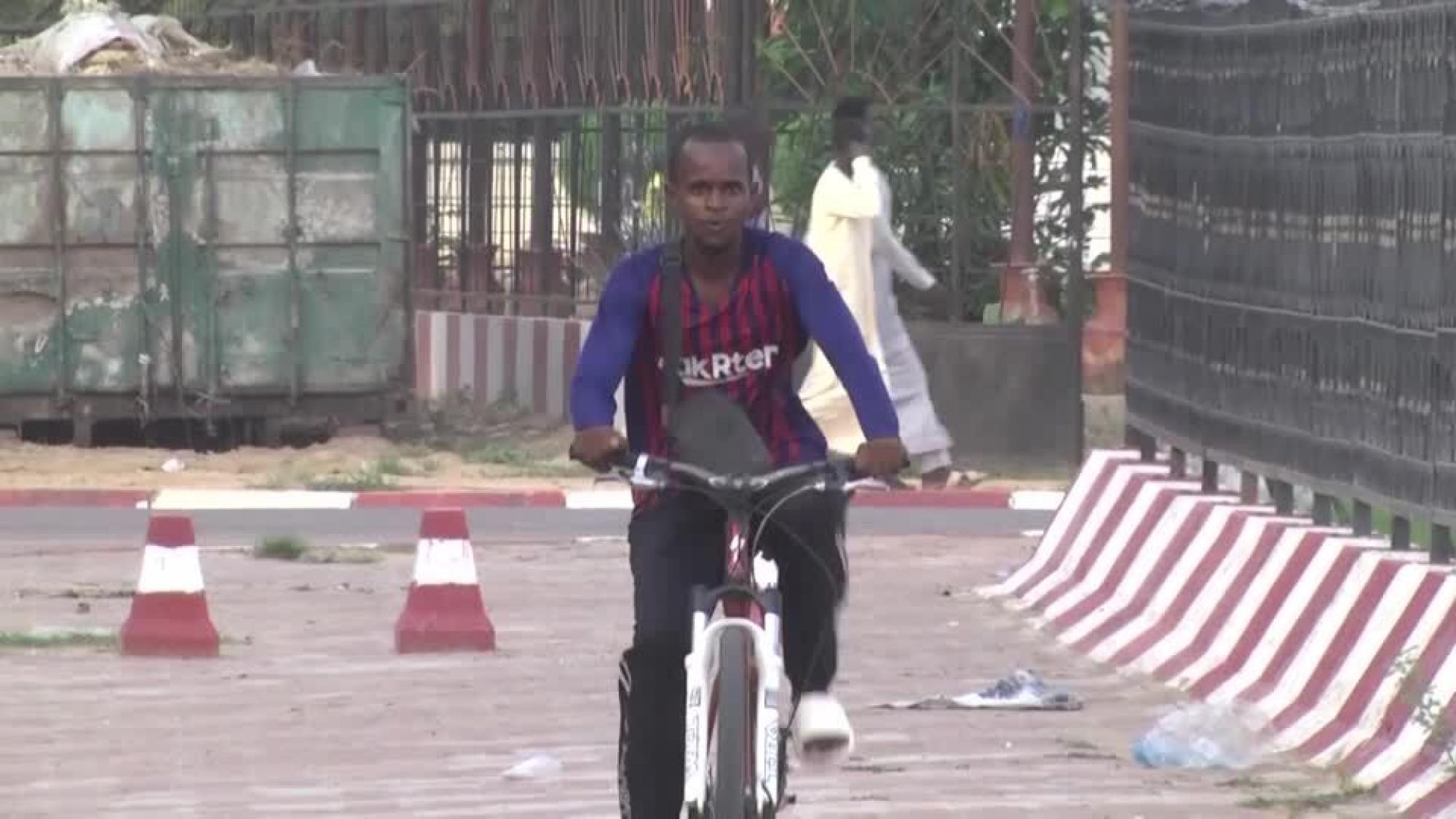
Our moms and dads used to tell us about their mile-long walk to school. But if we're talking about peda-powered travel to school, this man has set a new standard. Leaving his home in Conakry, Guinea, on a bike, Mamadou Safayou Barry traveled across the whole of West Africa and the Sahara Desert's road network2,500 miles"and across 5 countries in the mere hopes he'd be accepted into an Egyptian university. Along the way, the husband and father of one crossed Benin, southern Mali, Togo, and Chad, as well as some of the most bandit-filled areas on Earth, including parts of Burkina Faso and Niger. He was detained without cause or charge on three separate occasions, twice in Burkina Faso and once in Togo. It was in Chad, nearly four months after he left home, that he caught an auspicious wind. A local journalist reported on his efforts which led to a local philanthropist getting the man a flight to Cairo. Once there, the prestigious Al-Azhar University offered him a full scholarship, first for Islamic studies, then for engineering. Will Smith heard about Barry's successful voyage, and gave a surprise congratulations to the man. He video-called the Guinean in Cairo to gift him a new bicycle and a laptop for his studies. "When I saw him, I was confused in my head, because I had seen that man before," Barry told the BBC from Cairo. "Then I remember"it's Will Smith! Wow ... I used to watch his films. I was sat on a chair in front of Will Smith!"
Latest
Latest News
Each news summary is created according to strict standards. Here's how we do it.
Each summary is created using a consistent editorial procedure. The target length is approximately 16 lines of 11-point Arial text in a 650-pixel-wide column. Up to 25% of a summary may be set in bold to emphasize the most important ideas. Summaries are composed of verbatim excerpts presented in the same sequence as they appear in the original news source, with very minor editorial additions. Where material has been omitted between excerpts, the omission is indicated with ellipses (...). Any words added by an editor for clarity or context appear in [brackets]. Our original news editor was Fred Burks. Tod Fletcher edited most summaries from 2007 through 2014, and Mark Bailey has served as news editor since 2014.