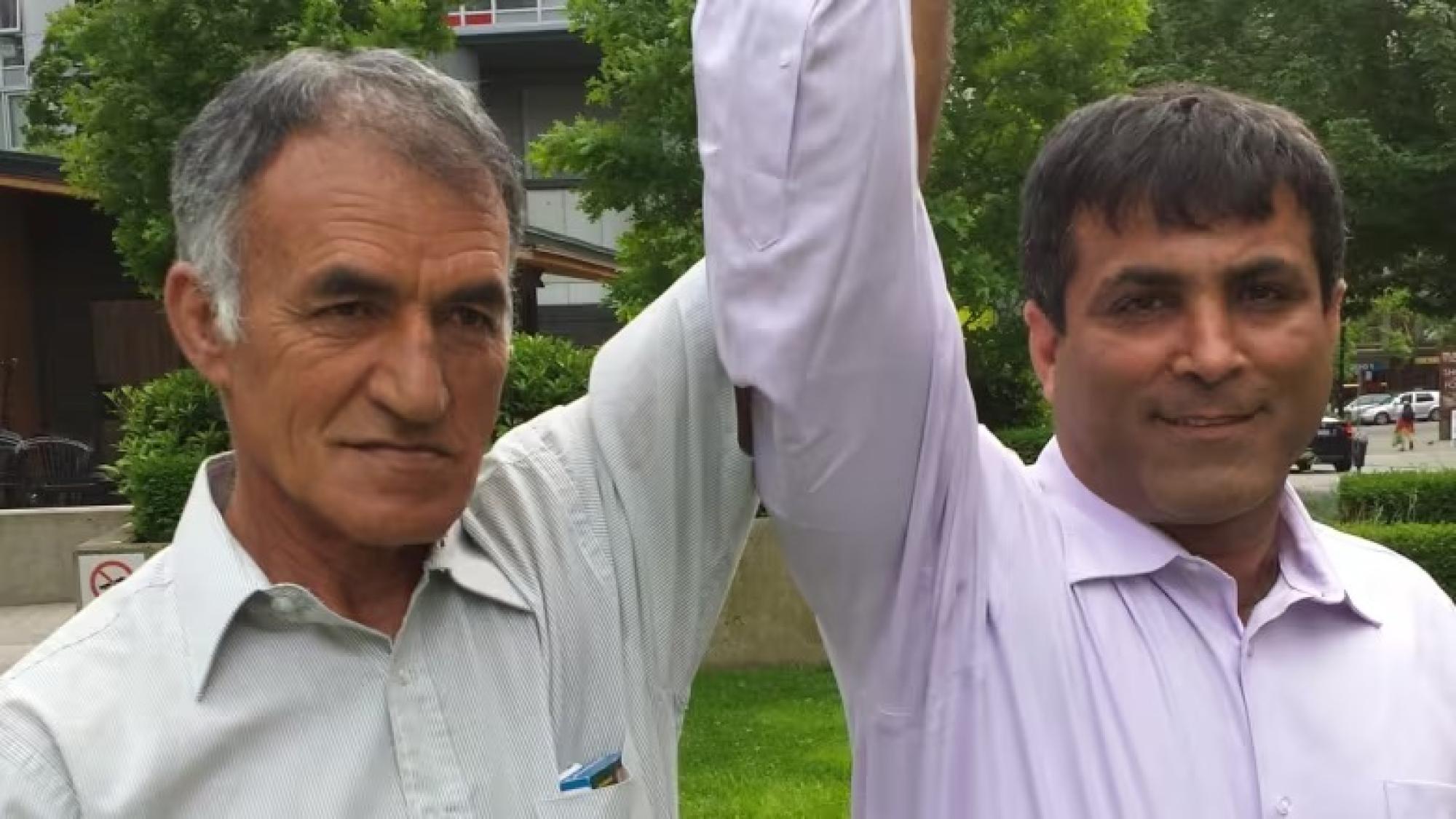
The story of two enemies cuts through the darkness. It begins on a battlefield in the Iran-Iraq war, and ends 20 years later in a waiting room in Vancouver. The Iran-Iraq war began in 1980, and ended eight years later. It was the longest conventional war of the 20th century, claiming at least a million casualties. Najah Aboud was nearly one of them. Najah was severely wounded. He crawled off to a bunker, where he saw corpses from both sides and prepared himself to die. Zahed Haftlang ... was assigned as a medic. After the Iranians recaptured Khorramshahr in May 1982, Zahed was ordered to go into the bunkers and treat wounded countrymen. It was then that he ... spotted Najah near the back. Both men were suspicious of each other. Zahed thought Najah's body might be booby-trapped. Najah thought Zahed might kill him. Then Zahed reached into Najah's breast pocket and pulled out a photograph. It showed Najah, with a beautiful woman, and infant son. It was at that very moment that Zahed decided to save Najah's life, even though it meant risking his own. Najah was taken to a prisoner of war camp, where he'd remain in unspeakable conditions for the next 17 years. While reading magazines in [a Vancouver] waiting room, Zahed noticed the door open as another man entered the room. The two men erupted into shouts, hugs, kisses and tears. Their spectacular reunion happened two decades years after the battle of Khorramshahr and on the other side of the world. Najah is like my family … he really is my angel, because he gave me life. After he got a new chance at life, he gave me a new chance at life. He is the dearest and most precious thing in the entire world to me."
Latest
Latest News
Each news summary is created according to strict standards. Here's how we do it.
Each summary is created using a consistent editorial procedure. The target length is approximately 16 lines of 11-point Arial text in a 650-pixel-wide column. Up to 25% of a summary may be set in bold to emphasize the most important ideas. Summaries are composed of verbatim excerpts presented in the same sequence as they appear in the original news source, with very minor editorial additions. Where material has been omitted between excerpts, the omission is indicated with ellipses (...). Any words added by an editor for clarity or context appear in [brackets]. Our original news editor was Fred Burks. Tod Fletcher edited most summaries from 2007 through 2014, and Mark Bailey has served as news editor since 2014.