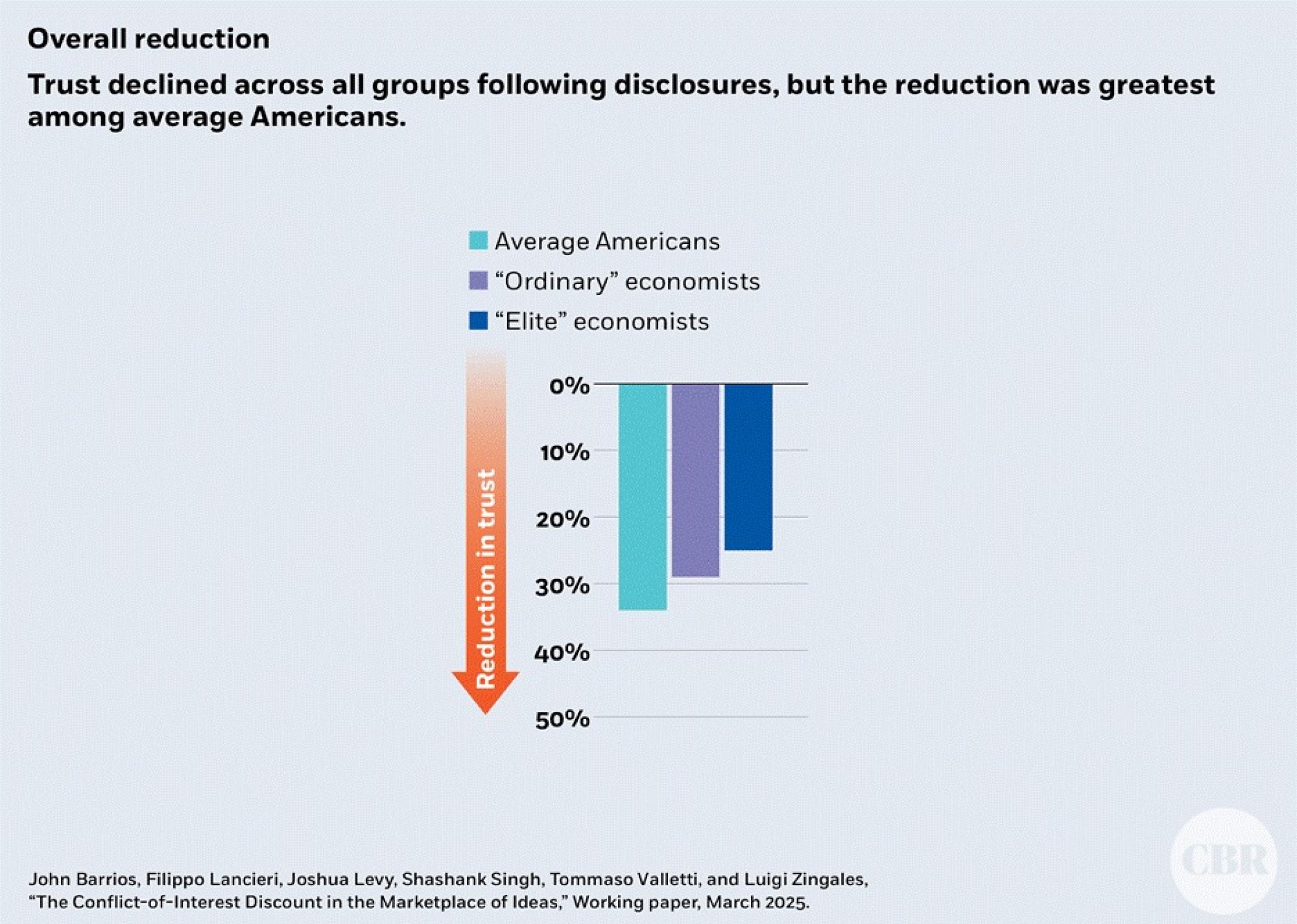
Trust in academic research is crucial. This trust, however, could be affected by the presence of conflicts of interest (CoIs), situations where a specific interest of the researcher could compromise the researcher's impartiality. Academic research in fields such as economics, medicine, and many others is becoming more costly and often depends on funding or access to databases controlled by private parties. To what extent do these relationships undermine trust in research? In our new NBER working paper, we address this ... by examining how different types of CoIs shape perceptions of the trustworthiness of economic research. Trust in the results declined across all groups (on average by 30%) following the disclosure of a CoI, despite the research being peer-reviewed and published in a prestigious academic journal. This decline was moderated by expertise, with average Americans experiencing greater declines in trust than "elite" economists (who publish in the top journals). Nonetheless, even elite economists experienced a drop in trust. Financial incentives (such as funding) were not the sole or the most significant factor influencing trust. Instead, privileged access to data had the most pronounced effect. When research utilized private data aligned with the interests of the data provider, trust in the results decreased by over 20%. Trust dropped by approximately 50% if the data provider retained review rights over the research outcomes.
Latest
Latest News
Each news summary is created according to strict standards. Here's how we do it.
Each summary is created using a consistent editorial procedure. The target length is approximately 16 lines of 11-point Arial text in a 650-pixel-wide column. Up to 25% of a summary may be set in bold to emphasize the most important ideas. Summaries are composed of verbatim excerpts presented in the same sequence as they appear in the original news source, with very minor editorial additions. Where material has been omitted between excerpts, the omission is indicated with ellipses (...). Any words added by an editor for clarity or context appear in [brackets]. Our original news editor was Fred Burks. Tod Fletcher edited most summaries from 2007 through 2014, and Mark Bailey has served as news editor since 2014.