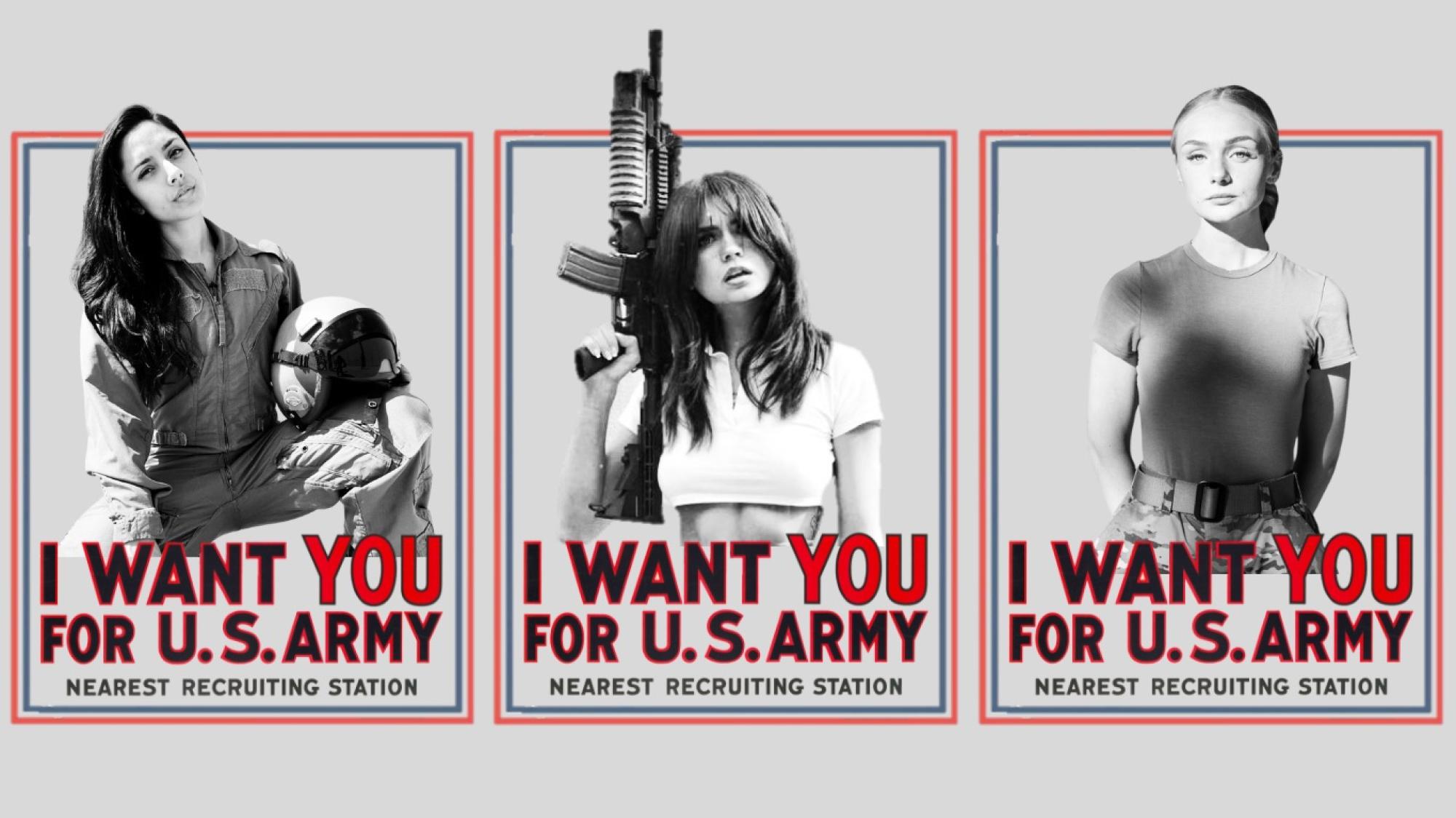
Amid a crisis in recruitment, the U.S. military has found a new way of convincing a war-weary Generation Z to enlist: thirst traps. Chief among these attractive young women in uniform posting sexually suggestive content alongside subtle ... calls to join up is Hailey Lujan. In between the thirst traps and memes, the 21-year-old makes content extolling the fun of Army life to her 731,000 TikTok followers. Lujan is a psychological operations specialist with the Army. Her [job] is to convince, persuade and propagandize in creative new ways. The Army recruitment website description of the role sounds eerily similar to her own content. "As a Psychological Operations Specialist, you'll be an expert at persuasion," it reads, adding: "You'll assess and develop the information needed to influence and engage specific audiences. You'll broadcast important information through various mediums and assist U.S. and foreign governments, militaries, and civilian populations." Lujan is far from the only serviceperson on military TikTok (#MilTok) promoting military life, however. Juliana Keding " a military policewoman with over 900,000 followers " regularly combines thirst traps with videos about Army life. TikTok is not the only battleground for young people's minds, however. In the last year, a significant portion of the Biden administration's record-breaking $857 billion defense budget went on advertising. The Army in particular has spent large sums of money collaborating with some of YouTube's biggest stars.
Latest
Latest News
Each news summary is created according to strict standards. Here's how we do it.
Each summary is created using a consistent editorial procedure. The target length is approximately 16 lines of 11-point Arial text in a 650-pixel-wide column. Up to 25% of a summary may be set in bold to emphasize the most important ideas. Summaries are composed of verbatim excerpts presented in the same sequence as they appear in the original news source, with very minor editorial additions. Where material has been omitted between excerpts, the omission is indicated with ellipses (...). Any words added by an editor for clarity or context appear in [brackets]. Our original news editor was Fred Burks. Tod Fletcher edited most summaries from 2007 through 2014, and Mark Bailey has served as news editor since 2014.