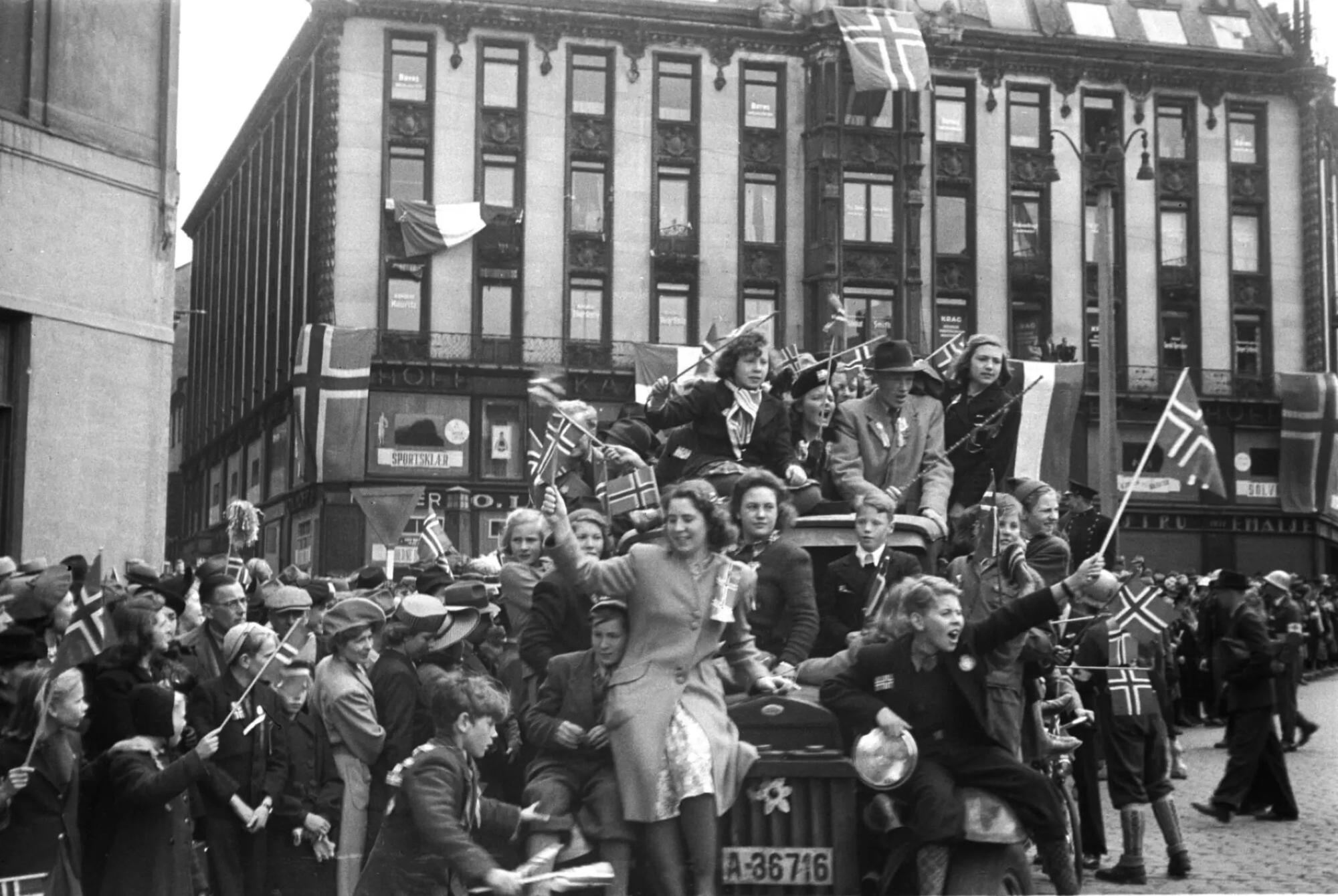
Consider the Norwegians, who experienced extreme polarization at the same time as the Germans did. The Norwegian economic elite organized against striking laborers and produced a polarized country that included both Nazi Brown Shirts goose-stepping in the streets and Norwegian Communists agitating to overthrow capitalism. The politician Vidkun Quisling, an admirer of Hitler, organized in 1933 a Nazi party, and its uniformed paramilitary wing sought to provoke violent clashes with leftist students. Quisling reportedly held discussions with military officers about a possible coup d'etat.The stage was set for a fascist "solution." Instead, Norway broke through to a social democracy. Progressive movements of farmers and workers, joined by middle-class allies, launched nonviolent direct action campaigns that made the country increasingly ungovernable by the economic elite. The majority forced the economic elite to take a back seat and invented a new economy with arguably the most equality, individual freedom, and shared abundance the developed world has known. The key to avoiding fascism? An organized left with a strong vision and broad support. Grassroots movements built a large infrastructure of co-ops that showed their competency and positivity when the government and political conservatives lacked both. Additionally, activists reached beyond the choir, inviting participation from people who initially feared making large changes. Norwegians also ... chose nonviolent direct action campaigns consisting of strikes, boycotts, demonstrations, and occupations. Norway therefore lacked the dangerous chaos that in Germany led the middle classes to accept the elite's choice of Hitler to bring "law and order."
Latest
Latest News
Each news summary is created according to strict standards. Here's how we do it.
Each summary is created using a consistent editorial procedure. The target length is approximately 16 lines of 11-point Arial text in a 650-pixel-wide column. Up to 25% of a summary may be set in bold to emphasize the most important ideas. Summaries are composed of verbatim excerpts presented in the same sequence as they appear in the original news source, with very minor editorial additions. Where material has been omitted between excerpts, the omission is indicated with ellipses (...). Any words added by an editor for clarity or context appear in [brackets]. Our original news editor was Fred Burks. Tod Fletcher edited most summaries from 2007 through 2014, and Mark Bailey has served as news editor since 2014.