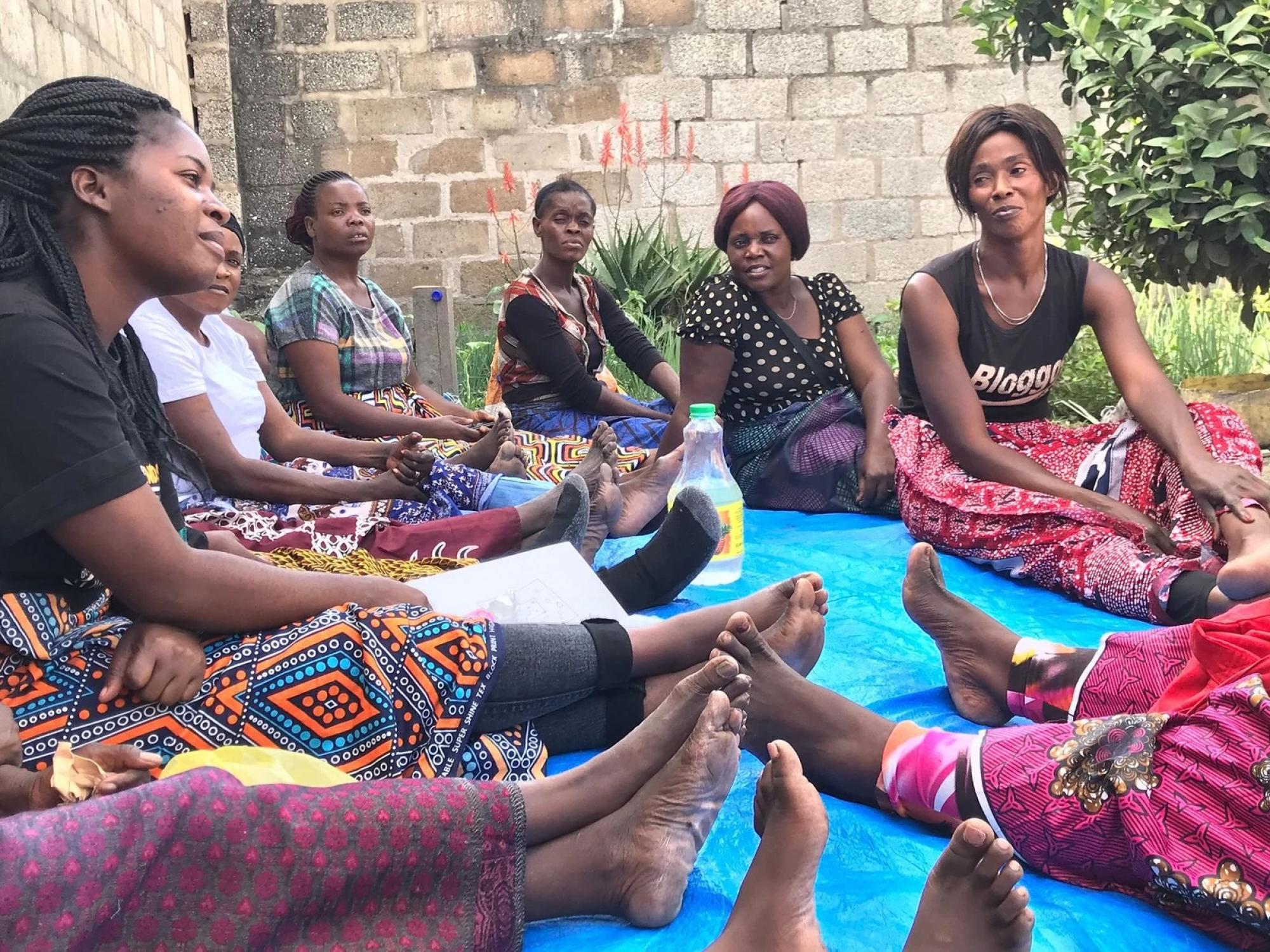
Rhoda Phiri was having a hard time sleeping. She found it difficult to mingle with people in her community and at church. Even basic chores were hard. She was, she says, in a "dark corner." Then one day in 2020, a couple of women knocked on the door of her home in Zambia. The women were with StrongMinds, an international nonprofit that provides support for depression, particularly among women and adolescents. She accepted the women's invitation to join a group therapy program, held under a tree in an area near her home, and as she learned about depression, she recognized the signs in herself. "All the symptoms they were talking about, it's like they were talking about me," Phiri says. "It's like they knew what I was going through." Instead of relying on mental health professionals, StrongMinds offers group therapy facilitated by trained community members " often clients who have completed the treatment themselves, like Phiri. This group therapy model has proven to be an effective way to treat depression. Since the organization launched in 2013, half a million people have gone through the treatment program. Three-quarters of participants screened as being free of depression symptoms two weeks after completing it. "What we've learned in 11 years is that depression treatment can be, what we call, democratized," says StrongMinds founder ... Sean Mayberry. "You can take it out of the hands of doctors and nurses and give it to the community itself."
Latest
Latest News
Each news summary is created according to strict standards. Here's how we do it.
Each summary is created using a consistent editorial procedure. The target length is approximately 16 lines of 11-point Arial text in a 650-pixel-wide column. Up to 25% of a summary may be set in bold to emphasize the most important ideas. Summaries are composed of verbatim excerpts presented in the same sequence as they appear in the original news source, with very minor editorial additions. Where material has been omitted between excerpts, the omission is indicated with ellipses (...). Any words added by an editor for clarity or context appear in [brackets]. Our original news editor was Fred Burks. Tod Fletcher edited most summaries from 2007 through 2014, and Mark Bailey has served as news editor since 2014.