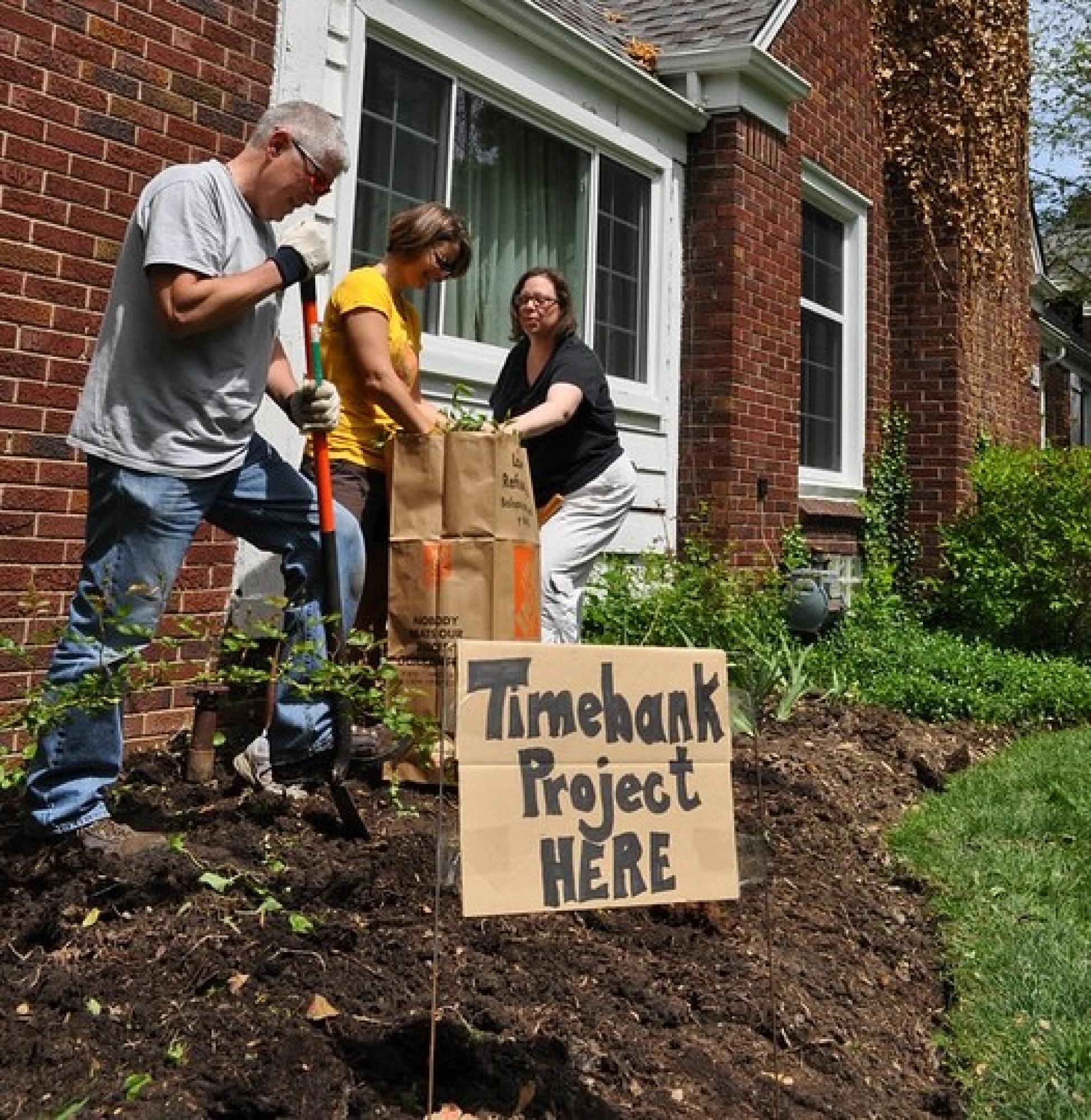
Time banks offer an alternative, powered by 21st-century technology, to the U.S. dollar. About 70 exist across the country some with a few members, others with hundreds " to give value to work that members say often goes uncompensated in a traditional market economy. The Silver Spring Time Bank formed in 2015 and has about 300 members, said co-founder Mary Murphy. Last year, she said, 1,000 hours were exchanged for basic home repairs, dog walking, cooking and tailoring, among other services, without the exchange of money. "You get to save that money that you would have spent," she said. "You get to meet somebody else in your community and get to know that person. That's a bonus." Edgar S. Cahn, an 84-year-old law professor who had worked on civil rights and anti-poverty legislation in president Lyndon B. Johnson's Justice Department, suffered a heart attack in 1980. He said doctors gave him two years to live, with "maybe two good hours a day. I thought: What do I do with two good hours a day?" he said, having beaten doctors' expectations by nearly four decades. "I have to teach people to value themselves ... We're all trained as human service professionals: 'How can I help you?'' " he said. "None of us is trained to say: 'How can you make a difference?' I need you as much as you need me." Cahn became a proselytizer for what he called the "time dollar" " a currency in which an hour of work is worth an hour of work, whether it's performed by a maid, a mechanic or a mechanical engineer. In 1995, he founded the D.C. nonprofit TimeBanks USA, which developed the software used by many time banks around the world. Time banks can serve as small-business incubators and a way for seniors to remain active after retirement.
Latest
Latest News
Each news summary is created according to strict standards. Here's how we do it.
Each summary is created using a consistent editorial procedure. The target length is approximately 16 lines of 11-point Arial text in a 650-pixel-wide column. Up to 25% of a summary may be set in bold to emphasize the most important ideas. Summaries are composed of verbatim excerpts presented in the same sequence as they appear in the original news source, with very minor editorial additions. Where material has been omitted between excerpts, the omission is indicated with ellipses (...). Any words added by an editor for clarity or context appear in [brackets]. Our original news editor was Fred Burks. Tod Fletcher edited most summaries from 2007 through 2014, and Mark Bailey has served as news editor since 2014.