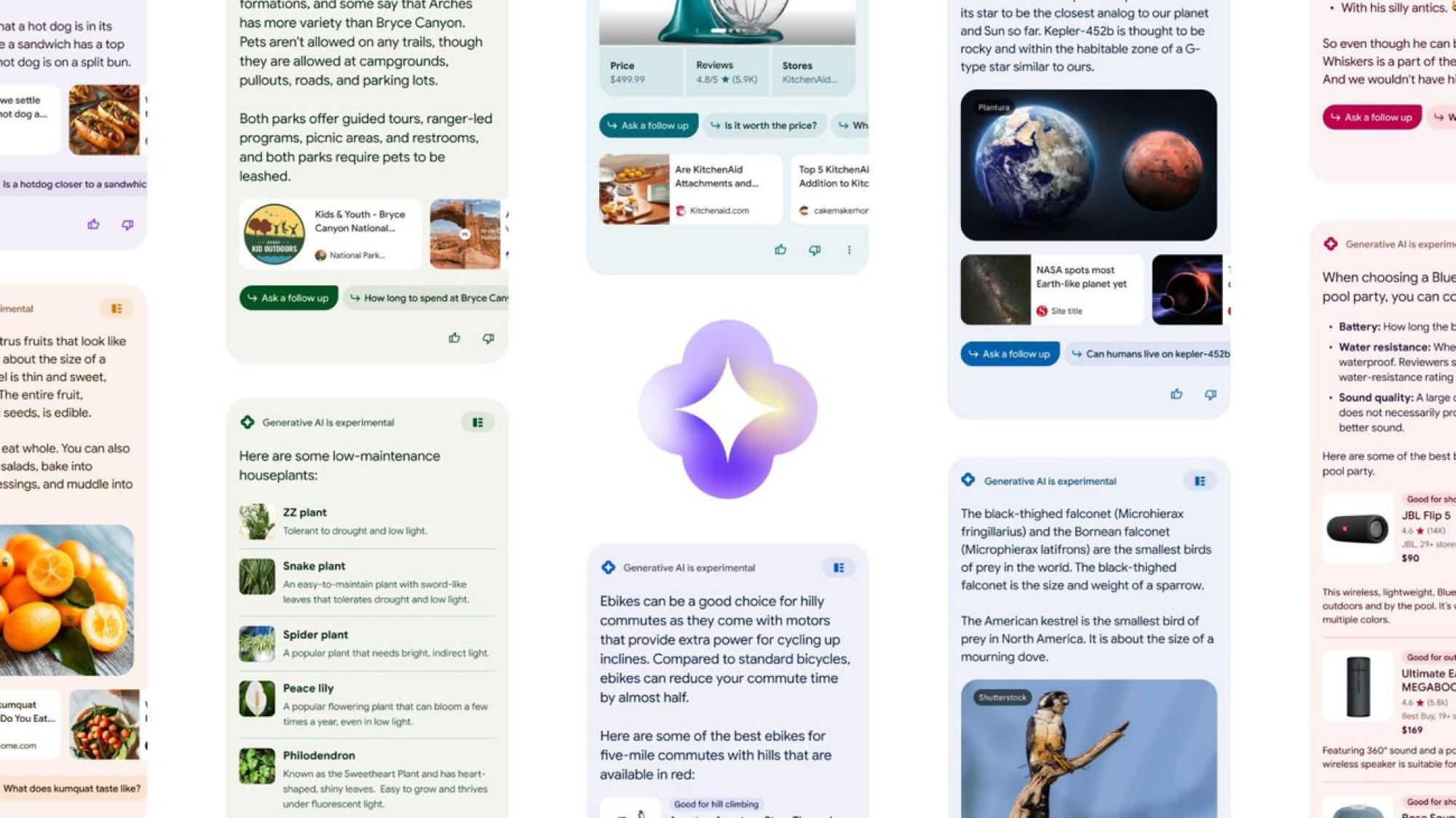
Have you heard about the new Google? They "supercharged" it with artificial intelligence. Somehow, that also made it dumber. With the regular old Google, I can ask, "What's Mark Zuckerberg's net worth?" and a reasonable answer pops up: "169.8 billion USD." Now let's ask the same question with the "experimental" new version of Google search. Its AI responds: Zuckerberg's net worth is "$46.24 per hour, or $96,169 per year. This is equivalent to $8,014 per month, $1,849 per week, and $230.6 million per day." Google acting dumb matters because its AI is headed to your searches sooner or later. The company has already been testing this new Google " dubbed Search Generative Experience, or SGE " with volunteers for nearly 11 months, and recently started showing AI answers in the main Google results even for people who have not opted in to the test. To give us answers to everything, Google's AI has to decide which sources are reliable. I'm not very confident about its judgment. Remember our bonkers result on Zuckerberg's net worth? A professional researcher " and also regular old Google " might suggest checking the billionaires list from Forbes. Google's AI answer relied on a very weird ZipRecruiter page for "Mark Zuckerberg Jobs," a thing that does not exist. The new Google can do some useful things. But as you'll see, it sometimes also makes up facts, misinterprets questions, [and] delivers out-of-date information. This test of Google's future has been going on for nearly a year, and the choices being made now will influence how billions of people get information.
Latest
Latest News
Each news summary is created according to strict standards. Here's how we do it.
Each summary is created using a consistent editorial procedure. The target length is approximately 16 lines of 11-point Arial text in a 650-pixel-wide column. Up to 25% of a summary may be set in bold to emphasize the most important ideas. Summaries are composed of verbatim excerpts presented in the same sequence as they appear in the original news source, with very minor editorial additions. Where material has been omitted between excerpts, the omission is indicated with ellipses (...). Any words added by an editor for clarity or context appear in [brackets]. Our original news editor was Fred Burks. Tod Fletcher edited most summaries from 2007 through 2014, and Mark Bailey has served as news editor since 2014.