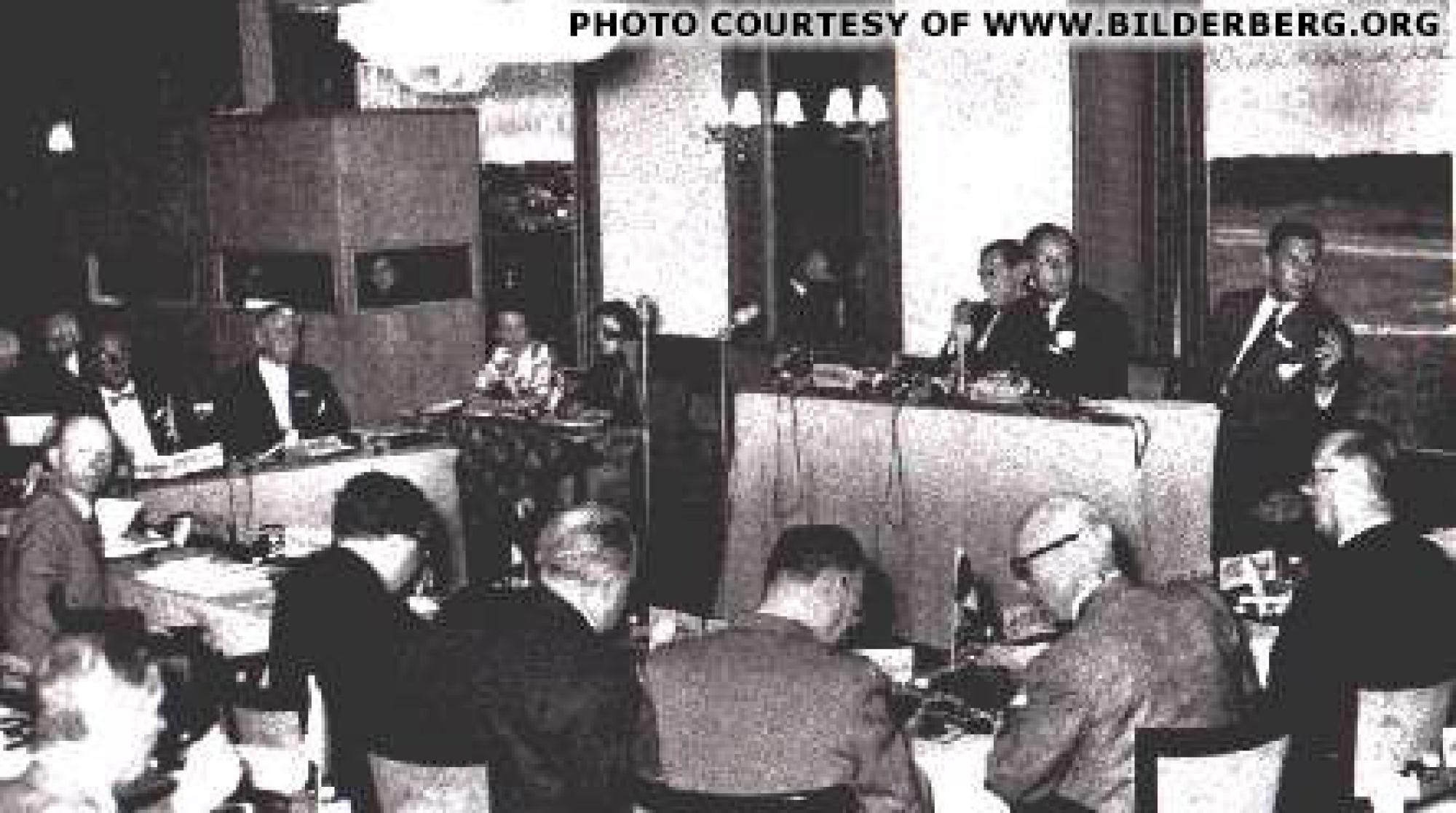
How much influence do private networks of the rich and powerful have on government policies and international relations? One group, the Bilderberg, has often attracted speculation that it forms a shadowy global government. Every year since 1954 [they have brought] together about 120 leading business people and politicians. At this year's meeting in Germany, the audience included the heads of the World Bank and European Central Bank, Chairmen or Chief Executives from Nokia, BP, Unilever, DaimlerChrysler and Pepsi ... editors from five major newspapers, members of parliament, ministers, European commissioners ... and the queen of the Netherlands. The chairman ... is 73-year-old Viscount Etienne Davignon. In an extremely rare interview, he played down the importance of Bilderberg. I don't think (we are) a global ruling class because I don't think a global ruling class exists." Will Hutton ... who attended a Bilderberg meeting in 1997, says people take part in these networks in order to influence the way the world works, to create what he calls "the international common sense". And that "common sense" is one which supports the interests of Bilderberg's main participants. For Bilderberg's critics the fact that there is almost no publicity about the annual meetings is proof that they are up to no good. Bilderberg meetings often feature future political leaders shortly before they become household names. Bill Clinton went in 1991 while still governor of Arkansas, Tony Blair was there two years later while still an opposition MP. All the recent presidents of the European Commission attended Bilderberg meetings before they were appointed. Informal and private networks like Bilderberg have helped to oil the wheels of global politics and globalisation for the past half a century.
Latest
Latest News
Each news summary is created according to strict standards. Here's how we do it.
Each summary is created using a consistent editorial procedure. The target length is approximately 16 lines of 11-point Arial text in a 650-pixel-wide column. Up to 25% of a summary may be set in bold to emphasize the most important ideas. Summaries are composed of verbatim excerpts presented in the same sequence as they appear in the original news source, with very minor editorial additions. Where material has been omitted between excerpts, the omission is indicated with ellipses (...). Any words added by an editor for clarity or context appear in [brackets]. Our original news editor was Fred Burks. Tod Fletcher edited most summaries from 2007 through 2014, and Mark Bailey has served as news editor since 2014.