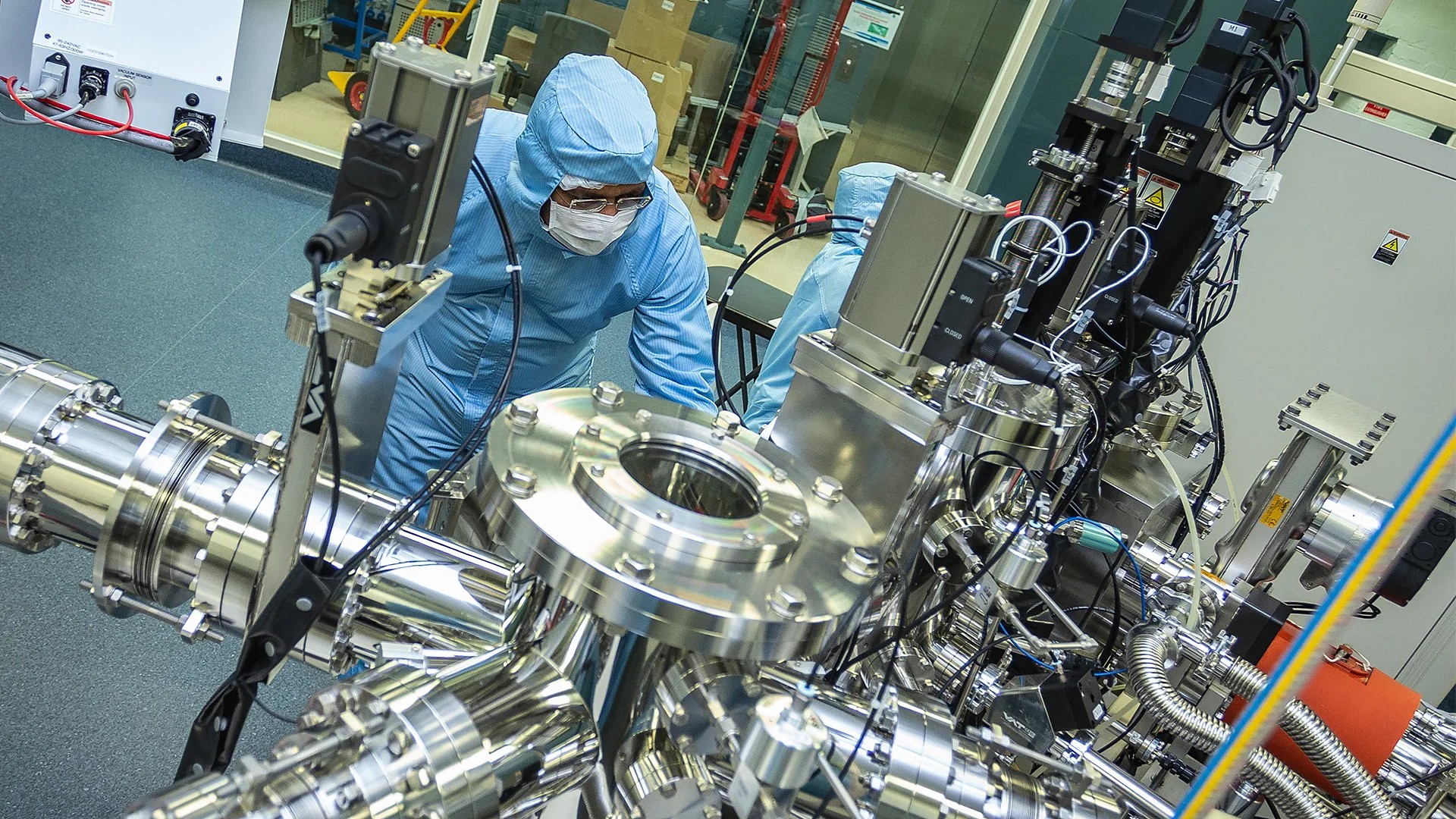
Everyone knows that the larger the battery, the longer it takes to charge – that's why it can take several hours to charge a laptop and typically all night to charge an electric vehicle. Quantum mechanics (the science of matter at atomic and subatomic scales) "sort of flips [that] on its head", says James Quach, a quantum science researcher at Csiro, Australia's national science agency. Quach is working to create a quantum battery that defies common sense by charging faster the bigger it gets. In March 2026, his team made an important breakthrough when they unveiled what they say is the world's first working quantum battery prototype. Quach's latest experiment represents a first tentative step towards a quantum battery that could one day be substituted for conventional ones. At present, the prototype battery can only hold a very small amount of energy – a few billion electron volts – for a matter of nanoseconds. To power conventional devices, it would need to store far more energy for far longer. Quach says he has already achieved this with a new design he's built, and is now working on a paper to publish the results. It uses "a hybrid structure", he says, involving quantum components to allow super-fast charging. Quantum mechanics is no stranger to mind-bending concepts, from "entangled" particles that influence each other at great distances to time that flows backwards. A milestone paper in 2015 showed that quantum entanglement means quantum batteries might charge – and discharge – more efficiently than conventional ones. "The key point is that quantum batteries are not about storing a great amount of energy, but about delivering it faster and with greater control," says [associate professor of physics at the University of Genova, Italy Dario Ferraro].
Latest
Latest News
Each news summary is created according to strict standards. Here's how we do it.
Each summary is created using a consistent editorial procedure. The target length is approximately 16 lines of 11-point Arial text in a 650-pixel-wide column. Up to 25% of a summary may be set in bold to emphasize the most important ideas. Summaries are composed of verbatim excerpts presented in the same sequence as they appear in the original news source, with very minor editorial additions. Where material has been omitted between excerpts, the omission is indicated with ellipses (...). Any words added by an editor for clarity or context appear in [brackets]. Our original news editor was Fred Burks. Tod Fletcher edited most summaries from 2007 through 2014, and Mark Bailey has served as news editor since 2014.