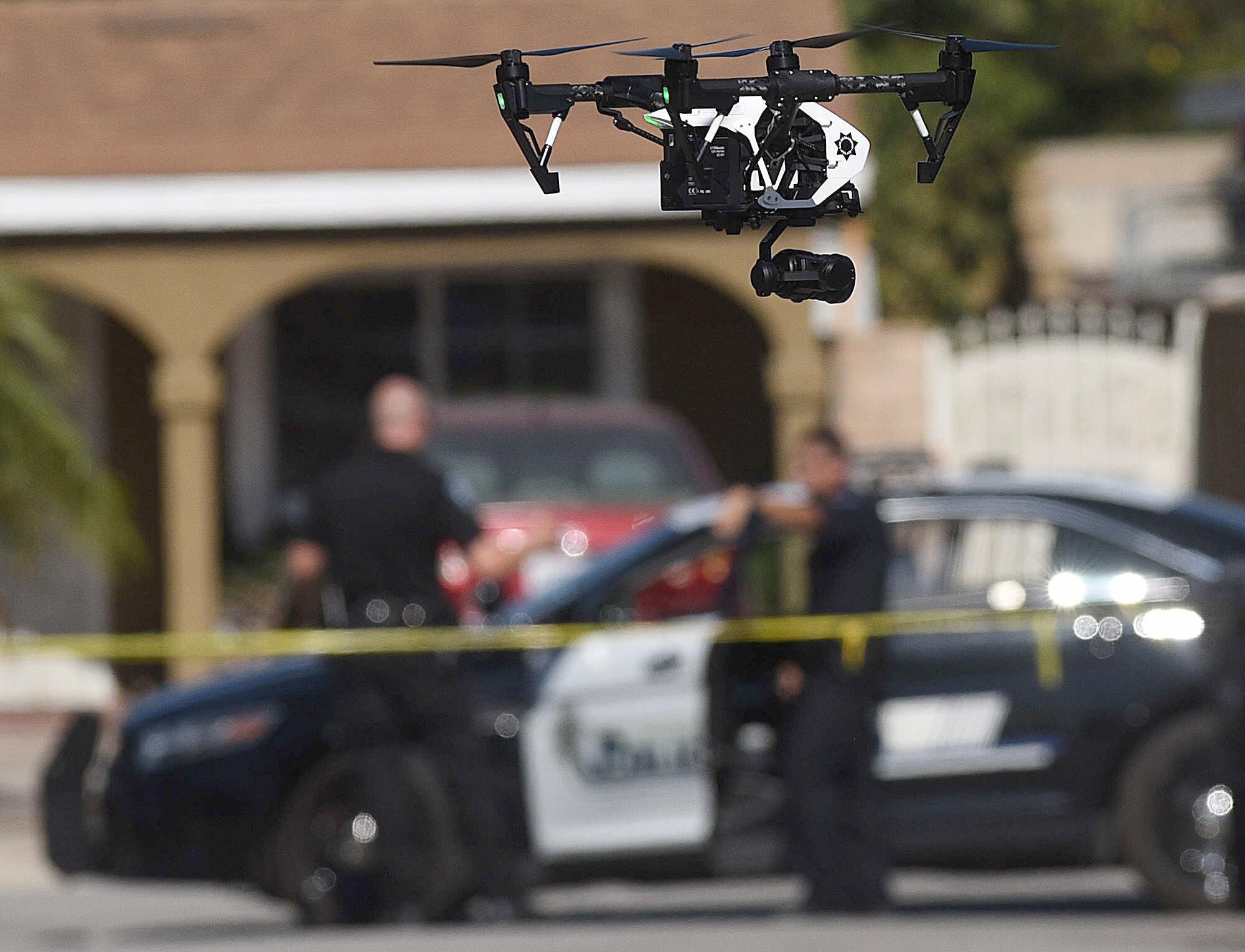
If you call 911 to report an emergency, the odds are increasing that a drone will be the first unit sent to respond. More than 1,500 departments across the country now use them, "mostly for search and rescue as well as to document crime scenes and chase suspects," according to ... MIT Technology Review. Generally, police drones don't carry weapons and are used primarily for video surveillance. It is possible for small drones to deliver chemical irritants like tear gas, however, a technology that police in Israel have used against Palestinians. In a report published on Thursday, American Civil Liberties Union Senior Policy Analyst Jay Stanley worries that these kinds of drone programs may normalize usage and "usher in an era of pervasive, suspicionless, mass aerial surveillance." He notes far more invasive turns that police drone usage could take, including warrantless surveillance of specific people, crime "hotspots" or even whole neighborhoods or cities. Stanley wonders if drone usage won't just ... "amplify the problems with the deeply broken U.S. criminal legal system." Many of the cities using drones in policing are doing so from so-called "real-time crime centers." These units function as centralized hubs to connect the various bits of surveillance and data that police collect from things like stationary cameras, drones, license plate readers and technology that listens for possible gunshots. Some centers can even integrate police body cameras and video from Ring doorbells.
Latest
Latest News
Each news summary is created according to strict standards. Here's how we do it.
Each summary is created using a consistent editorial procedure. The target length is approximately 16 lines of 11-point Arial text in a 650-pixel-wide column. Up to 25% of a summary may be set in bold to emphasize the most important ideas. Summaries are composed of verbatim excerpts presented in the same sequence as they appear in the original news source, with very minor editorial additions. Where material has been omitted between excerpts, the omission is indicated with ellipses (...). Any words added by an editor for clarity or context appear in [brackets]. Our original news editor was Fred Burks. Tod Fletcher edited most summaries from 2007 through 2014, and Mark Bailey has served as news editor since 2014.