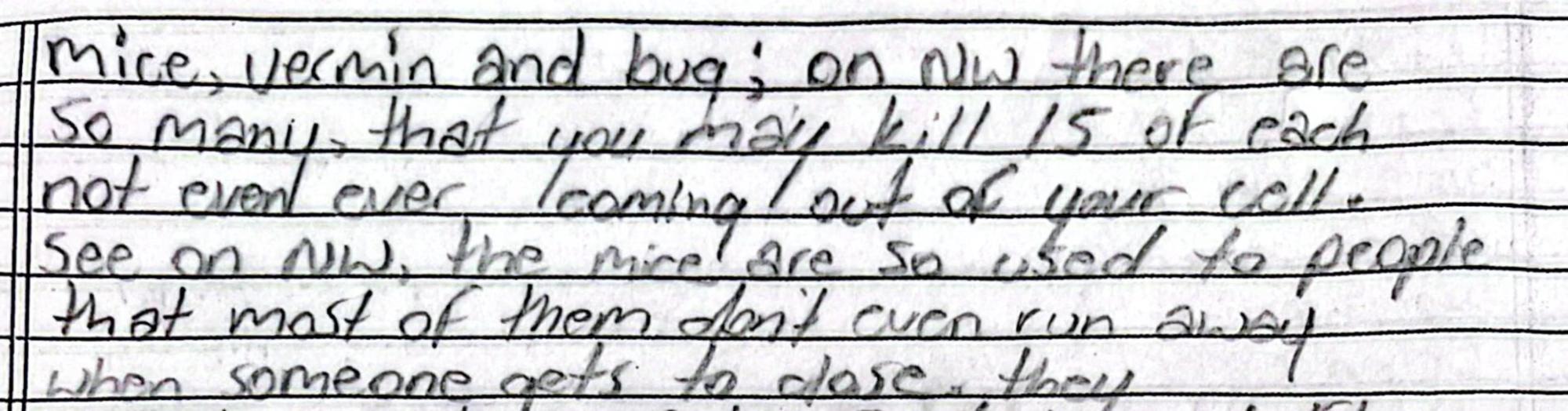
Down here in the tombs, there aren't any windows," writes Tremane Wood from inside his cell. Wood, 46, spent 17 years incarcerated in H Unit the underground cells at the state prison in the rural town of McAlester, Oklahoma, where no natural light ever reaches. According to prisoner letters seen by the Guardian and published here for the first time, H Unit " also known by the prisoners as the "tombs" " features a series of windowless cells that are built banked into the earth. The letters also tell of infestations of vermin, unsanitary conditions, and frequent instances of physical and sexual violence. The lack of sunlight is a matter of particular concern to the prisoners. Dr Sondra Crosby, an expert in torture survivors and a public health professor at Boston University and Physicians for Human Rights, calls it "a form of cruel, inhuman, and degrading treatment and torture". Crosby, who has worked with people imprisoned after 9/11 in CIA "black sites", says lack of sunlight was "used to punish people in the darkness of the prisons in Afghanistan". The letters from H Unit offer a glimpse into this sunless world. The prisoners " of whom there are currently 248 in total, according to prison authorities " write of living in squalor, and frequent violence and rape. Many are held in solitary confinement, with almost no human contact. Others stay in two-person cells, where they say violence is common because the space is not large enough for two men. "I've heard men scream and yell and seen them pulled out of cells with blood and waste running down their leg from sexual assault … maybe 5 times," [inmate Edward Sparks III] wrote. [Another prisoner] wrote that "the guards are putting chilli pepper symbols on their vest as a badge for every inmate that they are spraying with mace and the pepper ball gun."
Latest
Latest News
Each news summary is created according to strict standards. Here's how we do it.
Each summary is created using a consistent editorial procedure. The target length is approximately 16 lines of 11-point Arial text in a 650-pixel-wide column. Up to 25% of a summary may be set in bold to emphasize the most important ideas. Summaries are composed of verbatim excerpts presented in the same sequence as they appear in the original news source, with very minor editorial additions. Where material has been omitted between excerpts, the omission is indicated with ellipses (...). Any words added by an editor for clarity or context appear in [brackets]. Our original news editor was Fred Burks. Tod Fletcher edited most summaries from 2007 through 2014, and Mark Bailey has served as news editor since 2014.