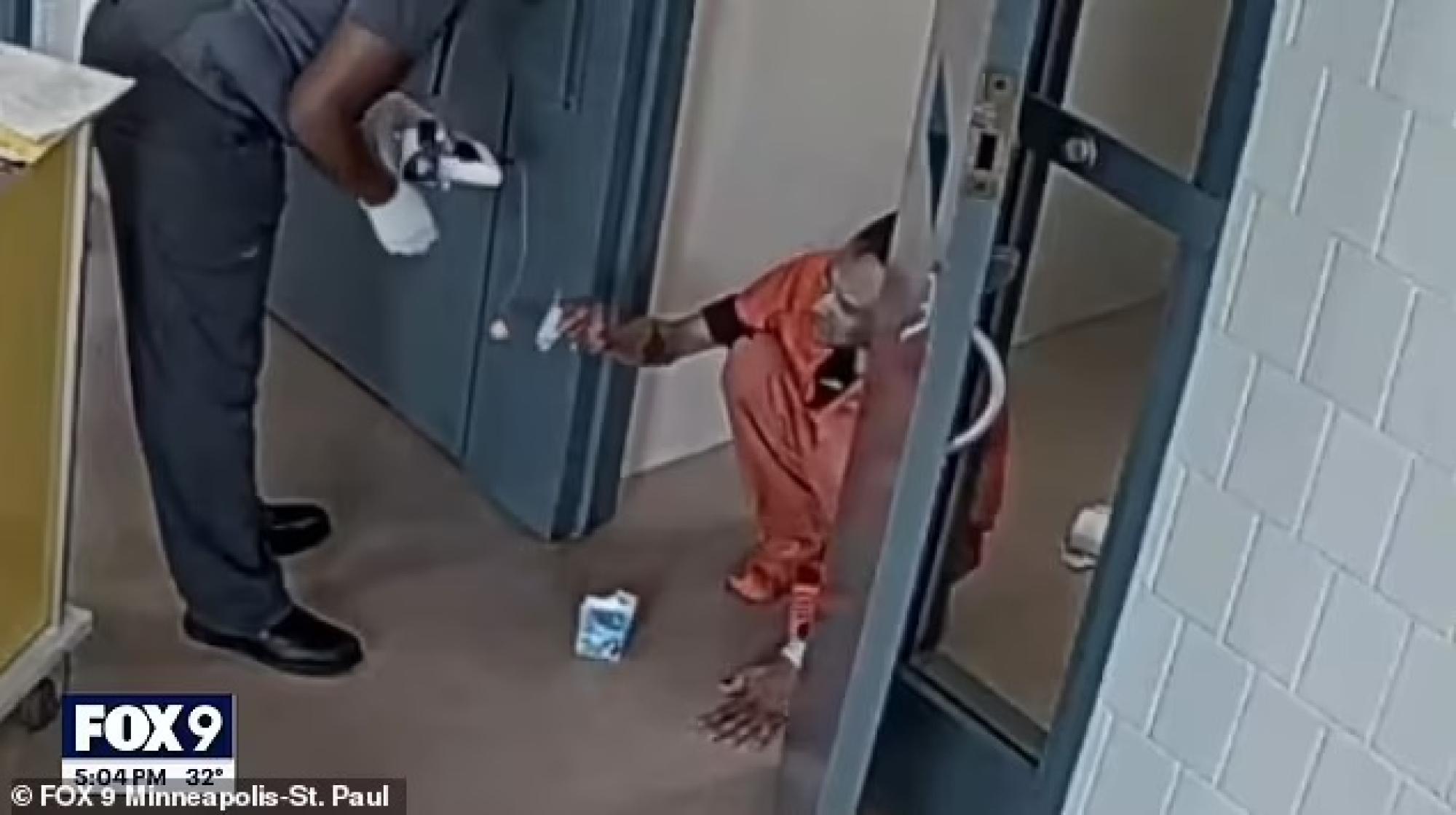
Look at the case of Lucas Bellamy. He had been arrested in Minnesota. Immediately before the arrest, he ate a bag of drugs in an effort to fool police into thinking that he didn't have any. But he immediately began feeling sick. Jail officers took him to a local hospital, where he was treated. The doctors there told the jailers to return him to the hospital if he became ill again. He began vomiting as soon as he got back to his cell. By evening he was refusing food and crawling around his cell as a guard and nurse stood and watched him. By noon the next day, he was dead on the floor. The case of Brandon Clay Dodson is even worse. Dodson was arrested on a burglary charge and was being held in the local jail in Clayton, Alabama. He told a guard that several other prisoners had been beating him, and he asked to be moved into segregated housing for his own protection. He later told the guards in solitary that he wasn't feeling well, but they ignored him. And a day after that, the 43-year-old was found dead in his bed. In a 104-page ruling, a federal judge in Louisiana ruled against the administrators of the Louisiana State Penitentiary at Angola, [highlighting] just a few of the untold number of medical horrors that prisoners suffer all the time there, including "a man denied medical attention four times during a stroke, leaving him blind and paralyzed; a man denied access to a specialist for four years while his throat cancer advanced; even a blind man denied a cane for 16 years."
Latest
Latest News
Each news summary is created according to strict standards. Here's how we do it.
Each summary is created using a consistent editorial procedure. The target length is approximately 16 lines of 11-point Arial text in a 650-pixel-wide column. Up to 25% of a summary may be set in bold to emphasize the most important ideas. Summaries are composed of verbatim excerpts presented in the same sequence as they appear in the original news source, with very minor editorial additions. Where material has been omitted between excerpts, the omission is indicated with ellipses (...). Any words added by an editor for clarity or context appear in [brackets]. Our original news editor was Fred Burks. Tod Fletcher edited most summaries from 2007 through 2014, and Mark Bailey has served as news editor since 2014.