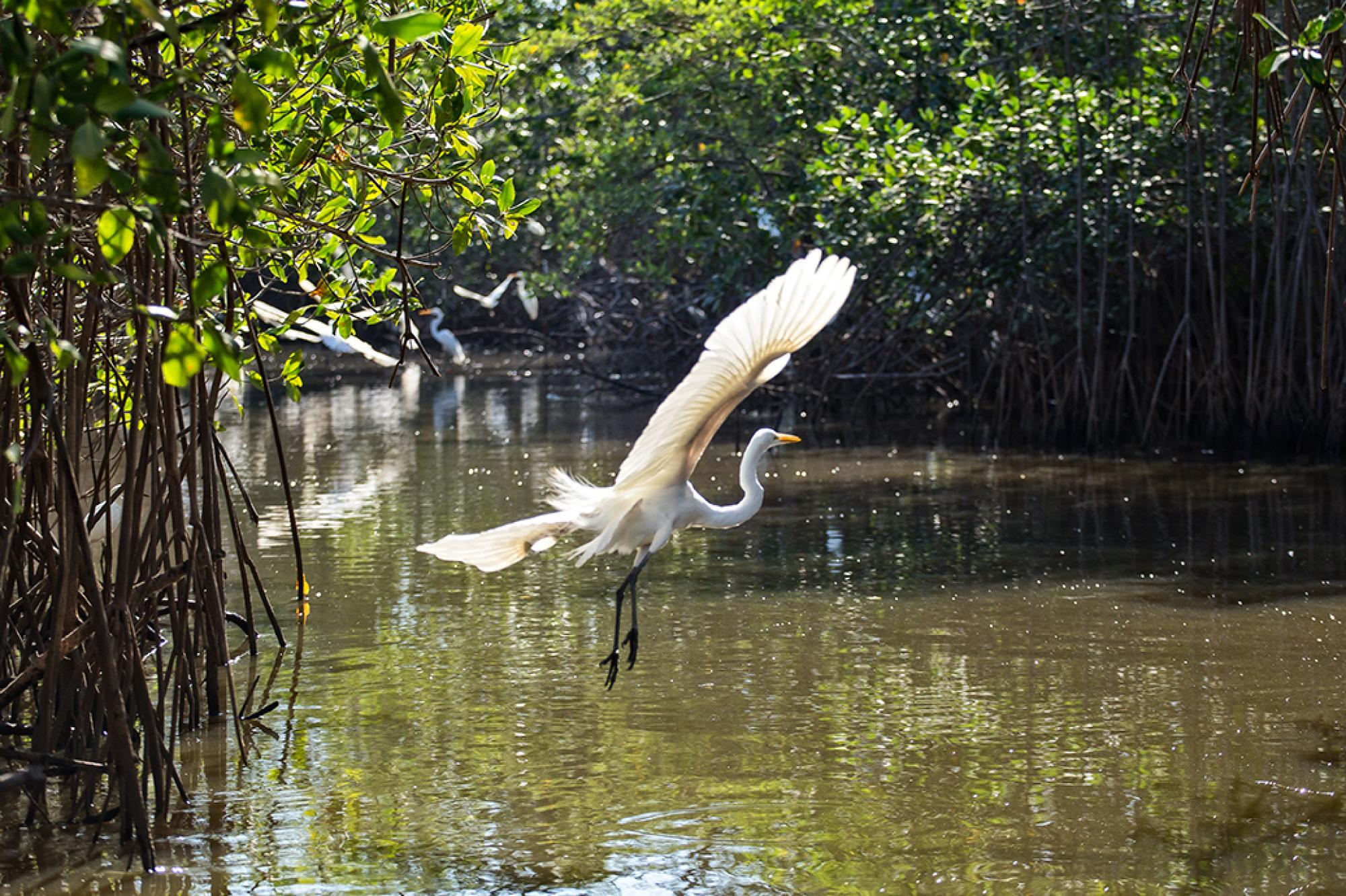
It was once Latin America's largest landfill. Now, a decade after Rio de Janeiro shut it down and redoubled efforts to recover the surrounding expanse of highly polluted swamp, crabs, snails, fish and birds are once again populating the mangrove forest. If we didn't say this used to be a landfill, people would think it's a farm. The only thing missing is cattle," jokes Elias Gouveia, an engineer with Comlurb, the city's garbage collection agency that is shepherding the plantation project. "This is an environmental lesson that we must learn from: nature is remarkable. If we don't pollute nature, it heals itself." The former landfill is located right by the 148 square miles (383 square kilometers) Guanabara Bay. Between the landfill's inauguration in 1968 and 1996, some 80 million tons of garbage were dumped in the area, polluting the bay and surrounding rivers with trash and runoff. In 1996, the city began implementing measures to limit the levels of pollution in the landfill, starting with treating some of the leachate, the toxic byproduct of mountains of rotting trash. But garbage continued to pile up until 2012, when the city finally shut it down. Mangroves are of particular interest for environmental restoration for their capacity to capture and store large amounts of planet-warming carbon dioxide, Gouveia explained. Experts say mangroves can bury even more carbon in the sediment than a tropical rainforest, making it a great tool to fight climate change. Comlurb and its private partner, Statled Brasil, have successfully recovered some 60 hectares.
Latest
Latest News
Each news summary is created according to strict standards. Here's how we do it.
Each summary is created using a consistent editorial procedure. The target length is approximately 16 lines of 11-point Arial text in a 650-pixel-wide column. Up to 25% of a summary may be set in bold to emphasize the most important ideas. Summaries are composed of verbatim excerpts presented in the same sequence as they appear in the original news source, with very minor editorial additions. Where material has been omitted between excerpts, the omission is indicated with ellipses (...). Any words added by an editor for clarity or context appear in [brackets]. Our original news editor was Fred Burks. Tod Fletcher edited most summaries from 2007 through 2014, and Mark Bailey has served as news editor since 2014.