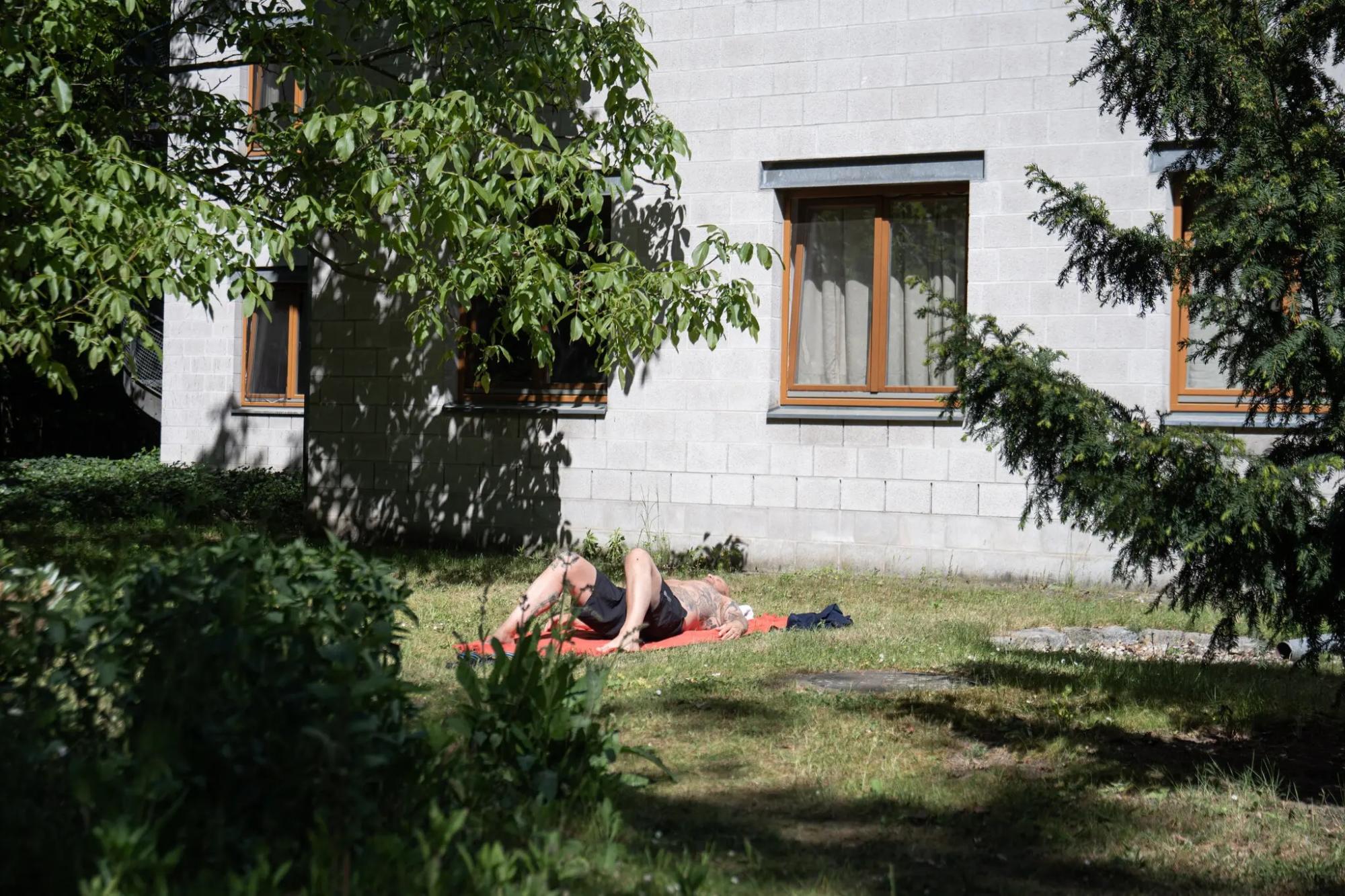
Over the course of a week, officials from Massachusetts, North Dakota and Oklahoma toured four German prisons where inmates wore street clothes, maintained their right to vote, cooked their own meals, played in soccer leagues and learned skills like animal husbandry and carpentry. One, called the Open Prison, allowed residents to come and go for work, school and errands. [German] prisons must provide single-occupancy cells at least 10 square meters in size. Many have kitchens where residents may cook their own meals. In the United States, privacy, time outside of cells and family visits are considered risky, and "over-familiarity" between correction officers and inmates is prohibited. German prisons take the opposite approach, known as dynamic security. Correction officers are expected to develop relationships with inmates and know when problems may arise. Yvonne Gade, a correction officer in a ward that houses a small number of prisoners deemed particularly dangerous, shrugged off concerns about their access to a gym with free weights. "It would be a huge potential for violence if you locked them up all the time," she said. A growing number of American states are looking abroad for ideas that can be adapted to their state prison systems. California, Arizona and Oklahoma's prison systems have shifted their focus to rehabilitation rather than punishment. In 2022, Pennsylvania opened a unit known as Little Scandinavia, and last year Missouri began a similar transformation project in four prisons. Six other states have established European-style units for younger prisoners. The efforts are still small. Prison conditions are not a priority for voters. U.S. prisons are in crisis, struggling with severe staffing shortages, crumbling facilities and frequent violence. Inmates in U.S. prisons often endure extreme temperatures, vermin-infested food and years, or even decades, in solitary confinement. High-profile cases have brought attention to prolonged shackling, fatal beatings and sexual abuse.
Latest
Latest News
Each news summary is created according to strict standards. Here's how we do it.
Each summary is created using a consistent editorial procedure. The target length is approximately 16 lines of 11-point Arial text in a 650-pixel-wide column. Up to 25% of a summary may be set in bold to emphasize the most important ideas. Summaries are composed of verbatim excerpts presented in the same sequence as they appear in the original news source, with very minor editorial additions. Where material has been omitted between excerpts, the omission is indicated with ellipses (...). Any words added by an editor for clarity or context appear in [brackets]. Our original news editor was Fred Burks. Tod Fletcher edited most summaries from 2007 through 2014, and Mark Bailey has served as news editor since 2014.