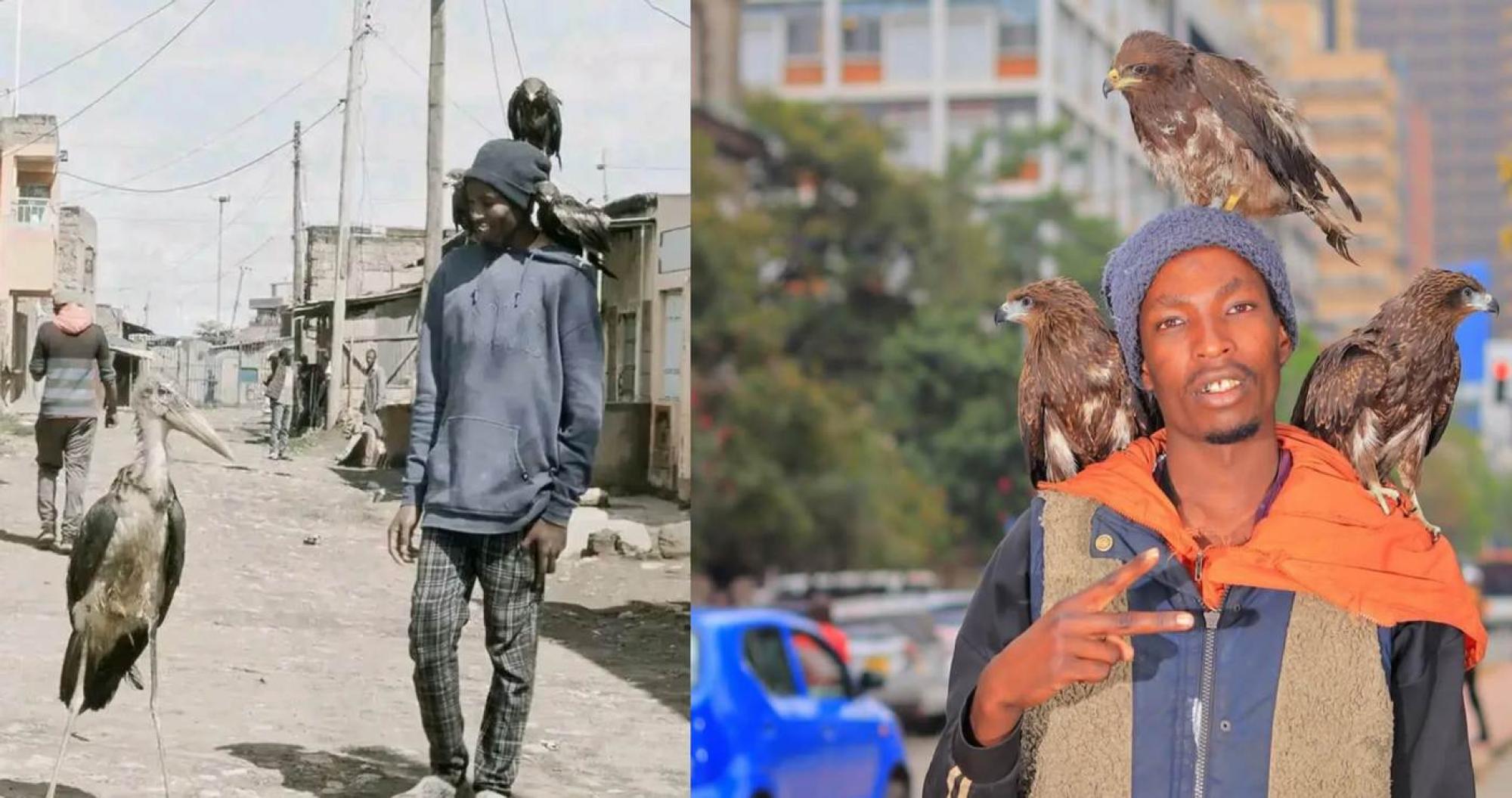
The "Nairobi Birdman" is filling gaps in Kenyan bird conservation on the streets of the country's biggest city. Seen around town with an injured kite perched on his head, it's just one of dozens that Rodgers Oloo Magutha has nursed back to health. These have included pigeons, storks, owls, and other wild birds that fall a-fowl of Nairobi's powerlines, cars, windows, or other hazards that industrialized areas pose to winged wildlife. Magutha himself is not from Nairobi, but grew up in poverty next to Kenya's Lake Nakuru National Park. A haven for bird life, Magutha used to sneak into the park to watch birds, birthing a love of nature and wildlife in the young man that lasts to this day. These quiet moments were rare in his difficult, homeless existence. He grew up without a family home, but as often as it was possible, he'd take care of birds he found that were hurt, hungry, or diseased. Today, Magutha has reliable lodgings, and he's used them to house birds which have in turn made him a local social media figure. His Instagram account has a distinctly African flavor ... but he also drops educational bombs for young fans, such as how flamingos get their pink coloration. His dream is to eventually open a proper avian rescue center; one that's legal, safe, and equipped with the facilities needed to care for them. Until then, he carries on with the help of donations, feeding the birds he saves as much as he is able to, and releasing them when or if they're able to return to the wild.
Latest
Latest News
Each news summary is created according to strict standards. Here's how we do it.
Each summary is created using a consistent editorial procedure. The target length is approximately 16 lines of 11-point Arial text in a 650-pixel-wide column. Up to 25% of a summary may be set in bold to emphasize the most important ideas. Summaries are composed of verbatim excerpts presented in the same sequence as they appear in the original news source, with very minor editorial additions. Where material has been omitted between excerpts, the omission is indicated with ellipses (...). Any words added by an editor for clarity or context appear in [brackets]. Our original news editor was Fred Burks. Tod Fletcher edited most summaries from 2007 through 2014, and Mark Bailey has served as news editor since 2014.