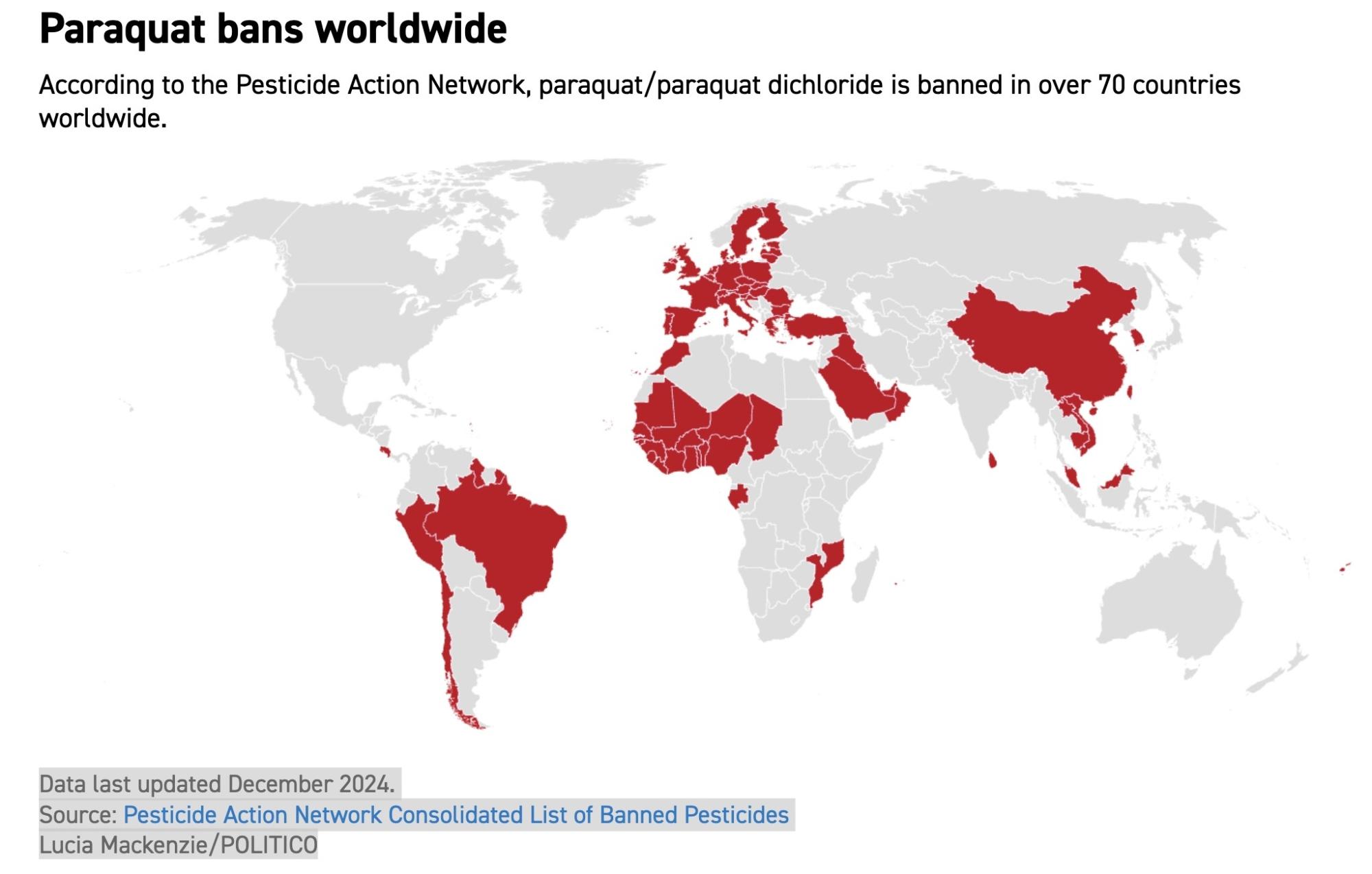
In the summer of 1982, seven heroin users were admitted to a California hospital paralyzed and mute. They were in their 20s, otherwise healthy until a synthetic drug they had manufactured in makeshift labs left them frozen inside their own bodies. Doctors quickly discovered the cause: MPTP, a neurotoxic contaminant that had destroyed a small but critical part of the brain, the substantia nigra, which controls movement. The patients had developed symptoms of late-stage Parkinson's, almost overnight. Until then, Parkinson's was thought to be a disease of aging, its origins slow and mysterious. But here was proof that a single chemical could reproduce the same devastating outcome. And more disturbing still: MPTP turned out to be chemically similar to paraquat, a widely used weedkiller that, for decades, had been sprayed on farms across the United States and Europe. Parkinson's disease has more than doubled globally over the past 20 years, and is expected to double again in the next 20. It is now one of the fastest-growing neurological disorders in the world. In a 2024 paper co-authored with U.S. neurologist Ray Dorsey, [Bas] Bloem wrote that Parkinson's is "predominantly an environmental disease" " a condition shaped less by genetics and more by prolonged exposure to toxicants like air pollution, industrial solvents and, above all, pesticides. "Parkinson's was a very rare disease," Bloem says. "Then with the ... explosion of pesticide use, rates started to climb."
Latest
Latest News
Each news summary is created according to strict standards. Here's how we do it.
Each summary is created using a consistent editorial procedure. The target length is approximately 16 lines of 11-point Arial text in a 650-pixel-wide column. Up to 25% of a summary may be set in bold to emphasize the most important ideas. Summaries are composed of verbatim excerpts presented in the same sequence as they appear in the original news source, with very minor editorial additions. Where material has been omitted between excerpts, the omission is indicated with ellipses (...). Any words added by an editor for clarity or context appear in [brackets]. Our original news editor was Fred Burks. Tod Fletcher edited most summaries from 2007 through 2014, and Mark Bailey has served as news editor since 2014.