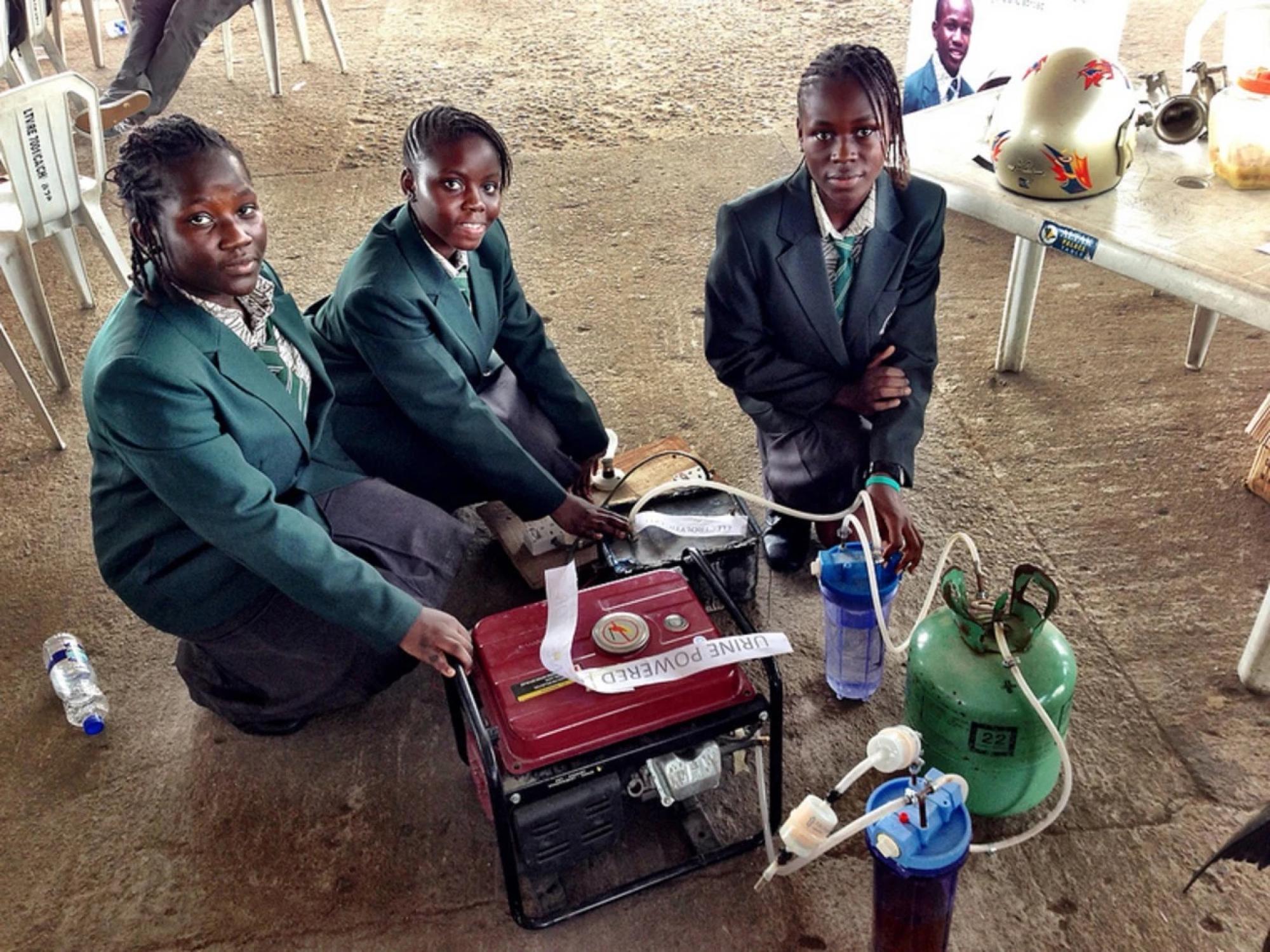
Four teenage African girls have come up with a urine-powered generator ... which they claim generates one hour of electricity from one liter (about a quart) of urine. The pee-powered product made its debut at Maker Faire Africa in Lagos, Nigeria. Urine is put into an electrolytic cell, which separates out the hydrogen. The gas cylinder pushes hydrogen into a cylinder of liquid borax, which is used to remove the moisture from the hydrogen gas. This purified hydrogen gas is pushed into the generator. The girls will probably be famous chemists one day, in any case, but they aren't the first to propose urine (or more solid human and animal waste) as a possible alternative fuel. Last year, in one example, researchers from Ohio University came up with their own technology for extracting hydrogen from urine. Doing so, they say, requires less power than plucking it from water, as hydrogen can be separated more easily from the ammonia and urea chemical compounds present in pee. The four African teens likely are the youngest researchers yet to dabble in pee as power. Skepticism aside, can we all just agree that the foursome should be lauded for their efforts to find alternative power sources on a continent that could really use them?
Latest
Latest News
Each news summary is created according to strict standards. Here's how we do it.
Each summary is created using a consistent editorial procedure. The target length is approximately 16 lines of 11-point Arial text in a 650-pixel-wide column. Up to 25% of a summary may be set in bold to emphasize the most important ideas. Summaries are composed of verbatim excerpts presented in the same sequence as they appear in the original news source, with very minor editorial additions. Where material has been omitted between excerpts, the omission is indicated with ellipses (...). Any words added by an editor for clarity or context appear in [brackets]. Our original news editor was Fred Burks. Tod Fletcher edited most summaries from 2007 through 2014, and Mark Bailey has served as news editor since 2014.