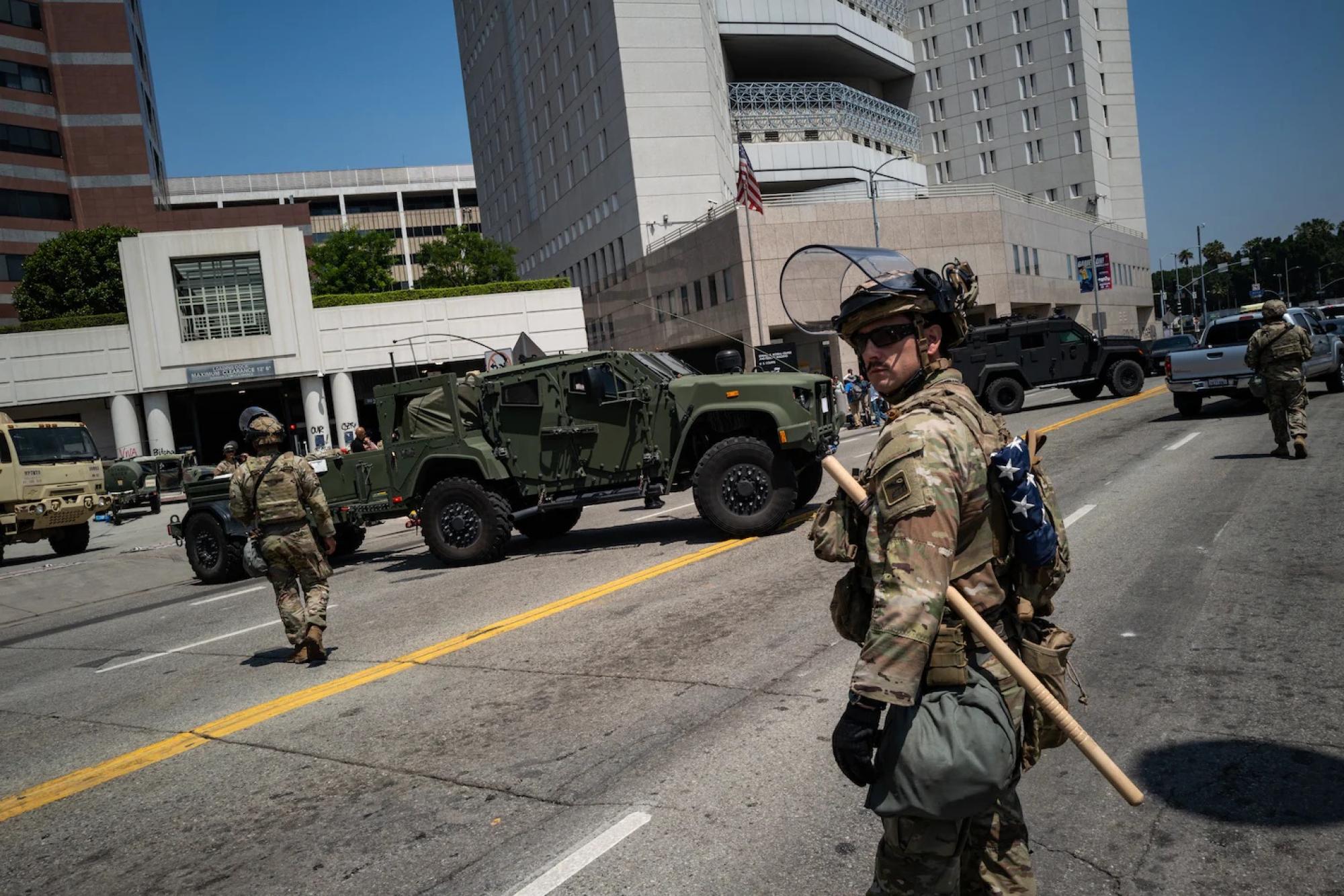
The Trump administration is evaluating plans that would establish a "Domestic Civil Disturbance Quick Reaction Force" composed of hundreds of National Guard troops tasked with rapidly deploying into American cities facing protests or other unrest, according to internal Pentagon documents reviewed by The Washington Post. The plan calls for 600 troops to be on standby at all times so they can deploy in as little as one hour, the documents say. They would be split into two groups of 300 and be stationed at military bases in Alabama and Arizona, with purview of regions east and west of the Mississippi River, respectively. Cost projections outlined in the documents indicate that such a mission, if the proposal is adopted, could stretch into the hundreds of millions of dollars. Trump has summoned the military for domestic purposes like few of his predecessors have. He did so most recently Monday, authorizing the mobilization of 800 D.C. National Guard troops to bolster enhanced law enforcement activity in Washington. The proposal represents a major departure in how the National Guard traditionally has been used, said Lindsay P. Cohn, an associate professor of national security affairs at the U.S. Naval War College. While it is not unusual for National Guard units to be deployed for domestic emergencies within their states, including for civil disturbances, this "is really strange because essentially nothing is happening," she said.
Latest
Latest News
Each news summary is created according to strict standards. Here's how we do it.
Each summary is created using a consistent editorial procedure. The target length is approximately 16 lines of 11-point Arial text in a 650-pixel-wide column. Up to 25% of a summary may be set in bold to emphasize the most important ideas. Summaries are composed of verbatim excerpts presented in the same sequence as they appear in the original news source, with very minor editorial additions. Where material has been omitted between excerpts, the omission is indicated with ellipses (...). Any words added by an editor for clarity or context appear in [brackets]. Our original news editor was Fred Burks. Tod Fletcher edited most summaries from 2007 through 2014, and Mark Bailey has served as news editor since 2014.