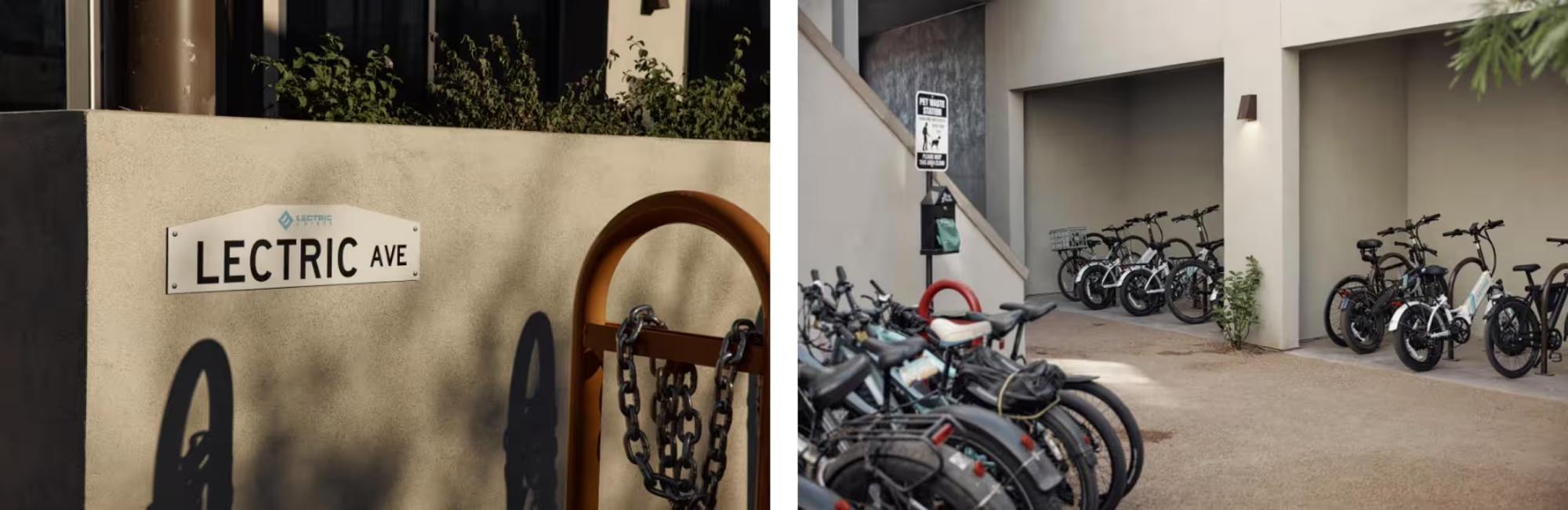
If you were to imagine the first car-free neighborhood built from scratch in the modern US, it would be difficult to conceive such a thing sprouting from the environs of Phoenix, Arizona. But it is here that such a neighborhood, called Culdesac, has taken root. On a 17-acre site ... an unusual experiment has emerged that invites Americans to live in a way that is rare outside of fleeting experiences of college, Disneyland or trips to Europe: a walkable, human-scale community devoid of cars. Culdesac ushered in its first 36 residents earlier this year and will eventually house around 1,000 people. Residents are provided no parking for cars and are encouraged to get rid of them. The apartments are also mixed in with amenities, such as a grocery store, restaurant, yoga studio and bicycle shop, that are usually separated from housing by strict city zoning laws. The $170m Culdesac project shows "we can build walkable neighborhoods successfully in the US," according to Ryan Johnson, the 40-year-old who co-founded the company. "We look back nostalgically at college, because it's the only time most people have lived in a walkable neighborhood. People are happier and healthier, and even wealthier when they're living in a walkable neighborhood." Vanessa Fox, a 32-year-old who moved into Culdesac with her husky dog in May, had always wanted to live in a walkable place only to find such options unaffordable. For her, Culdesac provided a sense of community without having to rely on a car.
Latest
Latest News
Each news summary is created according to strict standards. Here's how we do it.
Each summary is created using a consistent editorial procedure. The target length is approximately 16 lines of 11-point Arial text in a 650-pixel-wide column. Up to 25% of a summary may be set in bold to emphasize the most important ideas. Summaries are composed of verbatim excerpts presented in the same sequence as they appear in the original news source, with very minor editorial additions. Where material has been omitted between excerpts, the omission is indicated with ellipses (...). Any words added by an editor for clarity or context appear in [brackets]. Our original news editor was Fred Burks. Tod Fletcher edited most summaries from 2007 through 2014, and Mark Bailey has served as news editor since 2014.