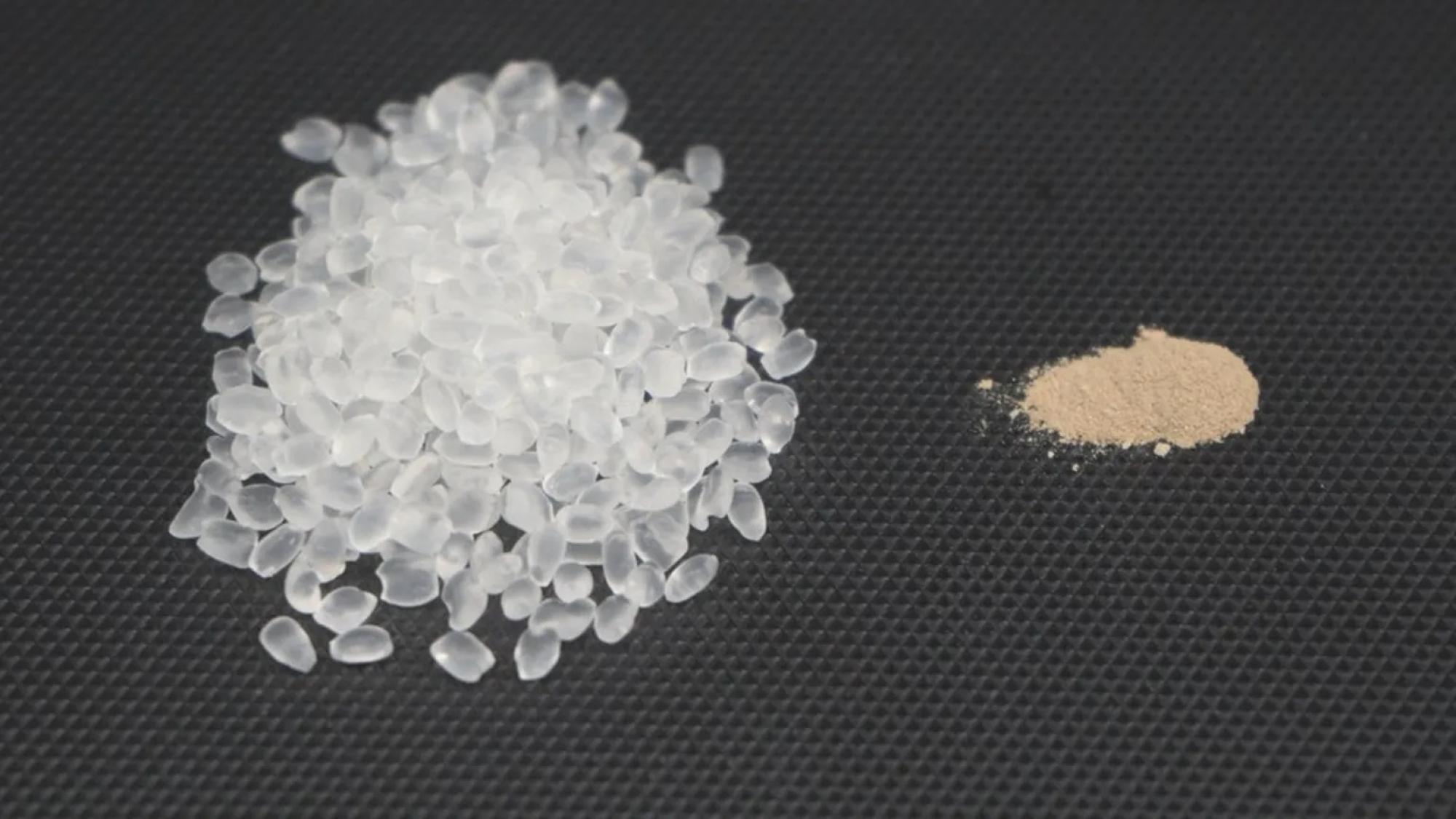
Scientists have developed a self-digesting plastic", which, they say, could help reduce pollution. Polyurethane is used in everything from phone cases to trainers, but is tricky to recycle and mainly ends up in landfill. However, researchers have come up with a sci-fi like solution. By incorporating spores of plastic-eating bacteria they've developed a plastic that can self-destruct. The spores remain dormant during the useful lifetime of the plastic, but spring back to life and start to digest the product when exposed to nutrients in compost. There's hope "we can mitigate plastic pollution in nature", said researcher Han Sol Kim, of the University of California San Diego, La Jolla. And there might be an added advantage in that the spores increase the toughness of the plastic. "Our process makes the materials more rugged, so it extends its useful lifetime," said co-researcher, Jon Pokorski. "And then, when it's done, we're able to eliminate it from the environment, regardless of how it's disposed." The plastic is currently being worked on at the laboratory bench but could be in the real world within a few years, with the help of a manufacturer, he added. The type of bacteria added to the plastic is Bacillus subtilis, widely used as a food additive and a probiotic. Crucially, the bacteria has to be genetically engineered to be able to withstand the very high temperatures needed to make plastic.
Latest
Latest News
Each news summary is created according to strict standards. Here's how we do it.
Each summary is created using a consistent editorial procedure. The target length is approximately 16 lines of 11-point Arial text in a 650-pixel-wide column. Up to 25% of a summary may be set in bold to emphasize the most important ideas. Summaries are composed of verbatim excerpts presented in the same sequence as they appear in the original news source, with very minor editorial additions. Where material has been omitted between excerpts, the omission is indicated with ellipses (...). Any words added by an editor for clarity or context appear in [brackets]. Our original news editor was Fred Burks. Tod Fletcher edited most summaries from 2007 through 2014, and Mark Bailey has served as news editor since 2014.