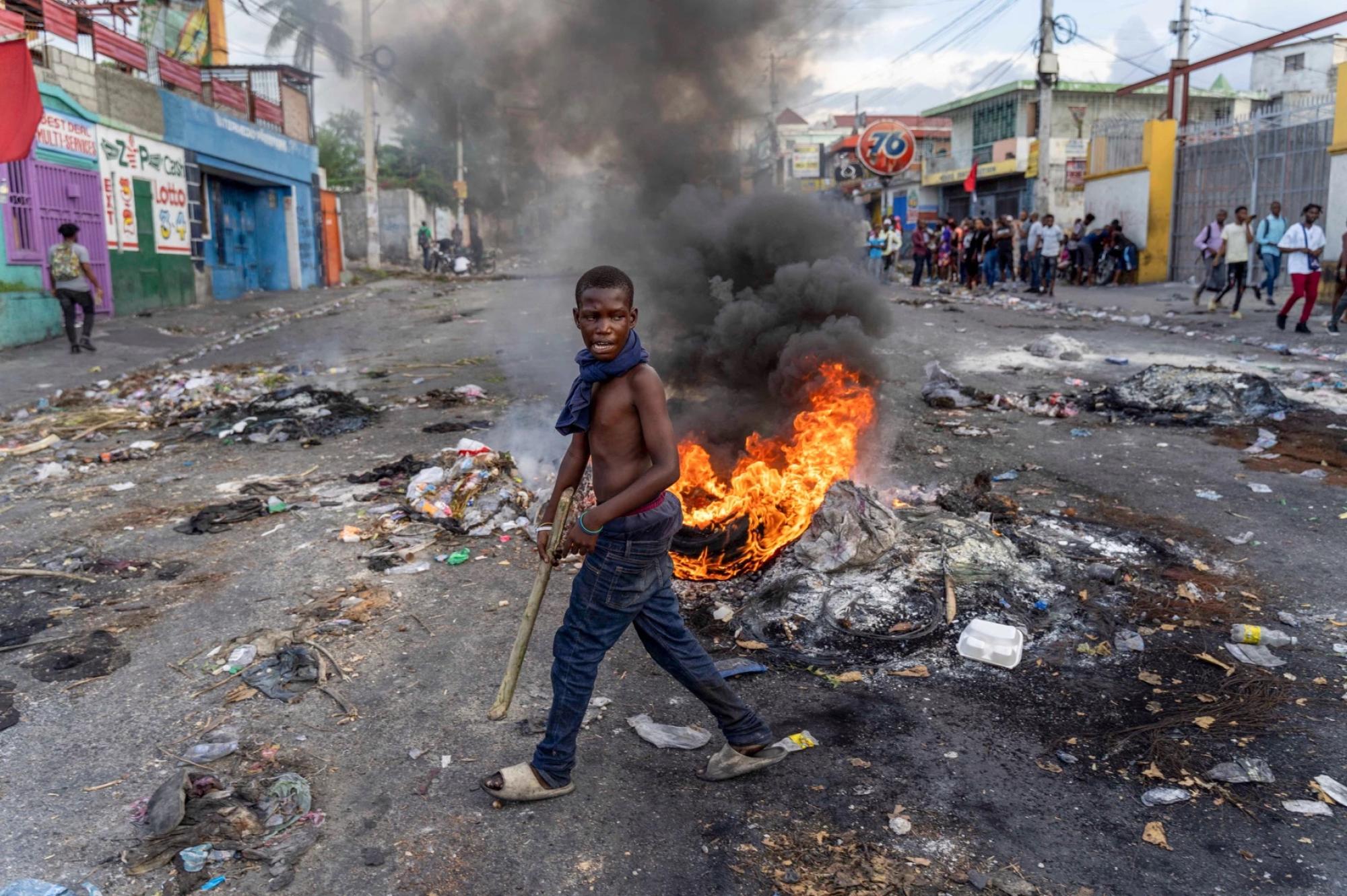
Haiti was born in 1804 out of a 13-year revolution in which the enslaved people of the then French colony of Saint-Domingue dismantled their chains, defeated, in succession, the armies of France, Britain and Spain, and established a new nation. Elites in Europe and America, meanwhile, fearful that the Haitian example might embolden others struggling for freedom, sought to isolate the new nation, refusing for decades even to recognise it. In 1825, France demanded, as the price of recognition, reparations of 150m francs. France was compelling enslaved people and their descendants to pay their former masters ... forcing [Haiti] to take out loans from French banks at exorbitant rates. By 1914, 80% of the government budget went to repaying the debt. Western nations have not only impoverished Haiti, they have also constantly intervened. Jean-Bertrand Aristide [was] a leftwing priest with mass support among Haiti's working class and poor. Twice, in 1990 and 2001, waves of public support propelled Aristide to the presidency. And twice, in 1991 and 2004, he was ousted in bloody coups. After the first coup, Aristide returned to power with US support. Nevertheless, many of the coup leaders were on the CIA payroll and the agency did not hide its hostility. A decade later, opposition to Aristide's economic and social policies led America to force him out of office. Today, the Haitian state barely exists.
Latest
Latest News
Each news summary is created according to strict standards. Here's how we do it.
Each summary is created using a consistent editorial procedure. The target length is approximately 16 lines of 11-point Arial text in a 650-pixel-wide column. Up to 25% of a summary may be set in bold to emphasize the most important ideas. Summaries are composed of verbatim excerpts presented in the same sequence as they appear in the original news source, with very minor editorial additions. Where material has been omitted between excerpts, the omission is indicated with ellipses (...). Any words added by an editor for clarity or context appear in [brackets]. Our original news editor was Fred Burks. Tod Fletcher edited most summaries from 2007 through 2014, and Mark Bailey has served as news editor since 2014.