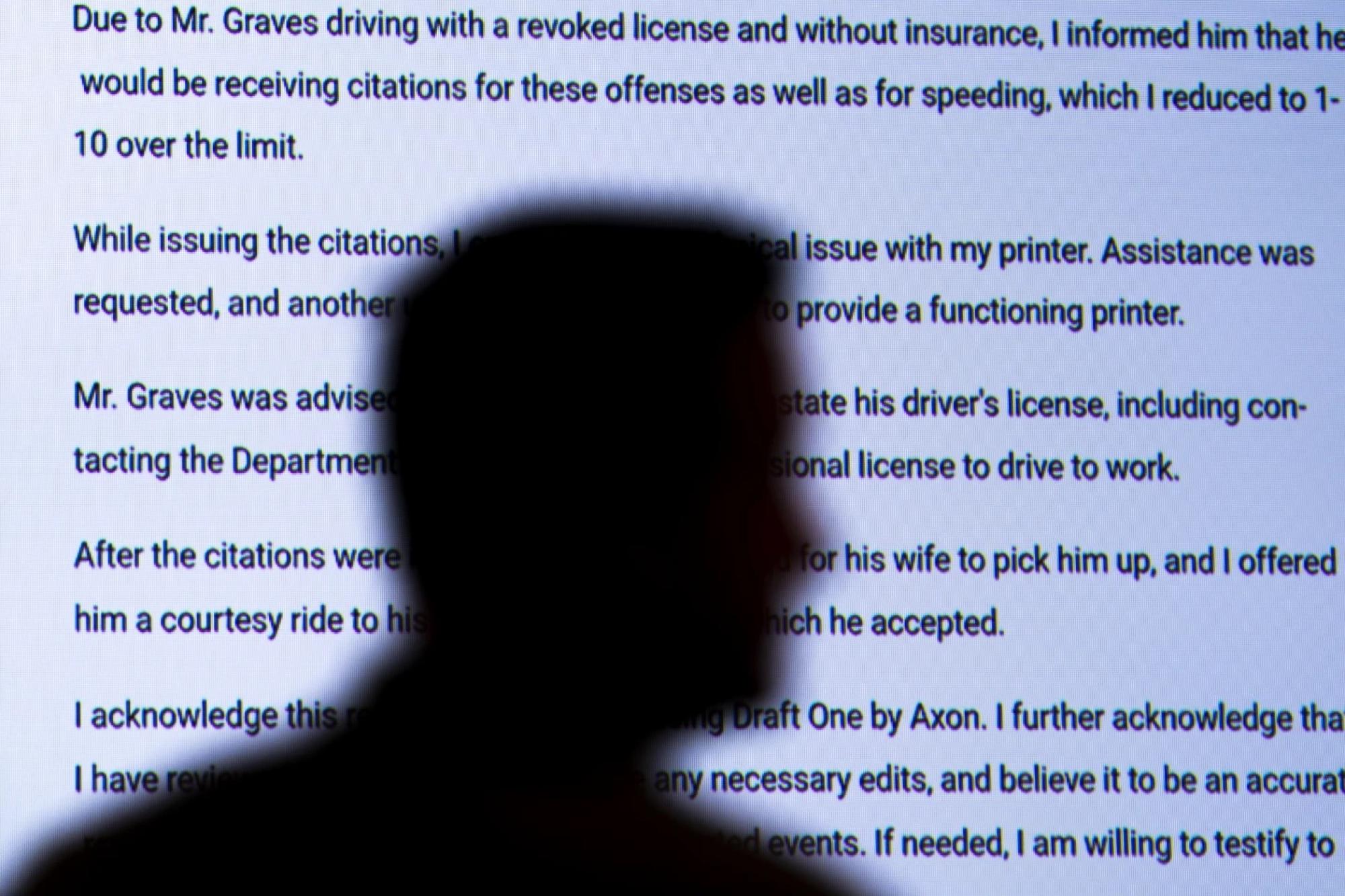
Technology companies are having some early success selling artificial intelligence tools to police departments. Axon, widely recognized for its Taser devices and body cameras, was among the first companies to introduce AI specifically for the most common police task: report writing. Its tool, Draft One, generates police narratives directly from Axon's bodycam audio. Currently, the AI is being piloted by 75 officers across several police departments. "The hours saved comes out to about 45 hours per police officer per month," said Sergeant Robert Younger of the Fort Collins Police Department, an early adopter of the tool. Cassandra Burke Robertson, director of the Center for Professional Ethics at Case Western Reserve University School of Law, has reservations about AI in police reporting, especially when it comes to accuracy. "Generative AI programs are essentially predictive text tools. They can generate plausible text quickly, but the most plausible explanation is often not the correct explanation, especially in criminal investigations," she said. In the courtroom, AI-generated police reports could introduce additional complications, especially when they rely solely on video footage rather than officer dictation. New Jersey-based lawyer Adam Rosenblum said "hallucinations" instances when AI generates inaccurate or false information " that could distort context are another issue. Courts might need new standards ... before allowing the reports into evidence.
Latest
Latest News
Each news summary is created according to strict standards. Here's how we do it.
Each summary is created using a consistent editorial procedure. The target length is approximately 16 lines of 11-point Arial text in a 650-pixel-wide column. Up to 25% of a summary may be set in bold to emphasize the most important ideas. Summaries are composed of verbatim excerpts presented in the same sequence as they appear in the original news source, with very minor editorial additions. Where material has been omitted between excerpts, the omission is indicated with ellipses (...). Any words added by an editor for clarity or context appear in [brackets]. Our original news editor was Fred Burks. Tod Fletcher edited most summaries from 2007 through 2014, and Mark Bailey has served as news editor since 2014.